Translate

Showing posts with label British Library. Show all posts

Saturday, 1 December 2018

December Labours: the close of the year

The main December labour for the peasant farmers in many Books of Hours seems to repeat November, with the killing of pigs.   But the wealthy who would commission and use these wonderful illuminated manuscripts ( and lived in the castles often shown in the background) would hunt the wild boar.  

December, a boar hunt. Hennessy Book of Hours, Simon Bening 1530-40
© Royal Library of Belgium, Brussels

This forest image is from the Hennessy Book of Hours: the lord's huntsman blows the 'mort' for the death of the boar, and other handlers hold back the dogs to preserve the carcass, while his master is shown with his long spear on a prancing horse:  "they blew the death of the boar, On blaring horns". *  
The artist, Simon Bening, suggesting different phases of the chase, contrasts the vivid colour and action of the hunt with the delicacy of the winter forest foliage and the castle turrets behind.


   December,  from the Tres Riches Heures de Duc de Berry   
attrib. Bartelemey d'Eyck c. 1440s ʩ Musee Cond̩, Chantilly France

This earlier miniature, with its equally expensive and vivid blues and scarlets, includes the zodiac signs, showing Capricorn, the sea-goat, as the calendar enters December.  The castle is Charles V's Chateau de Vincennes.

Boar hunts not only provided food for the rich man's feast, but culled the wild boar who would damage woodlands and next year's crops.  The famous Boar's Head Carol was first printed in 1521, celebrating the Queen's College Oxford student who, confronted by a wild boar in the woods, thrust his Aristotle text into the boar's mouth, saying 'Graecum Est' (very loosely translated as 'Meet the Greeks') as it choked.  But the Boar's head Feast is closely linked with the older pagan Yuletide, as the Norse Goddess, Freya, is shown riding on a wild boar.

Other calendar illustrations for December show a scurry of manual activities before the winter closes in, and in preparation for the Christmas and New Year feasts.


Farmers and labourers are usually shown bleeding the domestic pig's throat.  

According to region and climate, some are digging and ploughing for next year's crops,  chopping wood, still cutting pigs' throats for blood sausage (black pudding), baking bread, or already feasting. Below is an image from warmer climes - the pigs are still happily feeding while the farmer digs, ready for planting next year's crops.

December, digging.  Luca della Robbia ceramic ceiling plaque for Piero de Medici c. 1450-56
© Victoria & Albert Museum

A master baker at work,  Hours of Charles d'Angouleme c. 1475-1500
© National Library of France
Note the very clear image of Capricorn with its spiral tail.


These medieval bakers would be in a castle,  or a large town, with quantities to feed.  The dough trough has changed little in shape through the centuries.  (image wikimedia commons)

And finally the feasting, at court, or in prosperous comfort:

Those luxury embroidered table cloths come from Perugia in Italy (image wikimedia commons)


Here is December feasting for the wealthy, in fine domestic comfort, complete with cat.  
Rothschild Book of Hours c. 1500-1520   (see National Library of Australia)


Perhaps this December page from The Golf Book best sums up the end of the year activities and the annual cycle of Labours.  While the huntsmen chase the deer in the background, the farmer prepares his supplies of bread and pork, so there will be plenty of bacon sandwiches to enjoy in the last  month of the year.    


From the late 14th century English poem Sir Gawain and the Green Knight. see blog, 24 Dec. 2017 

Thursday, 15 November 2018

The Green Dwarf , a Tale of the Perfect Tense

If you like a dose of Victorian melodrama complete with an "unprincipled villain!", a stalwart Scottish hero and a tender heroine, plus battles, magic and some Gothic terror, I recommend The Green Dwarf.  


The Bard    John Martin, 1817  © Laing Art Gallery

This is a short novelette, written by Charlotte Bronte when she was seventeen, between her Roe Head schooldays and her first post as a teacher there.   Much of it is drawn from her and her siblings' juvenilia, all those tales and adventures inspired by the box of wooden toy soldiers her brother Branwell was given.  Isolated in Haworth parsonage,  Branwell and his sisters, Charlotte, Emily and Anne, created the imaginary worlds of Angria and Gondal.   Much of their juvenilia was inspired by their reading of Sir Walter Scott, Lord Byron, the Arabian Nights Entertainment and the visionary landscapes of artist John Martin*, popular through his engravings.

 The Fire Worshippers, battle scene     John Martin (1789-1854)

 For this tale, Charlotte has taken the city of Verdopolis in Africa,  the setting for the "African Olympic Games" and its war with the Ashantee tribe, as the background to the romance between the lovely Lady Emily, her countenance of "a most fascinating but indescribable charm" and her beloved, the painter Mr Leslie.    Her artist hero is in fact the noble Scot, Lord St. Clair, but his humble disguise does not deceive his rival, the handsome but treacherous Colonel Percy, a man with "a spirit of deep, restless villainy".

The plot is convoluted, with several fey characters who are not what they seem, but under cover of darkness Colonel Percy double-crosses the lovers and abducts Lady Emily, to make her his wife. "Behold me, fair lady, and know into whose power you have fallen!"

Drawing of a  fair young lady, by Charlotte Bronte
©  British Library

Emily is all too human a heroine: she repudiates Percy's evil power over her with this stirring riposte:

 "Then here I remain till death or some happier chance relieves me, for not all the tortures that man's ingenuity could devise should ever induce me to marry one whose vices have sunk him so low in the ranks of humanity as yours have, one who openly renounces the dominion of honour, and declares that he has given himself up to the blind guidance of his own departed inclinations."...
but then - somewhat breathless? - she succumbs to Percy's taunts of how her uncle ("her careful and affectionate guardian") will be suffering at her disappearance:
"She leant her head upon her hand and burst into a flood of bitter tears".

Readers of Jane Eyre will note that Lady Emily is left in her gloomy prison to the care of her attendant "the withered hag Bertha".

Much of the story's charm is seventeen year old Charlotte's evident relish in her fantasy drama, larded with adjectives, but with some wonderful descriptions:
here is the Ashantee battle array at daybreak: "It was a gorgeous but terrific spectacle as the first sunbeams flashed on that dusky host, and lit up to fiercer radiance their bright weapons and all the barbarous magnificence of gold and gems in which most of the warriors were attired",

and here the forest at night:  "Darkly and dimly, branch rose above branch, each uplifting a thicker canopy of night like foliage, till not a single ray of light could find an opening by which to direct the belated travellers passing underneath."


Twilight in the Woodlands   John Martin  1850
©  Fitwilliam Museum

Despite the melodrama of plot, characters and language,  like a theatrical MC she firmly takes control and addresses her readers at regular intervals.

Introducing  the African Olympics, which is a pivotal occasion in the narrative,  "It is not my intention to give a full and detailed account of all that took place on that memorable day, I shall merely glance at the transactions which followed and then proceed to topics more nearly connected with my tale."

Further interjections dot the narrative :  "Having given the reader this necessary information I will now proceed with my narrative in a more detailed and less historical style…."With his opportune arrival my reader is already acquainted, … and "I must beg my reader to imagine that a space of six weeks has elapsed before he again beholds my hero…"

These interjections are Charlotte reining in her runaway enthusiasm for the story she is presenting, much like a teacher who has strayed far from the topic, returning to her text.
" It may now be as well to connect the broken thread of my rambling narrative before I proceed further … and now,  having cleared scores, I may trot on unencumbered. "

She herself describes The Green Dwarf as a brief and 'jejune' narrative,  but it is full of spirit and style,  with a clear underlying sense of its unreality, which her readers (originally her siblings)  are invited to share and enjoy.


Charlotte Bronte, 1816-1855,
 probably a posthumous portrait by John H. Thompson (1808-1890), a close friend of Branwell
© Bronte Parsonage Museum 

Extracts from The Green Dwarf  by Charlotte Bronte, 1833,   Hesperus Press 2003

*John Martin appears in the story as the character Edward de Lisle, a successful artist.

Monday, 1 October 2018

October Labours: "And I sow my whete so rede (red)"


October is still the month when in the northern hemisphere we prepare for the winter ahead.  In medieval Europe the essential  second sewing of winter wheat or rye took place,  pigs were fattened on fallen acorns or mast before killing, and wood was stored for ovens and stoves.

In the scene below, ploughing and sewing seed for winter wheat takes front of stage: the skilled sewer will first have measured out the steps per furrow, so that the precious grain is broadcast evenly by handful per number of steps.  The harrow was used to loosen and then rake over the soil to protect the seed from eager birds.  In the background, a man is knocking down acorns or nuts to fatten the pigs rooting among the dead leaves and autumn fungi. Peasants would pay "pannage" for the right to forage their pigs in the landlord's woodland.


Golf Book of Hours, workshop of Simon Bening, Bruges, c. 1520-30
©  British Library Add. MS 24098

In the Golf Book of Hours, this is in fact the illustration for September, with October devoted to the vintage.   Other calendars also show the grape harvest in October,  with winter wheat sewing and pannage activities spread across the three autumn months, according to regional climate and custom.   

This decorated calendar page for October  emphasises the all-important autumn ploughing and sewing, to provide grain through the late winter months.  It also includes the zodiac sign of Scorpio against the same fertile landscape.

October Calendar page with Saints' Days 
©  Morgan Library, USA

And this cheerful, fifteenth-century stained glass Labour for October makes the harrow and the evenly scattered seed into a decorative pattern. Notice the extra large sack of seed,  all part of the pattern, along with the mettlesome horses and the fortified city.  


Painted and stained glass roundel, unknown maker, English c. 1450-75, probably based on woodblock engraving.  The skilled artist has used scratching, stippling and smearing of the brown pigment for shading and emphasis. 
© V&A Museum

Friday, 1 June 2018

June Labours: "scents, like a new-made haycock"

As the Labours of the Months are frequently linked with the zodiac signs, here for June, accompanying the mower scything is Cancer the Crab, .  Was this strange humanoid figure copied from a church carving, or a confusing description?  The face suggests that it was a stock image from a copy of a bestiary of the period, when many 'foreign' creatures (like the crocodile) were given these stylised faces.


Charite sur Loire Psalter c. 1175  BL. Hartley 2895 © British Library

Some cycles show the shearing of sheep, another important June activity providing a cash crop and warm clothing for the cold winter months.


June: Book of Hours of Agnes le Dieu, Bourges, 1500s
Utopia armarium codicum bibliophilorum, Stanford collection

The Cancer sign marks the summer solstice, when harvesting the hay crop would be at its height,  absolutely essential fodder for horses and cattle through the winter.  While the central figure is working, the man on the right is hammering the chine (blade) of his scythe, ready to fix to its long handle, the snaithe. The forked sticks the women are holding could be used for separating out weeds, or for raking up the mown hay.  Because the hay had to be cut and dried while the weather stayed fair,  traditionally for centuries women join with the men to get the harvest in.  The mowers are often shown barelegged or with stockings rolled for such hot work, but normally wearing shoes for protection. Is the fully dressed man with the large hat and puffed sleeves the owner of the meadow,  also hoping to make hay while the sun shines?  

French Book of Hours,  Nantes? fifteenth century,  Library of Geneva

Then here we can see the mowers, with legs bared and a variety of hats, working in rhythm while  women rake the dried grass into heaps, or mows, with the cart ready for loading later.  They are also well supplied with ale in wooden flasks.  In many areas haymaking traditionally began on St Barnabas Day, 11th June, but depending on region and weather, haymaking was also done in July.


                           Hours of Henry VIII, c. 1500  by Jean Poyer    Morgan Library

Centuries later haymaking was still a social occasion, although perhaps not quite so imperative a crop as in the past.  Mary Mitford writes (in 1832) about haymaking in Berkshire as "more of an innocent merriment, more of the festivity of an outdoor sport, and less of the drudgery and weariness of actual labour, than any of the other occupations of husbandry."  All the neighbours come to enjoy the party: 

 " Farmer Bridgwater set six men on to mowing by a little after sunrise, and collected fourteen efficient haymakers by breakfast time.  Fourteen active haymakers for our poor three acres! not to count the idle assistants; we ourselves, with three dogs and two boys to mind them, advisers who came to find fault and look on, babies who came to be nursed, children who came to rock the babies, and other children who came to keep the rockers company and play with the dogs; to say nothing of this small rabble, we had fourteen able-bodied men and women in one hay-field, besides the six mowers who had got the grass down by noon, and finding the strong beer good and plentiful, magnanimously volunteered to stay and help to get in the crop."

Our Village Mary Russell Mitford 

Tuesday, 1 May 2018

May Labours: "Grass and greenworld all together"*

Here is the month of May from one of my favourite Calendars of the Months, a roundel from the ceiling of Piero de Medici's private study, where he kept his treasures.

May labours:  glazed terracotta ceiling decoration by Luca della Robbia, 1456  Florence. 
©  V& A Museum

Piero commissioned the leading fashionable sculptor, Luca della Robbia, to decorate the ceiling with 12 coloured enamel plaques showing the agricultural labours for each month (the purple and green vestiges are the colours of Piero's livery).   The images are thought to be based on the classic Latin farmers' encyclopaedia (in 12 volumes) De Res Rustica, by Columella (AD 4 - c. AD 74)  which was listed in Piero's library inventory.  As well as showing the monthly task -  here the cutting of the spring grass in May - each calendar roundel indicates the month's average hours of daylight, in pale blue, and the phases of the moon, so important for planting.  
Above the head of the sun is the zodiac sign for Gemini, the classical twins,  the constellation of Castor and Pollux. The zodiac signs are commonly linked with the monthly labours, together representing the earthly and the heavenly cycle of the year.

The ceramic roundels are finely painted, but Piero's calendar is secular and eminently practical.  This was a time of transition when new printed books were embellished with hand painted illustrations.  Piero also commissioned illuminated manuscripts, and his library would have included devotional Books of Hours.   The other traditional image used for the May Calendar page, especially for noble patrons, were scenes of falconry and its associated pleasures of courtly dalliance.  This contemporary Arras tapestry illustrates both of these sports being enjoyed by the wealthy:

"Falconry":   Devonshire Hunting Tapestry, Arras c. 1430  
© V & A Museum


Central detail from "Falconry"
© V&A Museum

Detail from "Falconry" (top left corner) 
© V&A Museum

In Anglo-Saxon manuscript Psalters, calendar pages for May also celebrate the spring grass, with shepherds tending their flocks.  In the same vein is this May page from the Tiberius Miscellany of the eleventh century; a general knowledge collection, the manuscript included history and astronomy as well as monthly calendars.  So it seems that these early medieval texts, whether devotional or practical,  combined the seasonal labours with Christian imagery in their illuminations.

MS. Cotton Tiberius B. c. 1040   © British Library


* from "The May Magnificat"   G. M Hopkins

Thursday, 1 March 2018

March Labours: a foretaste of summer

Despite the daffodils, as the winter chill continues into March, many of us are dreaming of summer holidays and enjoying a glass of wine in the sunshine.  But that depends on those in wine growing regions working on the spring pruning which ensures a fruitful vintage.

Book of Hours, March Pruning   Master of Mary of Burgundy and others, Ghent or Bruges, 1500s 
© Houghton Library, Harvard University

It is often the southern countries of Europe which portray pruning vines as the Labour for the month of March, while colder northern regions focus on digging and delving, as in this sculpture from Carlisle Cathedral.    The twelve Labours of the Months are carved into the capitals of the pillars in the choir, images of devotion for the majority, who could not afford illuminated prayer books and their own stained glass. These vignettes of the agricultural year would illustrate many Bible references in the prayers and preaching for the whole congregation.

Medieval carved figure for March   © Carlisle Cathedral 

Whether digging or pruning, it was all hands to the work;  the smaller sickles suggest skilled pruning of valuable vines, or grafting trees, not just lopping dead branches, although the important Church symbolism of wine and vineyards would be a reason for vines to feature in these luxury devotional manuscripts. 


Page heading for month of March,  Queen Mary's Psalter,  English, c. 1310-20 

This manuscript was thought to be made for Edward II or his Queen, Isabella.  It was seized from the Earl of Rutland in 1533 when Mary Tudor, Mary I, succeeded to the throne and was presented to the Queen  by the Customs officer.  It was given to the British Library in 1757 by George II as part of the Old Royal Library.                
 © British Library Royal Collection

Sunday, 31 December 2017

January: the 'Golf' Book of Hours


The month of January from the "Golf" Book of Hours,  Simon Bening, Bruges c. 1540
© the British Library 

This beautiful Calendar page comes from a luxury Book of Hours, containing prayers and psalms for private worship, with each month showing the traditional European labours of the month.  January usually shows someone warming themselves by the hearth, or vigorously chopping wood, as many country dwellers will be doing even nowadays.  This illumination has several other popular images included, such as the windmill, the pigeonloft and farm animals, all in deep snow.  The 1500s saw Europe's "little Ice Age" taking hold -- in England the Thames froze in December and January (1536/37) so that King Henry VIII could travel on the ice by sleigh between London and Greenwich.

The Renaissance style borders in this Book of Hours show seasonal sports and pastimes, hence its name as the "Golf Book", and January shows boys happily sledging.  This is, of course, a particularly idealised view of ordinary villagers' life in January, with the blue-robed mother and child a reminder of the Nativity.  Prosperous, well-wrapped villagers and townsfolk are leaving a church which would not have looked out of place in the miniaturist's home town of Bruges, which can look particularly beautiful in winter when its canals are frozen and the trees are bare.


Sunday, 24 December 2017

Christmas at Camelot, a Yuletide story

Over six hundred years ago, in the reign of Richard II, an anonymous poet creates a tale of Arthurian adventure and romance, its hero the courteous Sir Gawain, one wintry Yuletide.

King Arthur and his court feasting   © British Library  

"Christmas time.  The king is home at Camelot
Among his many lords, all splendid men --
All trusted brothers of the Round Table
Ready for court revels and carefree pleasures.
Knights in great numbers at the tournament sports
Jousted with much joy, as gentle knights
Will do, then rode to the court for the carol dances.
The festival lasted fifteen days long
With all the meat and mirth the men could manage.
Such clamour and merriment were amazing to hear:
By day a joyful noise -- dancing at night --
A happiness that rang through rooms and halls
With lords and ladies disporting themselves as they pleased.
So in delight they lived and danced there together:
The knights of highest renown under Christ himself,
The loveliest ladies that ever on earth drew breath,
The most handsome king that ever ruled court,
The best and noblest of people -- all in their prime in that hall."

So this anonymous fourteenth century poet sets the scene at Camelot, and into all the merriment arrives the forbidding stranger, a giant horseman:

"There hove into the hall a hideous figure,
Square built and bulky, thickset from neck to thigh --
The heaviest horseman in the world, the tallest as well;
…the mightiest of men
And, astride his horse, a handsome knight as well.
…But the hue of his every feature
Stunned them: as could be seen,
Not only was this creature
Colossal -- he was bright Green --"  [as was his horse!]

"The arrival of the Green Knight" 
 This manuscript illustration (?from Froissart) shows his axe but not his evergreen holly bough

"Such a horseman had never crossed their tracks:
To them he looked as bright
As summer lightning that cracks
The sky -- and no man might withstand his dreadful axe."

The stranger proceeds to issue a daunting challenge to Arthur's knights:  an exchange of blows with his mighty axe,  and he will  take the first blow himself,  bare necked:

"...if any hold himself bold enough,
Has the stomach to strike one stroke for another,
I'll give him the gift of this beautiful battle-axe."

 Sir Gawain, King Arthur's nephew, takes up the challenge:
"I am to make this cut at you come what may,
And a twelvemonth from now I'll take another one
From you, with whatever weapon you choose, to pay it back."

Gawain duly strikes and the Green Knight's head rolls along the floor.  But this headless green apparition picks it up, remounts and holds his head aloft before the horrified company :

Original illustration to Sir Gawain and the Green Knight,  
Cotton Nero A. X manuscript © British Library

"And turns it to face the nobles at the table.  It lifts its eyelids, gives them a long stare,
Then slowly opens its mouth from which these words come forth,
Be prepared to come as you promised, Gawain,
Seek me faithfully until you find me, sir
As you have pledged in the presence of these noble knights."

This prelude to Gawain's quest is the traditional 'Champion's Bargain'.  This poem exists in a single manuscript of the late 1300s from the collection of Sir Robert Cotton;  and the story continues with Sir Gawain honourably setting out alone one year later, to search the icy wilderness of the Wirral for the home of his challenger. Braving robber knights,  fierce beasts and wild men ("wodewose") through the depths of winter, he prays to the Virgin Mary for help, and miraculously the castle of Sir Bercilak appears, where he finds rest from his travels. The hero's three 'Temptations' follow.

For three days Sir Gawain is to be entertained by Sir Bercilak's wife while her husband is out hunting, and agrees to exchange any 'trophies' with his host each evening.   Each hunt pictures the contemporary    customs in exciting detail as "the bugle sounds ricocheted round the woods".

The Boar and Bear Hunt  tapestry,  S. Netherlands, c. 1425-1430 © V& A Museum
"he rides through bush and briar, chasing the doughty boar"

While his host is out in the wild forest, hunting the deer, then the boar and lastly the fox, safe inside the castle each day Gawain is waylaid in his bedchamber by his hostess in courtly love contests.  The first two evenings he honourably returns the Lady's kisses  - first one and then two - to Sir Bercilak as agreed.   But on the third day, he succumbs to accept a special green girdle which she assures will protect him from the Green Knight's axe stroke.

The Lady 'beards' Sir Gawain in his chamber,  Cotton Nero A.X ms. © British Library

That last evening Gawain only gives to Sir Bercilak his wife's three kisses, but not the magic girdle, before he must face the Green Knight's deathly challenge on New Year's Day.

This unique English narrative poem mingles both Christian and pagan legend and symbols in the European folk tradition of Green Men, as found in carvings in medieval churches and chapels, notably the numerous versions in the Rosslyn Chapel in Scotland.

 
Gargoyle sprouting green leaves  (and see Rosslynchapel.com)  

This is another familiar version with a mane of greenery found in a carved roof boss at Pershore.

  Green Man carving, Pershore Abbey, Worcester

There are similarities to the wild men of the woods - the wodewose, hairy and leafy- which were popular characters of misrule in medieval court entertainments. 

Decorative Wild men and women tapestry,  Swiss c. 1430-70  © V & A Museum

These pagan figures from myth and folktale become conflated with the ancient Spirit of Winter, or Old Father Christmas, who introduces the Christmas mummers' plays, with staff and holly bough (like the Green Knight. 
By the later nineteenth century this Spirit of Winter becomes linked with St. Nicholas (or Santa Claus), still mingling pagan and Christian seasonal rituals.

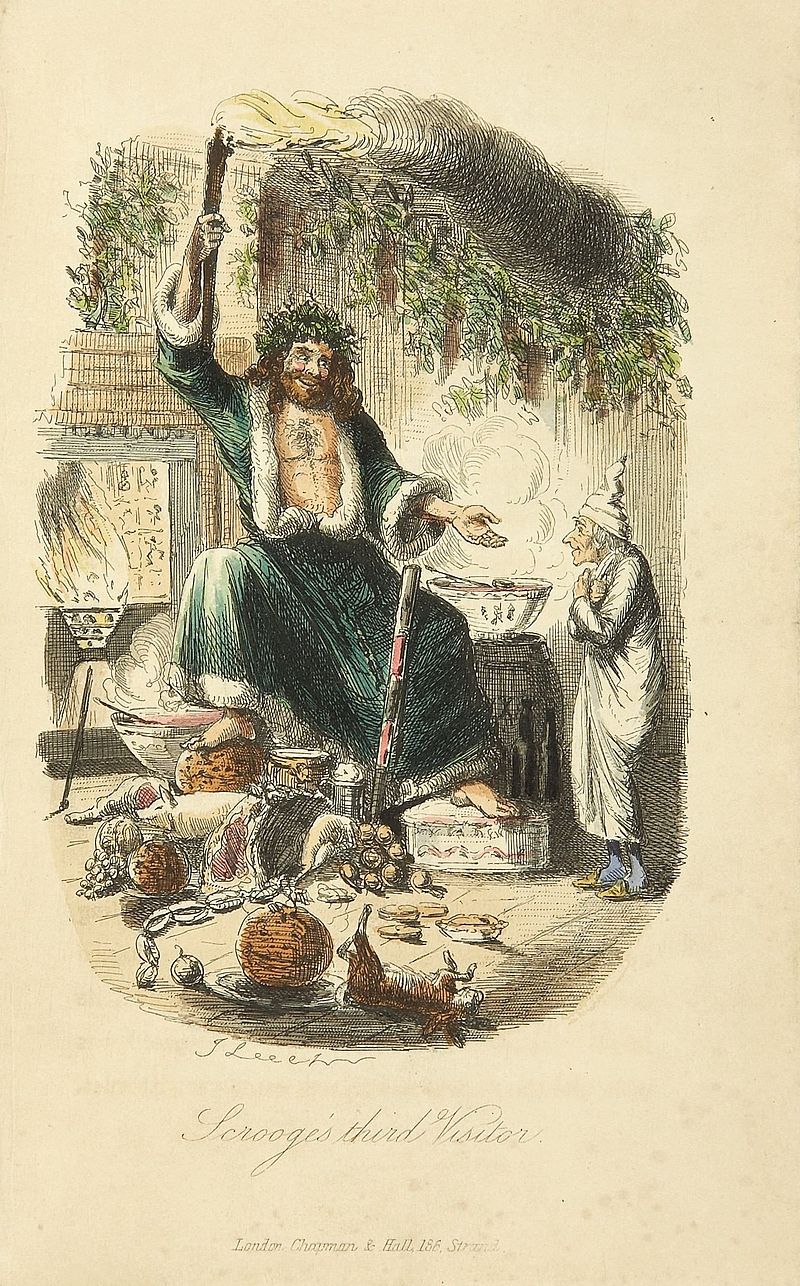
The 'Spirit of Christmas Present'   from Dickens' "A Christmas Carol" , 
illustration by John Leech 1834

The last part of Gawain's adventure is the 'Testing of the Champion',  a narrative of reward and retribution. Arrived at a desolate cave, a chapel more suited for the Devil, the Green Knight swings his huge axe at Gawain, who flinches, but the Green Knight stays his blade and calls Gawain coward.  Now Sir Gawain stands unflinching, "Though once my head is off, I cannot put it back".
A second time the Green Knight holds back his axe and Gawain angrily challenges him to make his full stroke.  But with this third blow, the Green Knight just nicks Gawain's neck, drawing blood.  This he explains, was because Gawain withheld the green girdle - for through enchantment the Green Knight is Sir Bercilak himself.
Returning to King Arthur's court,  Gawain wears the girdle with remorse as a reminder of his weakness; but because he steadfastly paid his debt to the Green Knight,  the Round Table adopts the green baldric as badge of honour:
"He who wore it would be honoured evermore
As it is recounted in the best books of old romance."

This centuries-old Christmas tale has been the subject of many interpretations (some link it with the founding of the Order of the Garter), much critical research and debate, and various translations. One thing is clear all through, it is the work of a master storyteller in creating mood and heightening drama.  For what does Sir Gawain hear as he reaches the sinister Green Chapel, and climax of his quest --

"Way off, beyond the brook, a weird sound.
It clattered against the cliffs as if to shatter them:
A sound like a scythe being ground against a stone.
There it goes again -- a whirring, like mill-water
In a race.  It clanged and ran out, rushing
Towards him. 'By God, this horrible instrument is meant
To honour me alone; it is for me he hones his blade!"

Like the best winter's tales, this unknown poet  keeps his listeners and readers on the edge of their seats!
"These marvellous things took place in the age of Arthur
As the books of Britain, Brutus' isle, all tell."


Christmas Greetings to my readers


[All the poem's quoted passages are from the verse translation by Keith Harrison, © The Folio Society 1983.]

Sunday, 12 March 2017

Giovanni di Paolo; "through the looking-glass"


St. John the Baptist goes into the wilderness,    Giovanni di Paolo, tempera on panel 1454 
 © National Gallery, London

This is one of my favourite paintings at the National Gallery.  I saw it on my first-ever visit, when I was taking a French pen-friend sightseeing; and I was beguiled by the diminutive figure of St. John the Baptist setting off into the desert and appearing undiminished, reading his book among those jagged threatening mountains.  There is a cinematic quality to its narrative, as St John leaves a towering fortified gateway enclosing a domestic style chimney and later we see far below the miniature fields and out-of-scale buildings of the world he has left behind.  And are those bordering roses pointing towards the new ethereal world awaiting on the horizon?

Although this small painting is well-known, I have hugged it to myself as a secret personal pleasure for decades, and only recently found out more about the artist.

Giovanni di Paolo (c.1403-1482) was a leading Sienese artist, working in the tradition of the masters of the previous century, particularly Duccio,  both as a manuscript illuminator and painter.  Records show an early commission for a Book of Hours for the wife of a wealthy Milanese family in Siena.     For the majority of citizens the equivalent of these luxury devotional books were the golden painted altarpieces in their churches, the central panel of Christ or  Madonna and Child surrounded by panels showing the Saints and their lives. Predella panels formed the base support.

This is another panel from his St John the Baptist series; they are thought originally to have been part of a Madonna & Child altarpiece now in the Metropolitan Museum, New York.


Birth of St John the Baptist   Giovanni di Paolo, predella panel 1454 
© National Gallery, London

Siena in the 14th and 15th centuries was a cosmopolitan trading city with influences from east and west for its artists, and particularly the Papal court in Avignon, as well as the new Florentine artists and sculptors.   Giovanni was a leading painter of the Sienese International Gothic school, which followed the Byzantine influences of the 1300s, to distinguish Siena from its rivals in Florence, but incorporated the new sense of Renaissance perspective and modelling of  human figures.  Here Di Paolo has manipulated the perspective of the bed to lead the eye back to the figures of the newborn saint and his father Zacharias writing his name, John.

He was also influenced by Gentile da Fabriano and Fra Angelico, and his paintings with their handling of colour and line create a dramatic sense of other worlds.


Saint Clare saves the sailors  c. 1455    © Gemaldergalerie, Berlin

 Composite altarpieces with many panels like these formed a visual focus of devotion during the ritual of prayers at Mass, when the priest had his back to the congregation.  When after the 1560s the priest stood behind the altar table, facing the congregation with the Eucharist in plain view, these powerful altarpieces were no longer as important and were gradually moved, broken up and destroyed or sold.   Now they are in collections across the world, on public view again but in parts and dispersed their original setting.

Fortunately Giovanni di Paolo's manuscript paintings for Dante's Paradiso are together and intact in book form just as they were conceived.  Here are a few of them:


Dante's "Paradiso",  Christ in his chariot,  Giovanni di Paolo  c. 1444-50   © British Library


   Beatrice guides Dante to meet Peter Damian in the sphere of Saturn, Canto 21.   © British Library


Nebuchadnezzar recounts his dream to Daniel,  Canto 4.  © British Library


Dante with Apollo before Parnassus,  Canto 1.    © British Library


"Minerva breathes, Apollo steers" - Beatrice leads Dante up towards the moon, Canto 2. 


Looking at Di Paolo's images of the Paradiso, it is no surprise that John Pope-Hennessy says of Di Paolo's work that, "he plunges, like Alice, through the looking-glass.."


Sunday, 19 February 2017

Pisces: piscatorial tales: "Come now, it's time to leave"

Pisces is the final sign of the zodiac in my blogs (and here it seems I have two ideas weaving about).

Pisces - the two fish - is the largest of the constellations and features in ancient mythology, the earliest known example of its symbol found on an Egyptian coffin lid  c. 2300 BC.   Many thousand years later, the fishes appear on the coinage of the Mogul Emperor, Jahangir:  he believed in divination to guide his actions so astrological symbols were an essential part of his environment.


Mogul gold coin from c. 1569 - 1627

In classical Greek myth, the two fish represent Aphrodite and Eros, escaping into the river Euphrates (like Pan or Capricorn) from the giant Typhon, and are usually shown joined with ribbons.  I rather liked this cheerful image from a 14th century manuscript:


Breviari d'amor, French early 1300s, M. Ermengau
© British Library

The Pisces myth seems to be closely linked with two great rivers of the ancient world, the Nile and the Euphrates, along with many ancient stories of magic fish.  In the biblical Apocrypha the Euphrates was where Tobias, guided by his angel, caught his giant fish; and the Euphrates runs through regions which were the source of many stories gathered together in the The Thousand and One Nights. Based on a lost book of Persian tales, the Hazar Asfanah,  Antoine Galland's French translation from a ninth century Arabic version was published early in the eighteenth century.

Edwardian children would have read these stories in Andrew Lang's famous fairy books,  particularly The Arabian Nights Entertainments published in 1898.  The books are also known for their dramatic and detailed illustrations by Henry Justice Ford.

Colour-plate illustration for "The Girl-Fish" by H.J. Ford, from The Orange Fairy Book 

Here is one of Ford's line drawings illustrating the tale of magic fish in "The Vizir who was Punished" from the Arabian tales.  "When the cook was about to turn them on the other side, the wall opened, the damsel appeared, addressed the same words to the fish ['Fish, fish, are you doing your duty?'], received the same answer, and then overturned the pan, and disappeared."

Even in this poorly scanned image you can sense the drama and see Ford's wonderful evocation of exotic eastern palaces, in the Princess's Egyptian-style dress and the Islamic tiled fireplace.


"The Girl Upsets the Frying Pan" in Lang's The Arabian Nights Entertainments, H. J. Ford  1898

Henry Justice Ford was born into a London solicitor's family on 5th February 1861 (not quite a Piscean) and after leaving Cambridge with a classics degree he studied art at the Slade and then at Hubert von Herkomer's Art School.  Between 1894 and 1916 his studio was in Edwardes Square, Kensington, a short walk from the Victoria and Albert Museum, where he could have seen this Turkish fireplace, acquired in 1891.

Tiled fireplace, possibly from the palace of Fuad Pasha, Istanbul, c. 1731
© Victoria and Albert Museum

The detail in Ford's drawing even indicates a frieze of arabic writing just above the chimney opening. 
In the V&A's fireplace, seven cartouche tiles list the names of the legendary seven Sleepers of Ephesus, another story from the Near East found in Christian and Islamic legend.   Similar stories of heroes sleeping under the earth to be awakened, cross many ages and cultures and, like tales of enchanted fish, inspire artists and writers.

"But come now, it's time to leave;
the Fish glitter on the horizon,
the Bear is right over Caurus
and over there we can climb down."

Dante, Inferno, Canto XI (trans. © Steve Ellis)