Translate

Showing posts with label Fitzwilliam Museum. Show all posts

Friday, 19 July 2019

Part 1. "Who announces the ages of the moon?" (Amergin, from the 12th century Irish Book of Leinster)

We will all be moon gazing on 20th July, 50 years since the first man stepped onto the moon, that "mythical " body watched in the night skies for  thousands of years.  Just 360 years ago, like Galileo and other contemporary astronomers,  Thomas Harriot, mathematician and navigator, with his splendid new telescope drew this map of the surface of the moon, although unlike Galileo, author of Sidereal Nuncio (or Starry Messenger)  in 1610, he never published his discoveries.  His friend and patron Sir Walter Raleigh  ended in the Tower, so maybe Harriot was being circumspect in uncertain political times.

Thomas Harriot's map measures just 6 ins across, and shows the 5-day-old moon's surface, 
as observed on 26th July 1609      © Petworth House Archives.

In 1679, the best map of the moon's surface for many years was compiled by Giovanni Domenico Cassini, the Director of the Paris Observatory, using a 34 ft telescope, and this was engraved for publication by Claude Mellan and widely copied.  


Cassini's Map of the moon, showing Cape Heraclides  and Sinus Iridium,   c. 1679
(wikimedia commons)

The light from the moon itself also contributed to the sciences from which the capacity for travel into space developed.  In eighteenth century Britain, the full moon lit the way for men of ideas to travel to meet together,  like the "Lunar Society" of Birmingham.  Its key members were Erasmus Darwin, Matthew Boulton, James Watt, Josiah Wedgwood and Joseph Priestley (discoverer of oxygen);  there must have been many such meetings elsewhere and on other continents, made practicable by moonlit nights. 

In seventeenth century Europe, the moon became not just a worldwide focus of ancient myth and legend in different cultures, or a universal practical guide to time and navigation, but now, as seen through the  astronomers' new telescopes, an intriguing subject of space travel stories, another aspect of this new spirit of scientific  exploration.  It becomes another New World, often a distant Utopia. 

One of Ben Jonson's court masques for James I in 1620 was News from the New World discovered in the Moon, (based on a classical Greek tale), but the bestseller of its day, The Man in the Moone, 1638, was written probably in the late 1620s by Francis Godwin, the Bishop of Hereford using a pseudonym.    

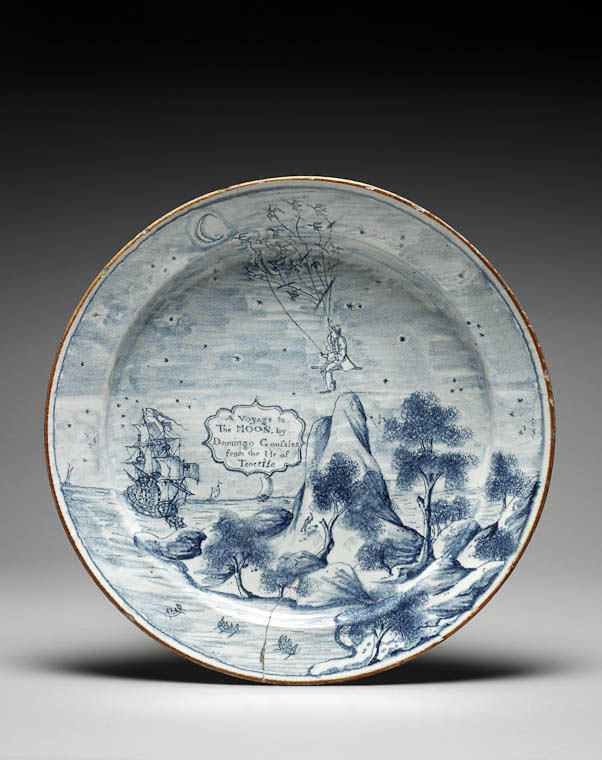
An early astronaut is transported to the moon by flying geese.  
 Bristol Delft plate c. 1740  Glaisher collection  © Fitzwilliam Museum 

It is also in the later seventeenth century that sees the discovery of the elephant in the moon --  but more of that and other tales in my next blog.


Thursday, 15 November 2018

The Green Dwarf , a Tale of the Perfect Tense

If you like a dose of Victorian melodrama complete with an "unprincipled villain!", a stalwart Scottish hero and a tender heroine, plus battles, magic and some Gothic terror, I recommend The Green Dwarf.  


The Bard    John Martin, 1817  © Laing Art Gallery

This is a short novelette, written by Charlotte Bronte when she was seventeen, between her Roe Head schooldays and her first post as a teacher there.   Much of it is drawn from her and her siblings' juvenilia, all those tales and adventures inspired by the box of wooden toy soldiers her brother Branwell was given.  Isolated in Haworth parsonage,  Branwell and his sisters, Charlotte, Emily and Anne, created the imaginary worlds of Angria and Gondal.   Much of their juvenilia was inspired by their reading of Sir Walter Scott, Lord Byron, the Arabian Nights Entertainment and the visionary landscapes of artist John Martin*, popular through his engravings.

 The Fire Worshippers, battle scene     John Martin (1789-1854)

 For this tale, Charlotte has taken the city of Verdopolis in Africa,  the setting for the "African Olympic Games" and its war with the Ashantee tribe, as the background to the romance between the lovely Lady Emily, her countenance of "a most fascinating but indescribable charm" and her beloved, the painter Mr Leslie.    Her artist hero is in fact the noble Scot, Lord St. Clair, but his humble disguise does not deceive his rival, the handsome but treacherous Colonel Percy, a man with "a spirit of deep, restless villainy".

The plot is convoluted, with several fey characters who are not what they seem, but under cover of darkness Colonel Percy double-crosses the lovers and abducts Lady Emily, to make her his wife. "Behold me, fair lady, and know into whose power you have fallen!"

Drawing of a  fair young lady, by Charlotte Bronte
©  British Library

Emily is all too human a heroine: she repudiates Percy's evil power over her with this stirring riposte:

 "Then here I remain till death or some happier chance relieves me, for not all the tortures that man's ingenuity could devise should ever induce me to marry one whose vices have sunk him so low in the ranks of humanity as yours have, one who openly renounces the dominion of honour, and declares that he has given himself up to the blind guidance of his own departed inclinations."...
but then - somewhat breathless? - she succumbs to Percy's taunts of how her uncle ("her careful and affectionate guardian") will be suffering at her disappearance:
"She leant her head upon her hand and burst into a flood of bitter tears".

Readers of Jane Eyre will note that Lady Emily is left in her gloomy prison to the care of her attendant "the withered hag Bertha".

Much of the story's charm is seventeen year old Charlotte's evident relish in her fantasy drama, larded with adjectives, but with some wonderful descriptions:
here is the Ashantee battle array at daybreak: "It was a gorgeous but terrific spectacle as the first sunbeams flashed on that dusky host, and lit up to fiercer radiance their bright weapons and all the barbarous magnificence of gold and gems in which most of the warriors were attired",

and here the forest at night:  "Darkly and dimly, branch rose above branch, each uplifting a thicker canopy of night like foliage, till not a single ray of light could find an opening by which to direct the belated travellers passing underneath."


Twilight in the Woodlands   John Martin  1850
©  Fitwilliam Museum

Despite the melodrama of plot, characters and language,  like a theatrical MC she firmly takes control and addresses her readers at regular intervals.

Introducing  the African Olympics, which is a pivotal occasion in the narrative,  "It is not my intention to give a full and detailed account of all that took place on that memorable day, I shall merely glance at the transactions which followed and then proceed to topics more nearly connected with my tale."

Further interjections dot the narrative :  "Having given the reader this necessary information I will now proceed with my narrative in a more detailed and less historical style…."With his opportune arrival my reader is already acquainted, … and "I must beg my reader to imagine that a space of six weeks has elapsed before he again beholds my hero…"

These interjections are Charlotte reining in her runaway enthusiasm for the story she is presenting, much like a teacher who has strayed far from the topic, returning to her text.
" It may now be as well to connect the broken thread of my rambling narrative before I proceed further … and now,  having cleared scores, I may trot on unencumbered. "

She herself describes The Green Dwarf as a brief and 'jejune' narrative,  but it is full of spirit and style,  with a clear underlying sense of its unreality, which her readers (originally her siblings)  are invited to share and enjoy.


Charlotte Bronte, 1816-1855,
 probably a posthumous portrait by John H. Thompson (1808-1890), a close friend of Branwell
© Bronte Parsonage Museum 

Extracts from The Green Dwarf  by Charlotte Bronte, 1833,   Hesperus Press 2003

*John Martin appears in the story as the character Edward de Lisle, a successful artist.

Wednesday, 31 January 2018

"Fly me to the Moon.."

Tin-glazed earthenware plate, Bristol  c. 1740   Glaisher bequest 1928. © Fitzwilliam Museum

This delftware plate celebrates a very early science fiction novel, The Man in the Moone, a discourse of a voyage thither.  Published in 1638 by a Spaniard, one "Domingo Gonsales", it tells the story of his travels, from his stay in St Helena,  where he trained the native wild swans as a means of aerial transport, to his escape off Tenerife when his ship home is attacked by the English.  Unable to land safely, the swans transport him higher and higher, reaching the moon after 12 days.  Here he finds a Christian Utopia among the Lunars. Becoming homesick, he travels back with his swans, landing in China.  From there his narrative is carried back to Europe by Jesuit missionaries.
The romance was very popular, meeting the 17th century interest in the lunar world, with the ideas of Copernicus and stories of distant voyages.    The real author was in fact Francis Godwin, Bishop of Hereford, and he probably wrote it in the late 1620s, inspired by classical and contemporary accounts of travel and astronomy.

The plate with its image taken from an illustration, was discovered in 1915 by Dr. James W. L. Glaisher, a Cambridge maths don, who was a prolific and organised collector, particularly of books and ceramics; his extensive collections now grace the Cambridge University Library and the Fitzwilliam Museum.

The image must have revived vivid memories for him, as his father (also James Glaisher) was a senior meteorologist at Greenwich Observatory, and took his schoolboy son with him on pioneering balloon ascents to collect weather data.

Sunday, 16 April 2017

Resurrection , imperfect


John Donne Arriving in Heaven   Stanley Spencer, 1911   Fitzwilliam Museum, Cambridge

Stanley Spencer was inspired to paint this by reading Donne's Sermons, a book given him by his friends and fellow students at the Slade, Jacques and Gwen (Darwin) Raverat.  "One had been brought up with the notion that heaven was, if not all enveloping, at least straight ahead.  In this picture [Stan] told me, he had the idea that heaven was to one side: walking along the road he turned his head and looked into Heaven,"  Gilbert Spencer.

Resurrection, imperfect

"Sleep sleep, old Sun, thou canst not have repast
As yet, the wound thou took'st on friday last;
Sleepe then, and rest; the world may beare thy stay,
A better Sun rose before thee to day,
Who, not content to'enlighten all that dwell
On the earths face, as thou, enlightned hell,
And made the darke fires languish in that vale,
As, at thy presence here, our fires grow pale.
Whose body having walk'd on earth, and now
Hasting to Heaven, would, that he might allow
Himselfe unto all stations, and fill all,
For these three daies become a minerall;
Hee was all gold when he lay downe, but rose
All tincture, and doth not alone dispose
Leaden and iron wills to good, but is
Of power to make even sinfull flesh like his.
Had one of those, whose credulous pietie
Thought, that a Soule one might discerne and see
Goe from a body, 'at this sepulchre been,
And, issuing from the sheet, this body seen,
He would have justly thought this body a soule,
If not of any man, yet of the whole."

Poems  John Donne, 1573-1631

Tuesday, 29 November 2016

A bird in the hand, at the Fitzwilliam Museum

Was it a wet, wintry day in 1828 when Isabella, Lady Hertford reached for her scissors and began cutting out some colourful pictures with which to liven up her blue wallpaper?  That wallpaper  had been imported from China, a gift from George the Prince of Wales many years before, and can still be seen in situ, duly embellished with exotic birds pasted amongst its flowering branches, at Temple Newsam House, near Leeds.


Embellished 18th century Chinese wallpaper in the Blue Drawing Room
© Temple Newsam House, Leeds

Far greater 'vandalism' was done to the newly published portfolio Lady Hertford cut all those exotic hand-coloured pictures from :  the first part of  John James Audubon's The Birds of America, with its 435 astonishing life-size images,  now regarded as one of the finest natural history publications held in any great library collection.

Plate from The Birds of America, from Original Drawings, made during a Residence of  Twenty-five Years in the United States  John James Audubon  (for images see www.audubon.org) 

Creating this labour of love over twenty-five years, Audubon was supported during his travels by his wife Lucy working as a governess.  "Every moment I had to spare I drew birds for my ornithology in which my Lucy and myself alone have faith.  My best friends solemnly regarded me as a madman, and my wife and family alone gave me encouragement,  My wife determined that my genius should prevail, and that my final success as an ornithologist should be triumphant."


Roseate Spoonbill


"Light as a sylph, the Arctic Tern dances through the air above and around you."  J. J. Audubon


Visitors to Cambridge this December can find out more about John Audubon, his years of perseverance  (at one stage his paintings were all eaten by rats)  and his remarkable creation,  at the Fitzwilliam Museum.    On selected dates the Founder's Library, named after Richard, the 7th Viscount Fitzwilliam, will be open to the general public in small groups at lunchtimes.


The mantel clock in the Founder's Library at the Fitzwilliam Museum

 The Library curators will introduce you to Audubon's giant masterpiece and reveal the fascinating stories about this rare hand-coloured volume and other historic printed books from the collection across the centuries.  Prepare to be amazed!*


Carolina Parrot or Parakeet

Great Blue Heron

* Or see the marvellous illuminated manuscripts in the Fitzwilliam exhibition "Colour" (www.fitzmuseum.cam.ac.uk).

Saturday, 12 November 2016

"She's a dish" ?

Shakespeare's Measure for Measure is a play full of moral ambiguity and vice, in which two virtuous women are threatened by hypocrisy and male power.  Isabella, a novice nun, must trade her virginity to save her brother's life,  while Mariana has been jilted for lack of her dowry, both at the mercy of Angelo, the outwardly upright Ducal deputy.
Elsewhere, Pompey the bawd, trying to make Mistress Overdone's brothel appear respectable to the officers,  describes how

 "..she came in…longing for stewed prunes.  Sir we had but two in the house, which at that very distant time stood, as it were, in a fruit-dish, a dish of some threepence; your honours have seen such dishes; they are not China dishes, but very good dishes."  Measure for Measure Act 2, sc, 1.


Small 'Kraak' porcelain dish,  imitated in blue and white Dutch delft   
© V&A Museum

The first recorded performance of  Measure for Measure was for the Christmas Revels of 1604.  Ever up to date, Shakespeare's "China dishes" would surely be recognised by his elite audience as a reference to the spectacular sale of Chinese porcelain in Holland from captured Portuguese carracks in 1602 and 1603. One cargo alone contained 50 tons or 100,000 pieces of Chinese export porcelain. Before this, Chinese porcelains were exotic rarities, owned only by royalty and the very wealthiest of courtiers and Levant merchants.

Pompey's "very good (threepenny) dishes" might have been pewter, but more likely Dutch 'delft' - imitations of the imported 'Kraak' i.e. carrack porcelains, made of tin-glazed earthenware - liquid resistant, shiny and colourful but prone to chip and crack.  Some immigrant Dutch potters were making basic tin-glazed earthenwares in London from 1570s (especially smooth tiles and jars for apothecaries). The Museum of London has a large collection, many found in pieces in old cesspits.  


                     3 rare survivals:  Tin-glazed drug pots, English or Dutch, c.1600-1650.  
                                                 © British Museum, London 

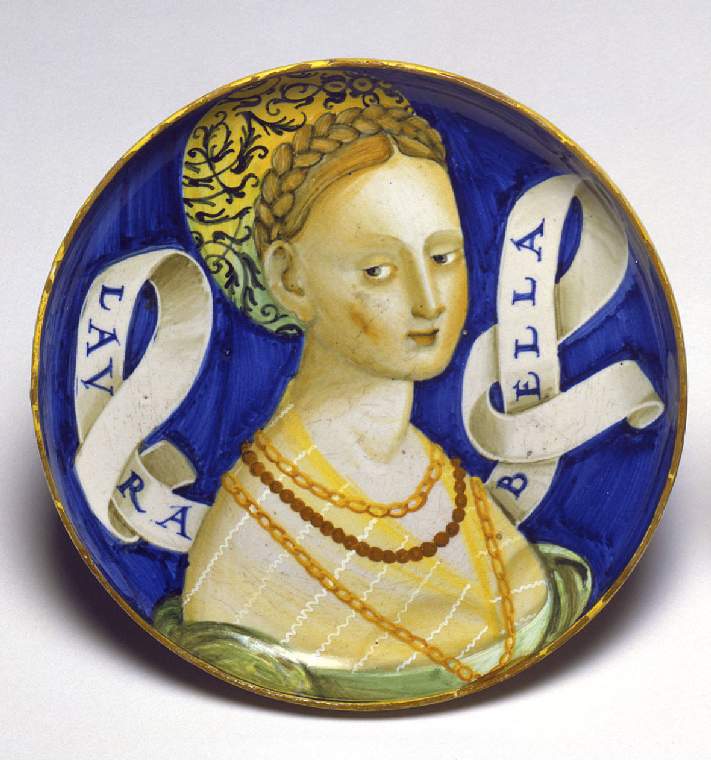
It was Italian potters who introduced the technique into Holland, for tin-glazing in Italy had reached a high art form in the early 1500s, with master potters decorating wares with scenes from history and classical myth in vivid colours (known as 'maiolica').  Popular display pieces were the coppe amatorie, stock  images of idealised beautiful women, inscribed with a name and flattering titles such as bella, diva, gracioza, galante.  

'Laura bella', shallow maiolica bowl on foot, Urbino or Casteldurante, Italy, c. 1525-35
© Fitzwilliam Museum


'Silvia diva mia bella' , Urbino or Casteldurante, Italy, c. 1540
© V&A Museum

A modern feminist take on these idealised  "fair women" has been created by the Boston-born book artist, Angela Lorenz in 1993,  in her set of 6 collagraphed paper plates, framed and stored in a slatted crate.  She now lives and works mainly in Bologna, and this piece was inspired by these 'Belle Donne' images.


She's a Dish: paper plates  © Angela Lorenz, National Art Library, V&A

The six paper plates are variously labelled:  
 "She is round. She is idealised. She hangs on the wall.
  She is not to be used. She is not disposable. She's a dish."

Angela Lorenz, from artist's book, 1993 


Angela Lorenz, from artist's book, 1993

Each 'She' is in fact a dish of collaged spaghetti, sealed with glue and inked in typical maiolica colours, making a relief print in the style of those Renaissance fair women, now captured in their 16th century ceramics in museums across the globe.

See Angela Lorenz's website: angelalorenzartistsbooks.com

Saturday, 1 October 2016

October: autumn's changes


October: Twelve Months of Flowers  Jacob van Huysum, early 18th century
©  Fitzwilliam Museum

"I mow the lawn for what I hope will be the last time this autumn; though in some years another cut is required in November, or even December.  Instead of  the grass-moths of spring and summer, long-legged craneflies leap from beneath the mower's blades, bouncing away in search of an uncut patch of sward where they can hide from predators.

Despite the warmth, signs of autumn are more and more visible; not least in the absence of those pink and purple flowers that lined the rhynes and hedgerows during the past few months.  Purple loosestrife, which only a few weeks ago was still flowering in any damp corner, has gone to seed, while only a few sad, drooping fronds of willow-herb remain.  Clouds of midges still hang in the air in more sheltered areas; but within a week or so I shall hear the high-pitched call of returning redwings in the night sky; and soon afterwards feel the crunch of early-morning frosts beneath my boots."

Wild Hares and Hummingbirds  Stephen Moss


Saturday, 24 September 2016

Libra: the Scales of Justice


"He shall have merely justice, and his bond."


  Charles Macklin in The Merchant of Venice,  Johann Zoffany c. 1768
©  Tate Gallery, London

"Merchant:  Most learned judge! A sentence! come, prepare!
Portia: Tarry a little: there is something else.
This bond doth give thee here no jot of blood;
The words expressly are 'a pound of flesh:'
Then take thy bond, take thou thy pound of flesh;
But, in the cutting it, if thou dost shed
One drop of Christian blood, thy lands and goods
Are, by the laws of Venice, confiscate
Unto the state of Venice."
 The Merchant of Venice, Act IV Sc. 1.  William Shakespeare

Many visitors in the audience at London's Globe Theatre are not that familiar with Shakespeare's plays.  I remember that there was an audible gasp at this point in the court scene as Portia plays her master stroke against Shylock - just as there must have been when the play was first performed around 1599.

Nearly 150 years later, at Drury Lane Theatre in 1741, Charles Macklin created another sensation by playing Shylock as a serious character, not the comic clown figure the eighteenth century had turned him into.
Eighteenth century engraving © National Portrait Gallery

To get in character he researched the London Jews, their dress and accents, to create a believable stage persona, and not the old 'bogeyman' as was then customary.

The dramatic figure of Shylock on this Staffordshire teapot is based on engravings of Macklin in the role (not David Garrick as was once thought).  You can see the scales hanging from his arm, while his fingers are testing the tip of the sharpened knife, just as in this other engraving of the actor below.


Jasper teapot, Neale & Co, Hanley c. 1785
© Fitzwilliam Museum


Engraving after J.H. Ramberg c. 1785  

Macklin, known as "wicked Charlie Macklin", was a tempestuous character; he accidentally killed a fellow actor in a backstage quarrel, and was tried and acquitted of murder. Zoffany's painting above is thought to portray one of the judges on the left.  Macklin had a long successful career, his portrayal of Shylock making his name, and he spoke a few lines at his last stage appearance in 1789.
He was a Libran, born on 26th September, 1697 and died in 1797,  probably not quite the 102 years recorded on his memorial plaque in St Paul's Church, Covent Garden.

Sunday, 14 August 2016

Poetry, Pots, and a Parson

North Devon is known for its large honey-coloured Harvest Jugs, particularly the boldly decorated, signed and dated ones from the eighteenth and nineteenth centuries.  The patterns and the inscriptions were widely copied and imitated, and inspire potters today.


Lead glazed slipware harvest jug, decorated with sgraffito, 1703 
© Fitzwilliam Museum

"now i am com for to Supply your workmen
when in harvist dry they do labor hard and sweat
good drink is better far than meat; in wintertime when it is coold
i Likewise then good drink can hold: booth seasons doe the same require,
and most men doe good drink desire"

These West Country harvest jugs are often decorated with tulips and other flowers, birds, unicorns, and, reflecting their coastal origins, ships, compasses, suns and mermaids.  There were thriving potteries in Barnstaple and Bideford, where the Burton Museum & Gallery has a magnificent collection of plain and fancy pots,  bequeathed by R.J.Lloyd.

Here are some more examples:

John Phillips, Bideford, 1780  © Trustees of the British Museum

"When I was in my native Place I was a lump of Clay
and Diged was out of the Earth and Brought from thence a Way,
but now I am a Jugg became by Potter's Art and Skiel
and now your Servant am Become and carry alle I will."

This one is much cruder, although the handle join is scrolled,  and its verse is more like a motto:

Slipware jug,  © Burton Museum, Bideford

"As A ring is round & hath no End
So is my Love Unto my Friend"

Others celebrate Ceres, Goddess of the harvest*, or the Barley Mow:


"harvest is come, all busy now
in making of the Barley mow
if you the Barley now neglect
you cannot then Good Ale Expect"
(signed T. Jones 1792)


Twentieth century and contemporary potters still create Harvest jugs in the traditional  North Devon style, often choosing inscriptions referring to their craft;  this verse was Michael Cardew's choice, in 1925:

"Despise me not because I'm made of clay -
But make me welcome when I come this way-
My belly fill with good strong punch (or beer) -
& I will make you merry all the year."


The inscriptions frequently are placed underneath the handle, which enlivens the simple flower pattern in this one below:


Devon Harvest Jug from Buckland Abbey, signed Abel Symons 1813
© National Trust/Lynda Aiano

Its inscription is the most interesting part of this grand jug, as it commemorates an old West Country ritual, "Crying the Neck".

"The Potter fashioned me complete, as plainly doth appear
for to supply the harvest men with good strong English beer.
Drink round my jolly reapers and when the corn is cut
we'll have the other jug - and cry A Neck A Neck."

As the last sheaf is cut (by hand) the reaper holds it aloft and cries " I 'ave un, I 'ave un". His fellows shout "What 'ave ee? What 'ave ee?" to which he replies "a Neck, a Neck" and  "Hurrah for the Neck! Hurrah!"  This age-old pagan custom was revived by the Old Cornwall Society (and see strawcraftsmen.co.uk),  but the churches' Harvest Festival tradition was begun in 1843, by the eccentric Parson Robert Hawker of Morwenstow, North Cornwall.

A poet, antiquarian (and opium smoker?), he built himself a tiny bothy (National Trust's smallest property), reached by a track along the cliff edge, where he could write and watch for ships in danger from the precipitous rocks at Hartland Point.

Hawker's driftwood hut © H. Bolton

 He rescued many seamen, and others are buried in the graveyard of his church of St John & St. Morwenna beside the vicarage at Morwenstow. It is worth exploring for its evocative headstones for the drowned sailors.  The Museum of Wrecks at Hartland Quay records the dangers of this coast, including an ill-fated aeroplane.


Hartland coastline  © H. Spurway

Parson Robert Hawker is best known for the Trelawney anthem,  --
"And shall Trelawney live? Or shall Trelawney die?  
Here's twenty thousand Cornishmen shall know the reason why!" --
which he published anonymously in 1825 as The Song of the Western Men, basing it on old Cornish ballads for a new literary audience. 

This is why the harvest jugs with inscriptions have so much more appeal for me, with their makers' initials and dates;  the earlier ones in particular are recording West Country oral history for us with all their craftsmen's skill.  This fine North Devon jug below is boldly decorated and glazed, but lacks the extra pleasure of these country rhymes saved by the potters.

 Harvest Jug, Barnstaple or Bideford, 1764 © V&A Museum

* see wikimedia for copyrights.

Thursday, 28 July 2016

Leonine stories


Persian Astrological illustration for Leo,  gouache, c. 1800s. 
(from the Wellcome Library Images ) 


 This is the time when the constellation of Leo is in the ascendent.  There are many examples of the kingly Lion as a symbol from myth and legend, from the lion-killing hero in the Epic of Gilgamesh, or the Old Testament's  Samson and David, or the Greek Hercules, all often shown wearing a lion skin.  Gentler heroes are St. Jerome, who befriended a lion by removing a thorn from its paw, a story taken from the classics and reimagined by G. B. Shaw in Androcles and the Lion,  and of course, the fourth Gospel-maker, St. Mark and his winged lion, historically associated with Venice. 

But for my Lion illustration I have gone back to the Babylonian myth of the tragic lovers, a tale popular in the  later Renaissance: 
"In such a night  
Did Thisbe fearfully overtrip the dew, 
And saw the lion's shadow ere himself, 
And ran dismayed away."  (Merchant of Venice  Act V)


Pyramus and Thisbe, maiolica plate from Urbino, c. 1550s  © Fitzwilliam Museum

As Ovid recounts, the eloping lovers are due to meet at Ninus' fountain outside Nineveh, but Thisbe, arriving first, is frightened by a bloody-mouthed lion and flees, dropping her cloak. Pyramus arrives, sees the lion mauling Thisbe's bloodstained cloak, and, most true lover, falls on his sword.   Here we see Thisbe returning and desperately following  Pyramus' example, watched by Cupid.

Not the finest rendering in maiolica - a very cluttered image with all the city backdrop encroaching.  The painter (or his customers) obviously liked scenes of impalement, but the lion has not got Thisbe's bloodstained cloak in its mouth, in fact Thisbe still seems to have a cloak around her; nevertheless the painter has captured the popular tragedy with dramatic 3D effect.  According to Ovid, a mulberry tree grew beside the fountain and, drenched in the lovers' blood, its white berries were ever after deep purple.

There are other finer maiolica examples in e.g. the Wallace Collection, and this popular story appears in paintings, mosaics, on Venetian glassware and French tapestry, although you sometimes have to look hard to spot the deadly lion.

I could not resist this Footnote:  a fresco by Benozzo Gozzoli, c. 1425, from Montefalco, Italy.


Tuesday, 19 July 2016

94 degrees in the Shade

I have been immersed in preparing a lecture and suddenly summer has arrived, so this painting captures today perfectly.


94 degrees in the Shade  Sir Lawrence Alma-Tadema  
© Fitzwilliam Museum

It was painted in 1876 at Godstone in Surrey and shows Alma-Tadema's friend's son, Herbert Thompson, just before he went up to Trinity College, Cambridge.   Herbert went on to become a barrister, lecturer and an eminent Egyptologist.  The Fitzwilliam also has twin portraits of Herbert and his father, Sir Henry Thompson, an very eminent surgeon,  painted by their friend Alma-Tadema.  In 1877 he had joined father and son for a painting holiday on board their boat Gypsy, on the Thames, and painted Herbert's portrait  - wearing a very fetching smoking hat (below) - on one of the houseboat doors;  the  following year  he painted the father.   Both the Thompsons were art collectors,  especially of Whistler and Fantin-Latour, but here Herbert is pursuing lepidoptery (above).


Young Herbert Thompson  by L. Alma-Tadema © Fitzwilliam Museum

Wednesday, 1 June 2016

June blossoms


Twelve Months of Flowers:  June    Jacob van Huysum
© Fitzwilliam Museum, Cambridge

"A spell of warm sunny weather early this month means that along the lanes, every hedgerow, bush and tree looks as if it is about to burst; and as I stare intently at one hawthorn I can almost see the foliage growing outwards by the minute.  Surely, if this fine weather continues, the trunks, branches and twigs will be unable to contain the green force within, and will simply explode.

On a warm muggy evening, the volcano-like silhouette of Brent Knoll is bathed in yellow sunshine as it pokes through horizontal fingers of cloud.  Opposite, towards Glastonbury Tor, a thick layer of grey fills half the sky, its folds and pleats as untidy as a teenager's duvet.  A broad, squat section of rainbow is just visible in the gap between the cloud base and the distant Mendip Hills, its layered bands of colour illuminating the sky.

…At this time of year, the walls around the parish are suddenly ablaze with a striking flower, red valerian, whose colour and texture remind me of something out of a Laura Ashley catalogue.  For a few weeks, from mid-June to mid-July, this attractive and conspicuous plant is thriving.  It may be called red, but in truth it is a deep pink:…occasionally, a striking snow-white variant appears among its neighbouring blooms.


Like so many of our wall-loving plants, red valerian is an immigrant, originally brought to Britain from the Mediterranean during Tudor times, to adorn rockeries in ornamental gardens.  After a couple of hundred years it managed to escape from confinement, and has since spread across much of England and Wales, though its stronghold remains here in the West Country
.….the stone itself is not a natural feature of the local landscape, but was brought here from the nearby Mendips."

Wild Hares and Hummingbirds  Stephen Moss

(Something to look forward to? if you are having torrential rain in your part of the world.) 

Tuesday, 22 December 2015

A Cabinet of Collectors 3: James Whitbread Lee Glaisher


It was Queen Mary II who introduced the passion for blue and white china into Britain, when she and her husband William III came over from Holland in 1689 to take the English throne.  The appeal of blue and white probably culminated in the mass production of the transfer printed Willow pattern in the nineteenth century, which continues to this day*.  The collector who owned this elaborate Delft posset pot describes "the real charm and beauty of the ware is to be seen in its highest perfection in some of the pieces decorated only in blue upon a white ground".  
This was Dr. James  W. L. Glashier, a mathematics  don at Trinity College, Cambridge,  lecturing to the Society of  Arts in 1897, and the posset pot features on his personal bookplate.   


Tin glazed earthenware (delft) posset pot, dated 1685,  Bristol/London c. 1504.  ©Fitzwilliam Museum
(Posset was a drink of warm milk with eggs, sugar and spices, curdled with wine or ale.)


James Whitbread Lee Glaisher (1848-1928)  © Trinity College, Cambridge

Dr Glaisher's father (also James) was a pioneering meteorologist and balloonist, who took his teenage son with him on two ascents,  and Dr Glaisher became a respected astronomer and was President of the Royal Astronomical Society for some years.  His collection contained several delftware plates commemorating early balloon flights, and this more unusual one from Bristol, dated 1740, (showing a holiday pastime in Teneriffe perhaps?).
It is based on a print illustrating "A Voyage to the Moone; or a Discours of a Voyage thither by Domingo Gonsales, the Speedy Messenger" of 1638.  The 'speedy messenger' was in fact Francis Godwin, Bishop of Hereford, and in his utopian story Gonsales describes how he harnesses wild swans to fly him to the Moon and back.


Bristol tin-glazed earthenware, 1740  
Purchased by Glaisher 1915 for £6.10s.  © Fitzwilliam Museum

As a mathematician and astronomer, and Fellow of Trinity, Cambridge,  this figure of Sir Isaac Newton from his collection would have appealed strongly to him.  He also helped Trinity to acquire a key manuscript letter from Newton to Hooke, discussing how to measure the rotation of the earth.


Sir Isaac Newton, showing the comet of 1680.
Ralph Wood, Staffs., overglaze enamels c. 1790 © Fitzwilliam Museum

Glaisher had an extensive library of books,  collecting manuscripts and Georgian chapbooks as well, which he donated in his will to his college and to Cambridge University Library.  He was a wealthy bachelor and his collections filled his rooms at Trinity.  "His collections never ceased to grow….outgrew available space, upstairs, downstairs, even in his remote bedroom.  He was granted an additional set of rooms at the top of his staircase and next to the upper floor of his own set; they, too, soon were filled.  He then hired a sort of warehouse, that also became filled in due course.  …the Fitzwilliam Museum … granted him a room (also soon filled) in the new wing…" wrote J. J. Forsyth.

He travelled widely, from Egypt to the United States,  and added to his collections (which included early samplers and Valentines) wherever he went. 


Haida totem pole from Queen Charlotte Island, British Columbia
©  Museum of Archaeology and Anthropology, Cambridge 

 In Cambridge, Glaisher would not have seemed eccentric, riding everywhere on his penny-farthing bicycle,  chairing a stormy public campaign meeting for Emily Pankhurst in 1910, and buying this Haida totem pole from the anthropologist C. F. Newcombe, for Cambridge University's Museum of Archaeology and Anthropology, where it is the centrepiece of the display.

His carefully recorded collections of nearly 6000 pieces of European pottery and porcelain now grace the Fitzwilliam Museum for our enjoyment and study today.

(with thanks to Dr. Julia Poole for her articles)

*  catch  Blue and White: British Printed Ceramics, at the V&A (ends January)  
Robert Dawson Blue Plate © V&A Museum