Translate

Showing posts with label Shakespeare. Show all posts

Saturday, 1 June 2019

June beginnings: "to reside In thrilling region of thick-ribbed ice…"*


HMS Erebus in the Arctic ice, Sir John Franklin expedition 1846,   Francois E. Musin  © Royal Museums Greenwich

"On the morning of September 4th, 1910, the inhabitants of Enmyn, a settlement spread out on the shores of the Arctic Ocean, heard an unusual clamour.  This was not the cracking of shattered ice, nor the rumble of an avalanche, nor the crashing of stones down the rocky precipices of the Enmyn cape.

Just then Toko was standing in his chottagin  [the outer entrance to his yaranga] pulling on a white kamleika.  He thrust his arms carefully into the wide sleeves, touching his face to the material, inhaling its smell -- had a good airing out in the freezing wind.  Otherwise all he touched - traps, Winchester, snowshoes - everything would be permeated with that smell.

A crashing noise roared in his ears. Toko quickly stuck his head through the neck-hole, and sprang out of the chottagin in a single bound.

Where, only yesterday, there had been the white people's ship, a cloud was spreading.  There were ice splinters under his feet,
People rushed out from all twelve of the yarangas.  They stood in silence looking out toward the ship, and making guesses about the explosion.  Now Armol' came up to him.
' Likely, they were trying to crack the ice…'  'I think so, too', Toko agreed.  'Let's go.'  And the two hunters set off for the ice-bound ship.

The cloud over the ship was dissipated, and in the dawn twilight you could make out a hole in the ice under the bowsprit.  There were more and more chunks of ice underfoot, strewn all about the ship.
The deck rang with agitated voices, long shadows flickering across the portholes.

Toko and Armol' slowed their step.  The others caught up with them.
'Blood!'  Toko exclaimed, bending down to the tracks that led from the hole to the ship. 'Blood!' the people echoed, looking down at the stains on the ice and on deck.

From the frozen-through wooden belly of the ship came a long drawn-out moan, just like the howl of a wounded wolf."

A Dream in Polar Fog  Yuri Rytkheu, 1968.  Eng. trans. I. Y. Chavasse, © 2005

This is the story of a young Canadian, John MacLennan, who sails to the Arctic to seek his fortune and make his name.

The Bering Strait and Chukotka Pensinsula, Eastern Siberia

Trying to sail right round the Chukotka Peninsula of Eastern Siberia, too late in the season, their ship is caught in an ice field and carried to Enmyn.

While dynamiting the ice-field a faulty fuse has blown John's hands apart and the captain (offering rifles) persuades the local Chukchi to carry John to hospital at far distant Anadyr.  To save his life on the journey, a shaman has to operate on his gangrenous stumps, but when the men finally get back to Enmyn, the ice has parted and the ship has sailed without him.

Spring in Chukotka    Photo A. Kutskiy

Stranded in this tiny remote settlement of a dozen families, over eight years, he learns to use his mangled hands, learns to hunt walrus and whale and adopts the Chukchi way of life,  marrying and raising a young family.   But white trappers and whalers arrive, outside elements which will threaten these indigenous people's traditions, with the revolution in Russia and the discovery of gold further north, and finally John is forced to make a far-reaching  decision.

"We believe that we live on the best land in the world.  That's the beauty, that no one wants it except for ourselves."

Yuri Rytkheu was born in 1930, and grew up among the Chukchi people, where his grandfather was a shaman, and whose way of life he celebrates in this novel.  In 1949 he studied at Leningrad University, where he made his name as a writer and journalist, and later settled there.  He died in St Petersburg in May 2008.

A walrus rookery   

Modern bulk carriers trapped in the Arctic ice   © maritime executive

* Measure for Measure, Act III   W. Shakespeare

Friday, 25 January 2019

Hats off to Robert Burns! and to beavers

"Hey brave Johnie lad, cock up your beaver!" Robert Burns
As we move into another month of woolly hat weather (and political gloom and doom) here is a little frivolity.  Admittedly Robert Burns' cheerful song has a political context, as it is thought to have come from an English song ridiculing those Scots who came to London, following James VI when he became King James I of England, or perhaps from a later Scots ballad of Jacobite claims or cross-border rivalry.  Robert Burns' 1792 version of this old song refers to:
"W'e'll over the Border and give them a brush, There's somebody there we'll teach better behaviour, Hey, brave Johnie lad, cock up your beaver!"

In Shakespeare's Hamlet*, the dead king's ghost appeared with his 'beaver' up (Act I, sc.2) but this was the face-guard of his helmet, which could be raised and lowered, (? from the Old French beve).
However, from the sixteenth century onwards, anyone who was wealthy enough wore some sort of beaver fur hat  with brims wide or narrow, worn pinned up (i.e. cocked), or otherwise, according to the dictates of fashion.   Here are some posh Tudor versions, possibly of wool felt or silk, though I think Anthony 2nd Viscount  Montague (centre) and his brothers liked to be ultra fashionable in beaver fur :


The Three Brothers Browne,   miniature by Isaac Oliver 1598   © Burghley House Preservation Trust

This oil painting  shows the changes in headgear across five generations of Sir Thomas More's family.  He, the Lord Chancellor, and his father left, wear the earlier flat cap, while his grandson, Thomas More II, who commissioned this historic family "assemblage", on the right with wife and sons, is wearing the later steeple crowned hat.


The More Family,  Rowland Lockey after Holbein,  c. 1593  © National Portrait Gallery

The Tudor man in the street wore a knitted wool or felted flat cap, compulsory wear on Sundays and holy days from 1571-79, to protect the English wool trades.
Real beaver fur made the very best felt, as its hairs, especially the soft under-hairs, were barbed and bound together well in its manufacture.  It was lightweight, pliable and rainproof.  European nobility depleted the supply of beaver in the late medieval period and had to import pelts from Scandinavia and then Russia.  The very best skins for manufacture were old ones, worn and greasy, the linings from the robes of Russians and then American Indians, for by the 1600s large numbers were imported from Canada;  demand spread and brims grew wider too.

The broad brimmed style was everywhere in the seventeenth century.  Here are two familiar images from Holland.

The Laughing Cavalier   Frans Hals,   1624  © Wallace Collection London


Detail from The Night Watch  Rembrandt van Rijn 1642   © Rijksmuseum, Amsterdam

A few years later, the Quaker William Penn, on good terms with his monarch, Charles II, according to Quaker precepts, kept his hat on before the King. But then Charles removed his own hat, saying to his friend: "It is the custom in this place that only one man should remain covered at a time."


Contemporary chalk drawing of William Penn,  Francis Place c. 1698  (see Historical Society of Pennsylvania)


Part of the Quaker faith was that all men were equal, and so they would not remove their hats before officials and those of higher social standing, (i.e. hat-honour); they only removed their hats when praying, as before God.  A leading Quaker in Rotterdam, friend and supporter of men like Penn and John Locke, one Benjamin Furly, fell out with his brethren over the hat-wearing rule, and was
ostracised.   He argued strongly, having followed Quaker practice for 30 years, that there were occasions when it might seem right to an individual to doff his hat, and this must be a matter of personal conscience.  "I have to this day forborne to practice the utmost liberty I have in mind, as to the Capital in ceremonious Ceremony". (7 Nov. 1692 to John Locke)

In the early 20th century, the famous Quaker Oats advertising shows a hatted Quaker, supposed to be copied from William Penn's portrait, although it is probably a generic image.

18th century engraving of William Penn, with hat  © National Portrait Gallery London


By the eighteenth century, Englishmen's hats were influenced by French and military styles from the numerous wars on the Continent.  Brims varied in size and could be fastened up in a variety of ways, front, back, sideways or including the tricorne.  Women also wore large brimmed masculine styles whether for hunting ( as in Tudor times) or following fashion's changes.  Gainsborough's portraits  show a wonderful display.

  Peter Muilman, Chas. Crokatt & Wm. Kneale  c. 1750  Thomas Gainsborough © Tate Gallery

In fashionable London,  these young men would have looked for the beaver signboard for where to buy their hats.
Manufacturing with its fumes and pollution took place elsewhere in suburbs like Battersea and Wandsworth:  The beaver fur was stewed in a toxic mix of copper acetate and mercury-laced gum arabic, before it could be processed into felt and moulded into hats.  This is sometimes thought to be the basis of the phrase, "Mad as a Hatter" (think Alice in Wonderland) which came from the USA in the mid nineteenth century.

 Another  American phrase, "Talking through one's Hat" spread in the 1900s, and Lilly Dache, the famous New York milliner to the stars,  used it as the title for her autobiography in  1946.

Dorothy Lamour in a Lilly Dache hat

The cousin who took her in when she arrived from France was a Quaker, and Lilly's short, fringed Parisienne dress did not go down well with Quaker ladies, until Lilly settled in and learnt more about the Society of Friends.  
"Believe me, I have made many hats.  And with each hat is a story… I have seen a hat change the whole course of a life."  And so, from Europe to North America, have beavers.

*Hamlet. A play for our times: a small nation on the edge of Europe -- beset by backstabbing, treachery, conniving, ineptness, wars and madness.

Saturday, 21 July 2018

August Labours - Ceres: "Earth's increase, foison* plenty, Barns and garners never empty" Shakespeare, The Tempest

Depending on geography and a region's expected August weather,  harvesting would continue with reaping and the subsequent threshing and winnowing of the grain, i.e. separating the wheat (or rye or barley) from the chaff.


This lovely miniature shows the sheaves of wheat, and the thresher with his flail lifted over his head, beating the ears of corn from its straw on the floor.   His companion the winnower with his basket, will toss the grain to let the lightweight husks fly off, leaving the heavier edible grains ready to bag up for grinding.  Shoes and hose (rolled down and tied?) protect their legs from all the flying dust and sharp debris.  Overseeing all this activity is the image of Ceres, goddess of the Harvest, who variously holds  a sheaf of wheat or a palm frond, and also represents Virgo, the constellation for the month.


Vignettes of monthly Labours from the Fontana Maggiore, Perugia.  
Nicola and Giovanni Pisano, c. 1277-78

In this Italian version, the Pisanos, father and son, have carved a vigorous thresher with his flail, with its long weight jointed to swing down on the ears of wheat, alongside the winnower using a broad long-handled spade rather than a basket, to toss the grains and separate the chaff.  In sunny Italy this threshing takes place under the earlier zodiac sign of Leo, the lion, seen tucked into a top corner.  

The new realism Nicola Pisano brought to these Labours of the Month sculpted figures, decorating twelve of the twenty-five sides of Perugia's  great public fountain,  show clearly that these all-important labours require a lot of physical effort. Working in stone and marble, with hammer and chisel, the carvers would have understood the harvesters' effort;  these vivid sculptures around Perugia's fountain were Nicola Pisano's last major work.

*foison: plenty, abundance (Dr. Johnson cites Shakespeare as his source for 'foison' in his Dictionary)

Tuesday, 1 August 2017

August: a heatwave in Lugano

In summer 1946 James Lees-Milne went on holiday to Lugano in Switzerland, travelling across Europe by train via Berne and Interlaken.

 View of Lake Lugano   Robert Kiener  1846-1945
Thursday, 1st August

"Although I have passed my time this week as I have intended and hoped, yet I shall be glad to leave on Sunday.  Ten, or rather eleven days of complete solitude are enough.  Besides, I am anxious about that accumulating pile of work at home.
Today there is some sort of festa and the shops are all shut. I went to church next door (Saint' Angioli) at 9.45.  Mass was in progress. I stayed till the end then studied very closely the Bernardo Luini 'Passion', a splendid thing, in excellent preservation.


Santa Maria degli Angeli,  Passion and Crucifixion fresco, Bernardo Luini 1529
(from: web gallery of art)

Visited the Museum in the Villa Cacci, a good late classical building of c. 1840, but the internal decoration poor: stucco and painted ceilings of feeble quality.  Museum itself awful, neglected and absolutely lifeless, as I should hate any of mine to be.  After luncheon took the steamer to Morcote. Extremely hot and muggy, there being high clouds behind which the sun is sheltering.  Climbed the steep eighteenth century stairs to the S. Sassa church, with splendid square Romanesque campanile, which I photographed."


Santa Maria del Sasso, Morcote   (wikimedia commons)

During this trip, filled with sightseeing, Lees-Milne encountered all the common mishaps of foreign travel: an upset tummy, fears of sunstroke, delays with money not arriving when expected, dirty trains and expensive hotel bills. "It is terribly hot in Berne and we wander about disconsolately.  Cannot even afford to buy postcards."  And arriving in Lugano, "The Grand Palace Hotel stiflingly hot".

He was comforted by his holiday reading:  Shakespeare's Sonnets --  "Poetry and architecture are my two great loves" -- and The Last Chronicle of Barset.     On the homeward  journey he stopped for lunch and sightseeing in Lucerne,  where he admired the famous bridge and the  "Marvellous .. exhibition of paintings and tapestries from the Ambrosiana, Milan.  Bought a catalogue to give to Ben Nicolson", but then he had to rush for the Basle train without time to buy food. 

He had one book left to sustain him on the long journey home between Basle and the Dunkirk-Calais crossing: "two days and one night without a sleeper and without food on the [filthiest, indescribable] French train, in this torrid heat.…I have never been dirtier….I arrived home tired out at 10 p.m. Read Jane Eyre on the journey. "

Caves of Ice  James Lees-Milne 1946

One English visitor to Lugano the previous summer took a more relaxed view:


At Lake Lugano    Winston Churchill, 1945
© The Churchill Heritage Ltd

Monday, 12 December 2016

Shakespeare at sea: the ship's concert 1

The ship's concert tradition goes back a long way, although in Shakespeare's plays sea voyages tend to be stormy and perilous, reflecting the reality for those wind-driven ships.

"Thou God of this great vast, rebuke these surges,
Which wash both heaven and hell;
……O! still
Thy deafening, dreadful thunders…"  Pericles, Act III

So Gertrude the Queen describes Prince Hamlet as:
 "Mad as the sea and wind, when both contend which is the mightier."   Hamlet, Prince of Denmark Act IV

The first recorded performance of Hamlet took place at sea in 1607, on board the East India Company ship, the Red Dragon, off the coast of Sierra Leone.


Woodcut of The Red Dragon c. 1595
(from the Dutch E. India Company archives, 1645-6)

The sailor audience would be keenly aware of the risks when Laertes is urged aboard by Polonius -
"The wind sits in the shoulder of your sail, and you are stayed for" - and later Hamlet too is  hastened on his sea voyage by Claudius, the king:

"The bark is ready, and the wind at help,
The associates ready and everything is bent for England!"

When Hamlet, safely back on land in Denmark, describes his narrow escape and rescue by pirates, did the sailors cheer and exchange anecdotes?
"…a pirate of very warlike appointment gave us chase. Finding ourselves too slow of sail, we put on a compelled valour;  in the grapple I boarded them: on the instant they got clear of our ship, so I alone became their prisoner…."

The Red Dragon began life in 1595 as the Earl of Cumberland's flagship,  a 38 gun 'privateer' ship, for raiding on the Spanish Main, and was given its name The Scourge of Malice by Queen Elizabeth I.  

In 1601 it was sold to the newly formed East India Company, renamed the Red Dragon and sailed for the Indian Ocean under the command of James Lancaster.


Sir James Lancaster c. 1600: (the ship may be one he captained in the Armada 1588) 
  © National Maritime Museum, Greenwich

The Red Dragon's third East India Company voyage was captained by William Keeling, and it is surviving accounts from him and his sailors which record the plays performed.

Later in the voyage, the entertainment was Shakespeare's Richard II, but even this tale of English wars and treachery two hundred years before would have extra meaning for sailors, far from home on a round trip voyage which would last two to three years.  As the play opens, Bolingbroke (the future Henry IV) and Mowbray, Duke of Norfolk are banished and sent into years of exile:

"Must I not serve a long apprenticehood
To foreign passages, and in the end,
Having my freedom, boast of nothing else
But that I was a journeyman to grief?"        Richard II, Act I

King Richard himself, returning from Ireland, marks the moment of landing in Wales:

Aumerle: "How brooks your Grace the air,
After your late tossing on the breaking seas?
Richard:   " I weep for joy to stand upon my kingdom once again.
Dear earth, I do salute thee with my hand."               Act III


King Richard II with his patron saints,  The Wilton Diptych, c. 1395-9
© National Gallery, London

 This folding devotional panel painting  was probably King Richard's personal portable altarpiece.  It has his emblems on the exterior side and the angels also are wearing his white hart device, and would have been taken on campaigns, such as his trip to Ireland.

And John of Gaunt's speech in Act II of the play might mean as much to the homesick sailors in the Red Dragon, sailing on distant oceans:

"……this little world,
This precious stone set in the silver sea,...
This blessed plot, this earth, this realm, this England,
…...
England, bound in with the triumphant sea,  
Whose rocky shore beats back the envious siege
Of watery Neptune,……"


Detail from the National Gallery's Wilton Diptych, showing a castle on an island, discovered during conservation in 1992


Saturday, 12 November 2016

"She's a dish" ?

Shakespeare's Measure for Measure is a play full of moral ambiguity and vice, in which two virtuous women are threatened by hypocrisy and male power.  Isabella, a novice nun, must trade her virginity to save her brother's life,  while Mariana has been jilted for lack of her dowry, both at the mercy of Angelo, the outwardly upright Ducal deputy.
Elsewhere, Pompey the bawd, trying to make Mistress Overdone's brothel appear respectable to the officers,  describes how

 "..she came in…longing for stewed prunes.  Sir we had but two in the house, which at that very distant time stood, as it were, in a fruit-dish, a dish of some threepence; your honours have seen such dishes; they are not China dishes, but very good dishes."  Measure for Measure Act 2, sc, 1.


Small 'Kraak' porcelain dish,  imitated in blue and white Dutch delft   
© V&A Museum

The first recorded performance of  Measure for Measure was for the Christmas Revels of 1604.  Ever up to date, Shakespeare's "China dishes" would surely be recognised by his elite audience as a reference to the spectacular sale of Chinese porcelain in Holland from captured Portuguese carracks in 1602 and 1603. One cargo alone contained 50 tons or 100,000 pieces of Chinese export porcelain. Before this, Chinese porcelains were exotic rarities, owned only by royalty and the very wealthiest of courtiers and Levant merchants.

Pompey's "very good (threepenny) dishes" might have been pewter, but more likely Dutch 'delft' - imitations of the imported 'Kraak' i.e. carrack porcelains, made of tin-glazed earthenware - liquid resistant, shiny and colourful but prone to chip and crack.  Some immigrant Dutch potters were making basic tin-glazed earthenwares in London from 1570s (especially smooth tiles and jars for apothecaries). The Museum of London has a large collection, many found in pieces in old cesspits.  


                     3 rare survivals:  Tin-glazed drug pots, English or Dutch, c.1600-1650.  
                                                 © British Museum, London 

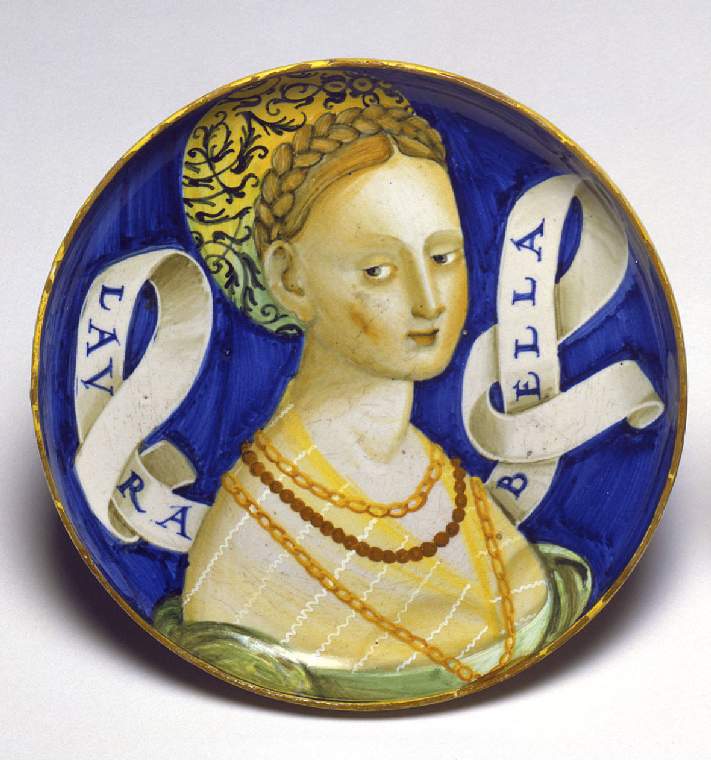
It was Italian potters who introduced the technique into Holland, for tin-glazing in Italy had reached a high art form in the early 1500s, with master potters decorating wares with scenes from history and classical myth in vivid colours (known as 'maiolica').  Popular display pieces were the coppe amatorie, stock  images of idealised beautiful women, inscribed with a name and flattering titles such as bella, diva, gracioza, galante.  

'Laura bella', shallow maiolica bowl on foot, Urbino or Casteldurante, Italy, c. 1525-35
© Fitzwilliam Museum


'Silvia diva mia bella' , Urbino or Casteldurante, Italy, c. 1540
© V&A Museum

A modern feminist take on these idealised  "fair women" has been created by the Boston-born book artist, Angela Lorenz in 1993,  in her set of 6 collagraphed paper plates, framed and stored in a slatted crate.  She now lives and works mainly in Bologna, and this piece was inspired by these 'Belle Donne' images.


She's a Dish: paper plates  © Angela Lorenz, National Art Library, V&A

The six paper plates are variously labelled:  
 "She is round. She is idealised. She hangs on the wall.
  She is not to be used. She is not disposable. She's a dish."

Angela Lorenz, from artist's book, 1993 


Angela Lorenz, from artist's book, 1993

Each 'She' is in fact a dish of collaged spaghetti, sealed with glue and inked in typical maiolica colours, making a relief print in the style of those Renaissance fair women, now captured in their 16th century ceramics in museums across the globe.

See Angela Lorenz's website: angelalorenzartistsbooks.com

Monday, 24 October 2016

St Crispin's Eve, 24th October 1415

Key moments in Shakespeare's plays include the eve of battle scenes in Richard III and in Henry V.  Before Agincourt, Henry walks around the camp incognito, in a borrowed cloak, testing the mettle of his men and himself: 

"Henry: Good morrow, old Sir Thomas Erpingham:
A good soft pillow for that good white head
Were better than a churlish turf of France.

Erpingham: Not so, my liege: this lodging likes me better,
Since I may say, 'Now lie I like a king'.

Henry: Lend me thy cloak, Sir Thomas." Act IV, sc.1.


Embroidered chasuble, English, early 1400s    © V& A Museum

When Henry borrows the cloak from Sir Thomas Erpingham, his senior commander who drew up the English line at Agincourt,  I am reminded of this medieval priest's chasuble, bearing the shields of Sir Thomas under the arms of the embroidered cross (the orphrey).

 It was made from the most luxurious fabric available, woven silk from Italy, here unusually portraying exotic camels with panniers of flowers,  and made suitable for religious use by applying a panel of English silk and gold thread embroidery, (opus anglicanum *).  This is the rear view of the chasuble, which would be seen when the priest celebrated mass.  Sometimes chasubles were cut down from a much larger cloak, or cope, deriving their name from the Roman soldier's enveloping cloak - or casula, little house.
I like to think it was so in this instance, linking cloaks for kings, soldiers and priests.

*see the current exhibition at the V&A Museum.

Saturday, 24 September 2016

Libra: the Scales of Justice


"He shall have merely justice, and his bond."


  Charles Macklin in The Merchant of Venice,  Johann Zoffany c. 1768
©  Tate Gallery, London

"Merchant:  Most learned judge! A sentence! come, prepare!
Portia: Tarry a little: there is something else.
This bond doth give thee here no jot of blood;
The words expressly are 'a pound of flesh:'
Then take thy bond, take thou thy pound of flesh;
But, in the cutting it, if thou dost shed
One drop of Christian blood, thy lands and goods
Are, by the laws of Venice, confiscate
Unto the state of Venice."
 The Merchant of Venice, Act IV Sc. 1.  William Shakespeare

Many visitors in the audience at London's Globe Theatre are not that familiar with Shakespeare's plays.  I remember that there was an audible gasp at this point in the court scene as Portia plays her master stroke against Shylock - just as there must have been when the play was first performed around 1599.

Nearly 150 years later, at Drury Lane Theatre in 1741, Charles Macklin created another sensation by playing Shylock as a serious character, not the comic clown figure the eighteenth century had turned him into.
Eighteenth century engraving © National Portrait Gallery

To get in character he researched the London Jews, their dress and accents, to create a believable stage persona, and not the old 'bogeyman' as was then customary.

The dramatic figure of Shylock on this Staffordshire teapot is based on engravings of Macklin in the role (not David Garrick as was once thought).  You can see the scales hanging from his arm, while his fingers are testing the tip of the sharpened knife, just as in this other engraving of the actor below.


Jasper teapot, Neale & Co, Hanley c. 1785
© Fitzwilliam Museum


Engraving after J.H. Ramberg c. 1785  

Macklin, known as "wicked Charlie Macklin", was a tempestuous character; he accidentally killed a fellow actor in a backstage quarrel, and was tried and acquitted of murder. Zoffany's painting above is thought to portray one of the judges on the left.  Macklin had a long successful career, his portrayal of Shylock making his name, and he spoke a few lines at his last stage appearance in 1789.
He was a Libran, born on 26th September, 1697 and died in 1797,  probably not quite the 102 years recorded on his memorial plaque in St Paul's Church, Covent Garden.

Thursday, 1 September 2016

September: "Then nightly sings the staring owl, Tu-whoo!"*


Marazion Marsh   Harold C. Harvey, 
© Penlee House Museum & Gallery

"Now that September is here, the nights are gradually drawing in.  By 8 p.m. the sun has set, and the sky is almost dark.  Outside the Old Vicarage, a hundred yards or so east of the village shop, a bird is perched on the telegraph wires: those same wires where, a few months ago, the first swallow of the summer was sitting.


The bird is a tawny owl.  It sits on the topmost wire, unnoticed by drivers passing beneath on their journey home from work.  Occasionally it twists its head slowly from side to side; though even when a medium-sized bat passes closely by it takes no notice.  After a few minutes, it drops off the wire on soft, silent wings, disappearing into the dense foliage of a sycamore.  In an hour or so, when the remaining glimmer of light has finally been enveloped by darkness, it will go hunting, listening for the rustling of hidden rodents below."
Wild Hares & Humming Birds  Stephen Moss

When I was young, we would look for solitary owls sitting on telegraph poles in the dusk along country lanes, almost indistinguishable from the ceramic insulators.  Just like this little owl in Dobrogea, Romania,  featured in the Daily Mail newspaper.


* "Tu-whit, tu-whoo!" Love's Labour's Lost, Winter song,  W. Shakespeare

Saturday, 20 August 2016

"Divinest creature, Astrea's daughter" *

Very soon the sign of Virgo takes over from Leo in the zodiac, and hints of incipient autumn make our summer pleasures keener, just as they did six hundred years ago -- for the harvesters as well as the elegant ladies and the lords in their straw hats, before the Chateau d'Estampes. 

August, from Les Tres Riches Heures du Duc de Berry, c.1412-16

The constellation of Virgo, according to  Greek myth, was created when Astrea, virgin goddess of the Golden Age, left the sinful earth for the heavens.   She is also linked with the goddess Ceres and harvest-time.

Here Virgo is portrayed by astronomer Johannes Hevelius in his Uranographia of 1690, her left hand holding its sheaf of corn.


In literature Astrea is seen to preside over a new Golden Age of Justice, symbolically representing Queen Elizabeth I in Spenser's  Faerie Queene, and similarly in Dryden's poem Astrea Redux, celebrating the return of Charles II in 1660.    In seventeenth century France, she was the heroine of Honore' d'Urfe's pastoral romance, L'Astree,  a best seller for many decades; her lover, the shepherd Celadon, dressed in grey-green, and gave his name to this colour in Europe.   The word celadon is now synonymous with Song dynasty porcelains.


Bowl with lid, Longquan ware; Song Dynasty **

* Shakespeare,  Henry VI Pt.1, Act I. vi, of Joan of Arc.
**  Chinese Ceramics , Dr. F. Lili, Chinese Intercontinental Press 


Friday, 5 August 2016

Did Shakespeare dine out? and other pressing questions.

All the best writings on Shakespeare - whether fact or fiction, articles, skits or imaginative recreations - should send you back to the text.  I have been reading novelist Angela Thirkell lately, and her light-hearted piece in the Cornhill Magazine from 1928*  certainly had me turning the pages of his plays.

She argues that from evidence in several plays, it is clear that Shakespeare did not dine in the best circles, as he shows little understanding of the proper way to entertain.  For example, the Capulets clearly cannot manage their servants - "We shall be much unfurnished for this time" (Act IV, sc.2), Timon of Athens keeps insulting his dinner guests, "trencher  friends"(Act III. sc. 6), and in Cymbeline (Act I, sc, 4),  Philario in Rome has no understanding of inviting compatible acquaintances, with two guests also hampered by language barriers.

In Macbeth, the noble guests politely ignore "the peculiar remarks of their host (never shake thy gory locks..., Act III sc. 4) and the obvious temper of their hostess", while in Hamlet  (Act III sc.2) the host Claudius rushes out shouting unintelligibly in the middle of the after-dinner entertainment.  Hamlet himself has rudely chattered all the way through the play, as Ophelia remarks: "You are a good chorus my lord".
As Angela Thirkell says, "Now can we suppose that any of Shakespeare's patrons would have given such outrageously improbable parties?"
 

Polite Tudor dining:  William Brooke, Lord Cobham and his family, 1567 
Longleat House Collection

It is the improbable "Ceremonial Boiling of the Potato" Party planned by Raleigh for Queen Elizabeth I and her court, which is one of the running jokes in No Bed for Bacon.  This comic novel by Caryl Brahms and S. J. Simon was a best-seller in 1941, and shares many popular jokes about Shakespeare with the Universal film of 1998,  Shakespeare in Love. 

Francis Bacon as Lord Chancellor, 1617 

In No Bed for Bacon -- which might have influenced Tom Stoppard, but was unknown (except by osmosis?) to the original writer of Shakespeare in Love, Marc Norman --  the stage-struck heroine Lady Viola falls in love with the Bard, with the rivalry of Henslowe and Burbage and their theatre companies as backdrop.

Geoffrey Rush as Philip Henslowe in the Universal  film

 Martin Clunes as Burbage in the Universal film

Shakespeare, however, is clearly only in love with himself : "a melancholy figure sat tracing its signature on a pad.  Shakesper, Shakespere, Shekspar.  He was always hoping that one of these days he would come to a firm decision upon which of them he liked the best."  
Still more precious is his current work-in-progress Lov's Labor Wunne.  He even risks his life to retrieve its title page (all he has yet written) from the flames of the Globe Theatre.  Writing another new play for a Royal Performance on 6th January, "'Call it what you will",  he mocks interfering Sir Francis Bacon, identifiable to all in the figure of Malvolio.
But Bacon plans his revenge:   "He would devise some dark revenge, something deep and literary to obscure Will's name to all posterity.  Bacon should deface the name of Shakespeare!  But how?  He concentrated."

This wonderful Elizabethan burlesque also features Raleigh, ordering ever more splendid but accident-prone cloaks for his 'Ceremonial Boiling of the Potato' before the Queen,  her sea-dog Drake's drunken analysis of the Armada, and poor Francis Bacon's abortive campaign to obtain a genuine Royal Progress bed.  Where has it gone: Shakespeare has queue jumped and sent Bacon's bed to Anne Hathaway, of course.


*included in Christmas at High Risings © the Estate of Angela Thirkell, Virago Publications 2013.

Thursday, 28 July 2016

Leonine stories


Persian Astrological illustration for Leo,  gouache, c. 1800s. 
(from the Wellcome Library Images ) 


 This is the time when the constellation of Leo is in the ascendent.  There are many examples of the kingly Lion as a symbol from myth and legend, from the lion-killing hero in the Epic of Gilgamesh, or the Old Testament's  Samson and David, or the Greek Hercules, all often shown wearing a lion skin.  Gentler heroes are St. Jerome, who befriended a lion by removing a thorn from its paw, a story taken from the classics and reimagined by G. B. Shaw in Androcles and the Lion,  and of course, the fourth Gospel-maker, St. Mark and his winged lion, historically associated with Venice. 

But for my Lion illustration I have gone back to the Babylonian myth of the tragic lovers, a tale popular in the  later Renaissance: 
"In such a night  
Did Thisbe fearfully overtrip the dew, 
And saw the lion's shadow ere himself, 
And ran dismayed away."  (Merchant of Venice  Act V)


Pyramus and Thisbe, maiolica plate from Urbino, c. 1550s  © Fitzwilliam Museum

As Ovid recounts, the eloping lovers are due to meet at Ninus' fountain outside Nineveh, but Thisbe, arriving first, is frightened by a bloody-mouthed lion and flees, dropping her cloak. Pyramus arrives, sees the lion mauling Thisbe's bloodstained cloak, and, most true lover, falls on his sword.   Here we see Thisbe returning and desperately following  Pyramus' example, watched by Cupid.

Not the finest rendering in maiolica - a very cluttered image with all the city backdrop encroaching.  The painter (or his customers) obviously liked scenes of impalement, but the lion has not got Thisbe's bloodstained cloak in its mouth, in fact Thisbe still seems to have a cloak around her; nevertheless the painter has captured the popular tragedy with dramatic 3D effect.  According to Ovid, a mulberry tree grew beside the fountain and, drenched in the lovers' blood, its white berries were ever after deep purple.

There are other finer maiolica examples in e.g. the Wallace Collection, and this popular story appears in paintings, mosaics, on Venetian glassware and French tapestry, although you sometimes have to look hard to spot the deadly lion.

I could not resist this Footnote:  a fresco by Benozzo Gozzoli, c. 1425, from Montefalco, Italy.


Thursday, 23 June 2016

A Dream of Wise Children

The British Library's current exhibition, "Shakespeare in Ten Acts", includes a section on A Midsummer Night's Dream,  with a flickering black and white clip from Max Reinhardt's full-blown 1935 Hollywood film production.


Titania and Bottom, with fairies  Max Reinhardt production, 1935.  

It starred a young Olivia de Havilland, with James Cagney as Bottom the Weaver  and Mickey Rooney as Puck.  With metal trees painted orange to glow eerily on the black and white film, truckloads of real trees and foliage, 650,000 candles and live owls, doves and ravens, as spangled fairies streamed across the screen, to music by Mendelssohn,  audiences and critics were of two minds as to its success.
   
    More stills from the Warner Brothers film, 
director Max Reinhardt, designer William Dieterle


But is it the words 'fairy' and dream' or even the play's hypnotic rhyming couplets, which, regardless of Shakespeare's lyrical verse,  spark such creative extravaganzas on canvas, stage and screen?   The play was a fruitful source for artists, from Fuseli's vision of c. 1790, even to Sir Edwin Landseer in 1851 (a commission for Isambard Brunel's Shakespearian themed dining-room). Titania and Oberon were popular subjects :


The quarrel of Oberon and Titania  Sir Joseph Noel Paton, 1849
© Scottish National Gallery


Sir Herbert Beerbohm Tree's famous stage production of 1907, in similar spectacular style, featured real grass and live rabbits, one of which bit Bottom the Weaver when he picked it up.

Scene from A Midsummer Night's Dream,  H. Beerbohm Tree, His Majesty's Theatre, London 1900  
© Victoria & Albert Museum


Angela Carter's great last novel, Wise Children, is another creative extravaganza, full of Shakespearian allusions, covering most of the plays: "…I wanted it to be very funny, and at the same time I wanted the complex ideas about paternity, and the idea of Shakespeare as a cultural ideology".

She tells the story of illegitimate identical twins, Nora and Dora Chance, the "Lucky Chances", from 49 Bard Road, Brixton, earning a hard living as music hall dancers in the 1930s. "By ourselves, neither of us was nothing much, but put us together, people blinked.  Which is Dora? Which is Nora?"

Their story as Dora narrates it intertwines with the famous Hazard theatrical family, their putative father being Melchior Hazard, the great Shakespearian actor-manager of the day.  Along with Melchior's twin brother (their 'Uncle' Perry), a succession of wives,  and more twin children, the legitimate Hazards, wealthy and successful, seem to be the lucky ones.

The climax of the Chance sisters' career is a trip to Hollywood to play Peaseblossom and Mustardseed in their father's film of A Midsummer Nights' Dream - clearly inspired by Max Reinhardt's famous 1935 film.  As pragmatic Dora relates:

 "I remember that day, the day The Dream began, as if it were yesterday.  We all arrived in costume -- we were a motley crew and no mistake.  None of your soppy fairies with butterfly wings and floral wreaths.  No, sir. As Peaseblossom and Mustardseed, our bras and knicks had leaves appliquéd at the stress points, there were little lights in our shaggy wigs, and when we saw how the rest had fared in the wardrobe, we thought we'd got off lightly, I must say, because some had antlers sprouting out of their foreheads and fur patches covering up the rude bits; others were done up as flying beetles, in stiff shiny bodices split up at the back; and one or two with boughs, not arms, plus a lavish use of leather and feathers all round.
Furthermore, remember that not fairies alone inhabited the wood near Athens.  A giant mouse, saddled and bridled trotted past.  A bunny, in a wedding wreath and veil. Some dragonflies, in masks.  Several enormous frogs.  Dwarfs, giants, children, all mixed up together.  Suddenly I had a sinking feeling; I knew it in my bones.  This film is going to lose a fortune."

This is a witty, bawdy, irreverent novel, where Carter's imaginative extravaganzas are grounded in the daily realities of the sisters' life: -- from liberty bodices to Grandma's square oilcloth shopping bag or Fuller's walnut cake. It is an irrepressible celebration of its players'  humanity.

"We do not come as minding to content you, Our true intent is.
All for your delight, we are not here.
That you should here repent you, The actors are at hand;
and, by their show,
You shall know all that you are like to know."

A Midsummer Night's Dream (the players' Prologue)  Act V.