Translate

Showing posts with label London. Show all posts

Saturday, 16 March 2019

Islamic art in Qatar

My local market has a very good second-hand bookstall, where I came across the guidebook to the Museum of Islamic Art in Doha, Qatar.


The building was designed by I.M Pei (probably best known for the Louvre's Glass Pyramid) and its faceted geometric shape,  which changes with the sun, captures the essence of Islamic art.  His inspiration was the ninth century mosque of Ahmed Ibn Tulun in Cairo:
 "If one could find the heart of Islamic architecture, might it not lie in the desert, severe and simple in its design, where sunlight brings forms to life?"

The Doha Museum's interior is more obviously spectacular, with its play on circles, octagons, stars and squares, key motifs in Islamic art, decorating objects and interiors.


The atrium, with double stairway and decorated chandelier


Diamond patterns and facets reflect the interior light  


These changing and intersecting patterns in the architecture are seen more clearly in the interior design and decoration and are repeated in the objects in the Museum's collection.


Detail of inlaid cabinet, with stars and foliage, India, 16th-17th century

Slip decorated plate with Kufic calligraphy, Samarqand or Nishapur,  10th century.*
"Foolish is the person who misses his chance and afterwards reproaches fate."  attrib. Yahya ibn Ziyad

The interior designer, in collaboration with I.M. Pei, was Jean-Michel Wilmotte, who used dark grey porphyry and bronzed exotic wood - Brazilian louro faya,  creating display galleries where the Museum's treasures appear suspended in space and light. 


Treasures of the Museum include an inlaid brass candlestick from Shiraz, an enamelled glass mosque lamp, and the Rothschild silk carpet, probably made in Kashan in the reign of Shah Tahmasp (1524-76).

Many of these and other objects are inscribed with dedications to their owners or, as around the mosque lamps, with verses from the Qur'an;  sophisticated carpet designs are closely related to the designs of book covers, for the highest art after architecture in the Islamic canon is the art of the book or calligraphy, which conveys the word of God.


Book binding, Herat, Afghanistan, 15th century
Kufic Qur'an, Abbasid or Fatimid, N. Africa or Near East, 10th century


Mamluk Qur'an, Egypt or Syria 14th century

Light and shadows on the Museum of Islamic Art, Doha, Qatar
(This and other images from mia.org.qa/collections)


*These epigraphic plates from Samarqand and Nishapur are among my favourites, with their spare designs and stylised inscriptions, often blessings or proverbs, providing convivial grace-notes to a meal.
There are good collections of these and other beguiling Islamic arts found in museums such as the Metropolitan New York, the British Museum and the V&A, London, or the Louvre, Paris. 


Friday, 1 March 2019

March beginnings: "Midway on our path through life, I found myself in a dark wood, Where the way ahead was obscured"*


The Cathedral and Gundulf's Tower,  from "The Gentleman's Magazine"

"An ancient English Cathedral town?  How can the ancient English Cathedral town be here! The well-known massive grey square tower of its old Cathedral?  How can that be here!  There is no spike of rusty iron in the air, between the eye and it, from any point of the real prospect.  What is the spike that intervenes, and who has set it up?  Maybe it is set up by the Sultan's orders for the impaling of a horde of Turkish robbers, one by one.  It is so, for cymbals clash, and the Sultan goes by to his palace in long procession. Ten thousand scimitars flash in the sunlight, and thrice ten thousand dancing-girls strew flowers.  Then, follow white elephants caparisoned in countless gorgeous colours, and infinite in number and attendants.  Still, the Cathedral tower rises in the background, where it cannot be, and still no writhing figure is on the grim spike.  Stay! Is the spike so low a thing as the rusty spike on top of the post of an old bedstead that has tumbled all awry?  Some vague period of drowsy laughter must be devoted to the consideration of this possibility.
Shaking from head to foot, the man whose scattered consciousness has thus fantastically pieced itself together, at length rises, supports his trembling frame upon his arms, and looks around. "
Charles Dickens, 1870

Illustration by Charles Keeping, Folio Society edition 1982

 So begins The Mystery of Edwin Drood, with the Cathedral choir-master, John Jasper, awakening in a Limehouse opium den.  This was Dickens' last, unfinished novel, being written for publishing in monthly parts.  He died suddenly on June 9th, 1870, leaving the conclusion of this last work itself an unsolved mystery.


The May monthly part, with scenes from the novel, 1870.
A young Luke Fildes made his name when he was chosen to illustrate The Mystery of Edwin Drood.


*The opening lines of Dante's Inferno (various translations):
Nel mezzo del cammin di nostra vita, Mi ritrovai per una selva oscura, Che la diretta via era smarrita."    

Saturday, 1 July 2017

July: Phoenix London 1944.

Saturday, 1st July

"All afternoon planes came over…….
At 6 I met James at Kings Bench Walk and we tubed to East Aldgate.  We walked down the Commercial Road to the river. God, the squalor, the desolation and the dreariness of the East End! We passed one beautiful church, burnt out, which I said must be by Vanbrugh.  J. identified it from his pocket guide-book as St. George's-in-the-East, by Hawksmoor.  The pinnacled square towers like those of All Souls gave the clue. "

St. George's-in-the-East,  1714-26, by Nicholas Hawksmoor (successor to Wren and Vanbrugh)

The church interior was destroyed by an incendiary bomb in the Blitz (and remodelled in the 1960s) but Hawksmoor's 160-foot tower and turrets survived.  This was one of his six landmark London churches; here at St George's he used his rejected designs for the tower of  St. Alfege-with-St. Peter which had been turned down by the Church Commissioners.

"We were smartly dressed underneath, but wore over our suits dirty old burberries buttoned up to the chin..  We went into a pub for a drink, and a robot [V1 or doodlebug] came over, nearer and nearer, exploding a few yards away. The pub keeper turned us out and shut the door, saying he had had enough for one day.  We wished him good luck.  'All the best,' he said.
We wandered through Wapping, to Wapping Old Stairs where Judge Jeffreys was captured trying to escape to France dressed as a sailor.  Then to the Prospect of Whitby on the water, with its rickety galleries built over the river on piles."


"We found Philip Toynbee there with a pretty little girl, a Communist.  We sat together on the gallery drinking beer and eating sandwiches, watching large boats struggle up the river, pirouette in front of us and retreat into the docks.  From here Jamesey saw his first robot .  It scurried through the clouds at a great rate and seemed to be circling and not going straight.  By 9.30 the inn was full, and a piano and a clarinet were playing hot music.  Women sang into a harsh microphone, sailors stamped, and  peroxide blondes and the worst characters of London danced like dervishes.  It was a strange, gay, operatic scene. ...
Slept in John Fowler's Anderson shelter on the top bunk, which was very luxurious, although there were as many as five of us in the shelter. A noisy night, but quieter at dawn. Incessant jokes and hoots of laughter non-stop.  In fact we laughed ourselves to sleep. Nobody woke before 10.15."

Prophesying Peace James Lees-Milne 1944

The Prospect of Whitby is one of London's oldest riverside pubs, frequented by Pepys, as well as Judge Jeffreys who lived nearby, and Thackeray, Turner, Dickens and Whistler among many.  Built in 1520, it was known as the Devil's Tavern for the smugglers and thieves it attracted. In 1777 it was renamed The Prospect, after a Whitby collier of that name which was moored nearby.

 .
Its rebuilt street facade, No. 57 Wapping Wall, E1.  The flagstone floor is its oldest part.

It would be appropriate if those hanging baskets contained fuchsias,  for the story is that in the Prospect a sailor sold an unknown plant to a nurseryman, and so the fuchsia was introduced to England.  


It was  Frenchman Charles Plumier who discovered the fuchsia in the Caribbean c. 1703, and named it after the 16th century botanist Leonhart Fuchs (this helps with the spelling as the English pronounciation has softened the 'k' sound).  Various versions mention a Captain Firth of Hammersmith and a plantsman, Mr Lee; what is confirmed is that in 1788 Kew Gardens acquired a fuchsia plant from a Captain Firth,  and the Prospect of Whitby was always a meltingpot of classes and occupations, where a sailor might have met a nurseryman, and was a source of exchanges of all kinds, for centuries here on the Thameside.


   Wappng from Rotherhithe  J.M. Whistler  c. 1861  

Images all Wikimedia Commons.


Sunday, 20 November 2016

Diverse dishes - and wartime celebrations 20th November


Saloon Bar 1940  Edward Le Bas
© Tate Britain

"For those who eat out in the West End, getting a meal is becoming more and more of a race to the swiftest, in which latecomers are greeted with nothing but polite headshakes and overflowing tables.  The five-shilling limit on bills has no real effect on the cost of dining out - the addition of various 'house charges' and sundry items see to that  - but it does have certain comic results,  Oyster fanciers, for instance, can start their dinner with six oysters if they can afford such luxuries, but if they have nine oysters they cannot have another course, for that would send the bill above the legal total.  A major in Driver's the other evening, affectionally regarding the last oyster on his plate, saw it snatched from under his nose by the barman, who had suddenly realised that he had given the guest ten by mistake. The unhappy major said that they were the first oysters he had had after three years in the desert, all of which time he had apparently spent dreaming about Whitstable Natives.  It didn't make any difference to the bartender, though."

Mollie Panter-Downes, in The New Yorker, November 1943

This wartime austerity continued through 1947:

"Potato rationing is not an unexpected blow, but after two years of peace, this continuous taking in of the belt is becoming very discouraging.  … It was surprising however, to hear that the sweet ration was to be reduced and this at a time when the sugar supply is so ample that some think it might be taken off the ration altogether.  When will austerity cease?"       Mass-Observation Archive, 9th November 1947

But all was not doom and gloom that month: on the 20th November 1947 the country celebrated the wedding of HRH Princess Elizabeth and Prince Philip:


"…I turned on the wireless.  A moving occasion….the feeling is genuine enough -- a delightful sort of family feeling. .. We do love our little ceremonies.  And why not? All of us are hungry for colour, romance and adventure.  Today's ceremony symbolised some dormant dream of perfection alive in the breast of every, well, woman at least. …I wept copiously into the washing-up bowl as I listened."
© Mass-Observation Archive, as above, both quoted in Our Hidden Lives  © Simon Garfield

The royal wedding banquet of Anglo-French dishes concluded with an ice-cream bombe, named after the Princess.  Maybe some people even celebrated with oysters, if not so prolifically as Lewis Carroll's pair:


The Walrus and the Carpenter  illus. John Tenniel 1871


"…Oh Oysters come and walk with us!
The Walrus did beseech.
A pleasant walk, a pleasant talk,
Along the briny beach:
We cannot do with more than four,
To give a hand to each. ….

Four  other Oysters followed them,
And yet another four; 
And thick and fast they came at last,
And more and more, and more --
All hopping through the frothy waves,
And scrambling to the shore….

A loaf of bread, the Walrus said,
Is what we chiefly need:
Pepper and vinegar besides
Are very good indeed --
Now if you're ready, Oysters dear,
We can begin to feed……

Oh Oysters, said the Carpenter,
You've had a pleasant run!
Shall we be trotting home again?
But answer came there none --
And this was scarcely odd, because
They'd eaten every one!"

Through the Looking Glass  Lewis Carroll
(see Poemhunter.com for the full text)


Saturday, 12 November 2016

"She's a dish" ?

Shakespeare's Measure for Measure is a play full of moral ambiguity and vice, in which two virtuous women are threatened by hypocrisy and male power.  Isabella, a novice nun, must trade her virginity to save her brother's life,  while Mariana has been jilted for lack of her dowry, both at the mercy of Angelo, the outwardly upright Ducal deputy.
Elsewhere, Pompey the bawd, trying to make Mistress Overdone's brothel appear respectable to the officers,  describes how

 "..she came in…longing for stewed prunes.  Sir we had but two in the house, which at that very distant time stood, as it were, in a fruit-dish, a dish of some threepence; your honours have seen such dishes; they are not China dishes, but very good dishes."  Measure for Measure Act 2, sc, 1.


Small 'Kraak' porcelain dish,  imitated in blue and white Dutch delft   
© V&A Museum

The first recorded performance of  Measure for Measure was for the Christmas Revels of 1604.  Ever up to date, Shakespeare's "China dishes" would surely be recognised by his elite audience as a reference to the spectacular sale of Chinese porcelain in Holland from captured Portuguese carracks in 1602 and 1603. One cargo alone contained 50 tons or 100,000 pieces of Chinese export porcelain. Before this, Chinese porcelains were exotic rarities, owned only by royalty and the very wealthiest of courtiers and Levant merchants.

Pompey's "very good (threepenny) dishes" might have been pewter, but more likely Dutch 'delft' - imitations of the imported 'Kraak' i.e. carrack porcelains, made of tin-glazed earthenware - liquid resistant, shiny and colourful but prone to chip and crack.  Some immigrant Dutch potters were making basic tin-glazed earthenwares in London from 1570s (especially smooth tiles and jars for apothecaries). The Museum of London has a large collection, many found in pieces in old cesspits.  


                     3 rare survivals:  Tin-glazed drug pots, English or Dutch, c.1600-1650.  
                                                 © British Museum, London 

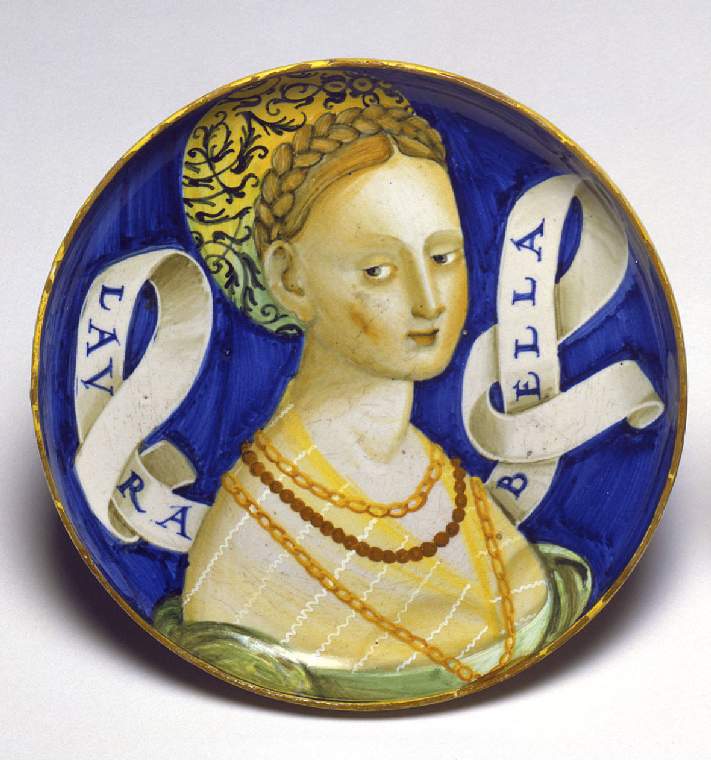
It was Italian potters who introduced the technique into Holland, for tin-glazing in Italy had reached a high art form in the early 1500s, with master potters decorating wares with scenes from history and classical myth in vivid colours (known as 'maiolica').  Popular display pieces were the coppe amatorie, stock  images of idealised beautiful women, inscribed with a name and flattering titles such as bella, diva, gracioza, galante.  

'Laura bella', shallow maiolica bowl on foot, Urbino or Casteldurante, Italy, c. 1525-35
© Fitzwilliam Museum


'Silvia diva mia bella' , Urbino or Casteldurante, Italy, c. 1540
© V&A Museum

A modern feminist take on these idealised  "fair women" has been created by the Boston-born book artist, Angela Lorenz in 1993,  in her set of 6 collagraphed paper plates, framed and stored in a slatted crate.  She now lives and works mainly in Bologna, and this piece was inspired by these 'Belle Donne' images.


She's a Dish: paper plates  © Angela Lorenz, National Art Library, V&A

The six paper plates are variously labelled:  
 "She is round. She is idealised. She hangs on the wall.
  She is not to be used. She is not disposable. She's a dish."

Angela Lorenz, from artist's book, 1993 


Angela Lorenz, from artist's book, 1993

Each 'She' is in fact a dish of collaged spaghetti, sealed with glue and inked in typical maiolica colours, making a relief print in the style of those Renaissance fair women, now captured in their 16th century ceramics in museums across the globe.

See Angela Lorenz's website: angelalorenzartistsbooks.com

Monday, 18 April 2016

A grace for London Taverns

"Long since, in King James's time, I have heard my uncle Danvers say (who knew him) that he lived without Temple Bar, at a comb-maker's shop about the Elephant and Castle*.  In his later time he lived in Westminster, in the old house under which you pass as you go out of the churchyard into the old palace; where he died.

A Grace by Ben Jonson, extempore, before King James:
'Our king and queen, the Lord-God bless
The Paltzgrave, and the Lady Bess,
And God bless every living thing
That lives, and breathes, and loves the king,
God bless the Council of Estate,
And Buckingham, the fortunate.
God bless them all, and keep them safe,
And God bless me, and God bless Raph.'

The king was mighty inquisitive to know who this Raph was.  Ben told him 'twas the drawer at the Swan tavern, by Charing Cross, who drew him good canary.  For this drollery his majesty gave him a hundred pounds."

Brief Lives  John Aubrey


 The Workes of Benjamin Jonson, Folio edition 1616
Folger Shakespeare Library


* "In the south suburbs, at the Elephant,
Is best to Lodge: I will bespeak  our diet,
Whiles you beguile the time and feed your knowledge
With viewing of the town: there shall you have me." 

Antonio in Twelfth Night, Act III

Monday, 16 November 2015

Westminster Bridge - 'all bright and glittering in the smokeless air'.

Here are two views of the newly built Westminster Bridge, finally opened in 1750,  the only crossing between Putney Bridge and London Bridge, for a city which had grown extensively in the last hundred years.  Both show Westminster Abbey,  viewed from opposite directions.  The simple topographical scene has its charm, (the shimmering light, the reflected arches), but the one taken from Lambeth, on the south bank of the Thames, is a wonderful atmospheric landscape of the Thames traffic and eighteenth century London.  


Westminster Bridge  Antonio Joli (attrib.) c.1750
© Parliamentary Art Collection


Joli came to London in 1744, and was known for his theatre scenery and mural paintings, but he also learnt from his fellow countryman, Canaletto, as this other view of the Thames crossing shows.


Westminster from the River, London  Antonio Joli c. 1750
© Bank of England Museum

The bridge was replaced a century later when it become unstable, but it was from this first Westminster Bridge that the poet Wordsworth saw the city in 1802.


Sunday, 13 July 2014

Signs and wonders

"I have heard that on a day
Mine host's signboard flew away
Nobody knew whither till
An astrologer's old quill
To a sheepskin gave the story --
Said he saw you in your glory
Underneath a new-old Sign
Sipping beverage divine,
And pledging with contented smack
The Mermaid in the Zodiac!

Lines on the Mermaid Tavern   John Keats

Sunday, 6 April 2014

"Lacon, or Many Things in few Words.."


"Mr Redding draws the following picture of Mr. Colton's lodgings in [Princes Street], London.

'His sitting-room was carpetless; a common deal table stood in the centre, and a broken phial placed in a tea-saucer served for an inkstand, surrounded with letter covers and paper scraps.  Four common chairs, one or two rickety, a side table holding a few books, half a quire of foolscap paper, and some discarded pens, on one side of the room, composed nearly all the furniture, fishing-rods and gun excepted.  Here he indited Lacon.  His copy was written on scraps of paper, blank sides of letters, and but rarely on bran-new paper.  It is untrue that his rooms were as bad as some penny-a-line scribbler made out in a newspaper sketch of him.  They were always clean …'  "

Village London. part 4,  Edward Walford,  quoting Cyrus Redding's Recollections on C.C. Colton, Vicar of Kew and Petersham

Monday, 3 March 2014

In Bevis Marks

"There was not much to look at.  A rickety table, with spare bundles of papers, yellow and ragged from long carriage in the pocket, ostentatiously displayed upon its top; a couple of stools, set face to face on opposite sides of this crazy piece of furniture; a treacherous old chair by the fireplace, whose withered arms had hugged full many a client and helped to squeeze him dry; a second-hand wig-box, used as a depository for blank writs and declarations and other small forms of law, once the sole contents of the head which belonged to the wig which belonged to the box, as they were now of the box itself; two or three common books of practice; a jar of ink, a pounce box, a stunted hearth-broom, a carpet trodden to shreds but still clinging with the tightness of desperation to its tacks -- these, with the yellow wainscot of the walls, the smoke-discoloured ceiling, the dust and cobwebs, were among the most prominent decorations of the office of Mr. Sampson Brass."

The Old Curiosity Shop  Charles Dickens

Sunday, 29 December 2013

Seasonal Greetings from frozenink.blogspot

A very big thank you to all those whose blogs I follow and enjoy reading regularly - including Spitalfields Life, English Buildings, Quad Royal, Fired Up, James Russell,  First Known when Lost, and many others.

And if you wish to raise a glass, you may find a tipple or a tavern to your taste here :…

"Home-made drinks in England are beer and ale, strong and small:  those of most note that are to be sold, are Lambeth ale, Margaret ale, and Derby ale; Herefordshire cider, perry, mede.  There are also several sorts of compounded ales, as cock-ale, worm-wood ale, lemon-ale, scurvygrass-ale, College-ale, &c.  These are to be had at Hercules Pillars, near the Temple; at the Trumpet, and other houses in Sheer Lane, Bell Alley; and, as I remember, at the English Tavern near Charing Cross."

Letters, 1697    John Locke
[and see www.pepysdiary.com for more detail]


Friday, 1 November 2013

Gough Square to Gunpowder Alley

For the shade of the author of Rasselas still seems to haunt the scenes of his Titanic labours, and his ponderous but homely and temperate rejoicings.  Every court and alley whispers of books and the making of books; formes of type trundled noisily on trollies by inksmeared boys, salute the wayfarer at odd corners, piles of strawboard, rolls or bales of paper, drums of printing-ink or roller composition stand on the pavement outside dark entries; basement windows give glimpses into Hadean caverns tenanted by legions of printer's devils, and the very air is charged with the hum of press  and with odours of glue and oil.  The entire neighbourhood is given to the printer and binder;..."

Dr. Thorndyke and the Eye of Osiris  R. Austin Freeman

Friday, 25 October 2013

Undiscovered letters


"Sign of the Vulture,
St. Paul's Churchyard,
London
Nov. 1, 1678

Dear Mr. Bunyan,
Many thanks for letting me see the manuscript of Pilgrim's Progress, which I am returning as I am afraid we cannot envisage a use for it in the foreseeable future.  The fact is, there really isn't much demand for travel books at this moment in time.  Also it is a bit gloomy in places.

Are you interested in madrigals, at all?  We find there is a  growing demand for books of this nature.  We would also be quite interested in something based on your prison experiences.

Incidentally, I am afraid we have had to put Grace Abounding to the Chief of Sinners on the remainder list.  It didn't do as well as expected.  Perhaps it is unfortunate that it came out at the same time as Paradise Lost.

Yours sincerely,
Thos. Jarvis
Printer and bookbinder. "

Tonight Josephine, and other undiscovered letters  Michael Green

Thursday, 17 October 2013

The University Carrier

"On the University Carrier who
sickn'd in the time of his vacancy, being
forbid to go to London, by reason of
                   the Plague


'Here lies old Hobson, Death hath broke his girt,
And here alas, hath laid him in the dirt,
Or els the ways being foul, twenty to one,
He's here stuck in a slough, and overthrown.
'Twas such a shifter, that if truth were known,
Death was half glad when he had got him down;
For he had any time this ten yeers full,
Dodg'd with him, betwixt Cambridge and the Bull.
And surely, Death could never have prevail'd,
Had not his weekly cours of carriage fail'd;
But lately finding him so long at home,
And thinking now his journeys end was come,
And that he had tane up his latest Inne,
In the kind office of a Chamberlin
Shew'd him his room where he must lodge that night,
Pull'd off his Boots, and took away the light:
If any ask for him, it shall be sed,
Hobson has supt, and's newly gon to bed.' "


"Another on the Same
'..........
His Letters are deliver'd all and gon,
Onely remains this superscription.'  "


Poems  John Milton

Saturday, 14 September 2013

Cloud atlas

"Thursday, 7th November  --

Beyond the Indian hamlet, upon a forlorn strand, I happened on a trail of recent footprints.  Through rotting kelp, sea cocoa-nuts & bamboo, the tracks led me to their maker, a white man, his trowzers & Pea-jacket rolled up, sporting a kempt beard and an outsized Beaver,  shovelling and sifting the cindery sand  with a tea-spoon so intently that he noticed me only after I had hailed him from ten yards away.
Thus it was, I made the acquaintance of Dr Henry Goose, surgeon to the London nobility.  His nationality was no surprise.  If there be any eyrie so desolate, or isle so remote that one may there resort unchallenged by an Englishman, 'tis not down on any map I ever saw."

Cloud Atlas  David Mitchell

Sunday, 1 September 2013

A warming read


"The Gift is Small,
Good will is All"

Delft Handwarmer,  London 1688   © Fitzwilliam Museum

Monday, 12 August 2013

A ' killer' novel

"Exclude from your library all books that have no Albany connections.  Buy only such books as were written here, planned here, written elsewhere by men who once lived here or peopled with characters who had chambers here by writers who owned no part of Albany.  With the touch of Albany as sole criterion, and still you will own a not unrepresentative collection of English literature since the end of the eighteenth century.

It began, this relationship between Albany and literature,  almost in that moment when the mansion house became what everywhere else in Britain (but never in Albany) would be called a block of flats.  And it began with a sensation which, after the fashion of sensations, has since slithered off the front page of knowledge into the graveyard of footnote obscurity.  One of the most famous of all habitués of Albany's forerunner, Melbourne House, was killed, (or was said to have been killed) by a novel.  In 1806, a clerk at the Bank of England, Thomas Surr, published a bestseller, Winter in London.  In it he caricatured the Duchess of Devonshire so successfully that when she read the book the shock of self-recognition hastened her death."

'Albany'  J.E. Morpurgo in The Book of Westminster  ed.  Ian Norrie


Friday, 9 August 2013

Macaulay's New Zealander

"And she may still exist in undiminished vigour when some traveller from New Zealand shall, in the midst of a vast solitude, take his stand on a broken arch of London Bridge to sketch the ruins of St. Paul's."

 Essay (on von Ranck's History of the Popes)  Thos. Babington Macaulay

[and see  "Contemplating the Ruins of London",  David Skilton;
and "When the New Zealander Comes" in The Strand Magazine, Sept. 1911]

Thursday, 8 August 2013

Ozymandias in London

"We wonder, and some Hunter may express
Wonder like ours, when thro' the wilderness
Where London stood, holding the Wolf in chase,
He meets some fragments huge, and stops to guess
What powerful but unrecorded race
Once dwelt in that annihilated place."

from "Ozymandias"  Horace Smith

Saturday, 3 August 2013

A London Diversion (part two)

The Lord Mayor's Coachman continues on his way...

"Up to Old Bailey then he goes on to the Viaduct,
Up Holborn and High Holborn, there was nothing to obstruct,
When 'Now you're going up Oxford Street',  the Lord Mayor shouts again,
But John said 'I don't go that way! I go down Drury Lane.'
Down Drury Lane, Long Acre, and St. Martin's Lane he drives,
And thus to keep out of a street he artfully contrives,
And when they reach Trafalgar Square, the Lord Mayor in a pet,
Said, 'Dash my wig and barnacles! I think he'll do it yet.'

John nearly drove into the Strand, then stopped as if in doubt,
And the Lord Mayor said, 'I'm not surprised to find that you're put out.
Through Parliament Street you must go, or else cross Cockspur Street,
It's very hard, but still you must acknowledge your defeat,'
But John turned back and said, 'My Lord, I don't much think I shall,
If you ask me, I think you'll find I'm going down Pall Mall',
Then round the Square the coachman goes and drives at racing rate,
Goes through Pall Mall, into the Park to Buckingham Palace straight.

Chorus:
The Coachman gave the Lord Mayor, the Lord Mayor, the Lord Mayor,
The Coachman gave the Lord Mayor a curious kind of treat,
He drove him from the Mansion House, the Mansion House, the Mansion House
From Mansion House to Buck'n'am Palace and didn't go through a street."

Song by Harry Hunter and David Day, 1896
Historians of London  Stanley Rubinstein