Translate

Showing posts with label V&A. Show all posts

Saturday, 16 March 2019

Islamic art in Qatar

My local market has a very good second-hand bookstall, where I came across the guidebook to the Museum of Islamic Art in Doha, Qatar.


The building was designed by I.M Pei (probably best known for the Louvre's Glass Pyramid) and its faceted geometric shape,  which changes with the sun, captures the essence of Islamic art.  His inspiration was the ninth century mosque of Ahmed Ibn Tulun in Cairo:
 "If one could find the heart of Islamic architecture, might it not lie in the desert, severe and simple in its design, where sunlight brings forms to life?"

The Doha Museum's interior is more obviously spectacular, with its play on circles, octagons, stars and squares, key motifs in Islamic art, decorating objects and interiors.


The atrium, with double stairway and decorated chandelier


Diamond patterns and facets reflect the interior light  


These changing and intersecting patterns in the architecture are seen more clearly in the interior design and decoration and are repeated in the objects in the Museum's collection.


Detail of inlaid cabinet, with stars and foliage, India, 16th-17th century

Slip decorated plate with Kufic calligraphy, Samarqand or Nishapur,  10th century.*
"Foolish is the person who misses his chance and afterwards reproaches fate."  attrib. Yahya ibn Ziyad

The interior designer, in collaboration with I.M. Pei, was Jean-Michel Wilmotte, who used dark grey porphyry and bronzed exotic wood - Brazilian louro faya,  creating display galleries where the Museum's treasures appear suspended in space and light. 


Treasures of the Museum include an inlaid brass candlestick from Shiraz, an enamelled glass mosque lamp, and the Rothschild silk carpet, probably made in Kashan in the reign of Shah Tahmasp (1524-76).

Many of these and other objects are inscribed with dedications to their owners or, as around the mosque lamps, with verses from the Qur'an;  sophisticated carpet designs are closely related to the designs of book covers, for the highest art after architecture in the Islamic canon is the art of the book or calligraphy, which conveys the word of God.


Book binding, Herat, Afghanistan, 15th century
Kufic Qur'an, Abbasid or Fatimid, N. Africa or Near East, 10th century


Mamluk Qur'an, Egypt or Syria 14th century

Light and shadows on the Museum of Islamic Art, Doha, Qatar
(This and other images from mia.org.qa/collections)


*These epigraphic plates from Samarqand and Nishapur are among my favourites, with their spare designs and stylised inscriptions, often blessings or proverbs, providing convivial grace-notes to a meal.
There are good collections of these and other beguiling Islamic arts found in museums such as the Metropolitan New York, the British Museum and the V&A, London, or the Louvre, Paris. 


Monday, 4 September 2017

September: a visit to Constable country


Willy Lott's Cottage, Dedham Vale;  watercolour, grey ink   John Constable 1832  © British Museum 

Friday, 1st September
"A crisp, chilly morning, with that whiff of melancholy in the air.  Autumn is well on the way.  I would not mind if only I felt well, clear-headed and un-drugged.  Sisson* took me to Flatford Mill which the N.T. has acquired.  I love Constable, but I do not love this place.  It has been made a travesty of the totally unpretentious, rural, domestic scene of one of England's greatest painters.  Today the manor house is too picture postcardy for words.  Willy Lott's Cottage is abominably whimsy inside.  Sisson favours whitewashing or white painting all interior beams, I am glad to say. I concur with nearly all his ideas.  The Mill itself is still relatively unspoilt, and the island garden, with fat box hedges and old apple trees is full of charm.

We drove to Thorington Hall.  It has a rather neglected look, and the furniture inside -- well!  The house has had evacuees, and not been inhabited as a private house since the war, which explains much.

Thorington Hall's landmark octagonal, star-topped chimneys at Stoke-by-Nayland


Paycocke's House  elaborate carved frontage 

I left the Sissons after luncheon, and drove to Paycocke's, that hideously over-restored house in Coggeshall.  The tenants' bogus French furniture most inappropriate.  Sisson and I would like to whitewash all the harsh new brick nogging on the street elevation."

Prophesying Peace  James Lees-Milne 1944

Dedham Vale and Dedham Church  John Constable 1828 
© National Gallery of Scotland

Flatford Mill, Thorington Hall, and Paycocke's House in Coggeshall, near Colchester  were all acquired by the National Trust.  They represent the prosperity of the Stour and other  East Anglian river valleys where, like the medieval monks before them, Tudor butchers progressed from keeping  flocks of sheep to becoming wealthy cloth merchants, with river transport to major ports like Ipswich (where Cardinal Wolsey's father was a butcher-cum-grazier and merchant). By the eighteenth century cloth manufacture moved north and the cloth-fulling mills were converted to grain mills, like Flatford, where the Constable family farmed, and shipped their flour down to Pin Mill near Ipswich.


Dedham Lock and Mill   John Constable 1820  ©V&A Museum


*Marshall Sisson was an architect who lived in Shermans House in Dedham; in August the next year Lees-Milne stayed with the Sissons for the weekend:  "Sisson and I walked to Flatford Mill, where we watched the milling crowds bathing, running, jumping and enjoying themselves".  Prophesying Peace  1945  James Lees-Milne

Maybe they walked along Fen Lane, which was Constable's boyhood path from East Bergholt to school in Dedham?

Fen Lane, East Bergholt  John Constable 1817  © Tate Britain

Wednesday, 19 July 2017

Charles Dickens describes a school outing

This is the time of year when you see troops of school children on their end of term summer outings, to  parks and zoos  and museums.  Charles Dickens gives an account of a Infant school visit to the Crystal Palace in Hyde Park, to see the 1851 Great Exhibition,  much of which still rings true today.

View of the Crystal Palace, 1851  © V&A Museum

…"the school was composed of a hundred 'infants', who got among the horses' legs in crossing the main entrance to Kensington Gate, and came reeling out from between the wheels of coaches undisturbed in mind.  They were clinging to horses, I am told, all over the park.  When they were collected and added up by frantic monitors, they were all right.  They were then regaled with cake, etc., and went tottering and staring all over the place; the greater part wetting their forefingers and drawing a wavy pattern on every accessible object.  One infant strayed.  He was not missed. Ninety and nine were taken home, supposed to be the whole collection, but this particular infant went to Hammersmith.  He was found by the police at night, going round and round the turnpike, which he still supposed to be a part of the Exhibition.  He had the same opinion of the police, also of Hammersmith workhouse, where he passed the night.  When his mother came for him in the morning, he asked when it would be over?  It was a great Exhibition, he said, but he thought it long."

Charles Dickens,  Letters, July 1851

Monday, 12 June 2017

Mysteries of the Yellow Earth

This cleverly designed jar could be a well used piece of twentieth century studio pottery, but it is in fact a Neolithic Chinese pot from c. 3000 BC, and is now in the Museum of Far Eastern Arts in Stockholm.


Storage jar, MFEA, Stockholm

This one has a similar dynamic curvilinear design, but is more obviously ancient.


Burial jar from Gansu Province, China   c. 2600-2300 BC.  © V&A Museum 

These Stone age Chinese pots caused a sensation when they were discovered in 1921 from ancient settlement sites in Yang Shao province, as they had been lost for thousands of years, neither seen nor recorded in China's long history.  They included both burial urns and storage jars and bowls.

It was geologist-turned-archeologist Johann Gunnar Andersson, who discovered several similar sites along the Yellow River Valley in Gansu province and at Yang Shao in 1921, and recorded the first recognised evidence of Neolithic culture in China.

These pots were made before the potter's wheel was in use - a straw mat was probably used to help turn the pot around as more clay coils were added; some pots show the weave impress on the base.  The pots were beaten and smoothed with rib bones and paddles, and after drying, the fine loess clay surface was decorated with earth pigments, iron black and manganese purple, before firing. The early brushes were probably just a bamboo stem frayed.  Others were painted after firing, and the decorated surface was carefully burnished with a bone or pebble to preserve it.*

Yangshao neolithic earthenware pot, Banpo Museum 


Andersson was a Swedish geologist, who had visited the Antarctic as a member of the Swedish expedition  (collecting fossils of plants) in 1901-03.  The loss of their ship the Antarctic meant Andersson was in one of the small groups completely isolated on different islands through the long winter with small odds of rescue in the spring.  China must have seemed very different when in 1914 he was employed by the Chinese government's geological survey to advise on coal and oil resources.

Johan Gunnar Andersson (1874-1960) in China, 1920
© Swedish East Asian Museum


Intrigued by a strange piece of quartz and tales of dragon-bones, when he first excavated their source at Zhoukoudian not far from Beijing, he correctly predicted that fossils of early man - homo erectus - would also be discovered in that region. Soon fossil teeth sent back to Uppsala were identified as human, and eventually announced to the world as Peking Man in 1926, when the Swedish Crown Prince visited China.  So from fossil hunter Andersson turned full-time archaeologist, and with all his Yang-Shao discoveries he became Director of Stockholm's  Museum of Far Eastern Antiquities, and more of these striking painted burial urns later made their way into other European collections.


Painted pottery funerary urn, Yang Shao, c. 3000 BC MFEA Stockholm

A further major discovery (again a result of economic enterprise) was made in 1952 near Xi'an, when a site was being excavated for a new factory.  This site is now known as Banpo, after its team of diggers, and an extensive settlement was revealed with as many as six pottery kilns.  The Banpo pots clearly show the early animal and fish paintings from which the striking abstract geometric patterns were developed.

Fish decorated bowl   Banpo Museum China

Abstract patterns derived from fish decorations   Photo M. Reuterdahl 


Abstract patterned bowl, c. 3200-2650 BC. Gansu area  Metropolitan Museum, New York

The Banpo major archeological site is now a very busy tourist destination, with its museum opened in 1958.

But the story is incomplete.  Many of the Yang Shao ceramics, buried unknown for so many millennia before Andersson's excavations,  were then lost again after barely a quarter of a century.  Andersson returned very many of his finds (which had been studied in Sweden and were held in the Stockholm Museum), to China where they were last seen in 1937,  although some were still listed in 1948 in the Nanjing Museum guidebook.    Some  surviving pieces of those returned by Andersson were found  forgotten in storage in 2012, but many of these miraculous objects from prehistory which he brought to the light of day are still lost without trace.

And see China Heritage Quarterly; Archeologybulletin.org; China Before China, Magnus Fiskesjo & Chen Xingcan, 2004.

*Reference books give different accounts regarding whether the painting was done before or after firing, but as the excavated pots were being made over a very long time period, I assume there would have been differences in the materials and techniques and firing kilns at the various sites.

Tuesday, 22 December 2015

A Cabinet of Collectors 3: James Whitbread Lee Glaisher


It was Queen Mary II who introduced the passion for blue and white china into Britain, when she and her husband William III came over from Holland in 1689 to take the English throne.  The appeal of blue and white probably culminated in the mass production of the transfer printed Willow pattern in the nineteenth century, which continues to this day*.  The collector who owned this elaborate Delft posset pot describes "the real charm and beauty of the ware is to be seen in its highest perfection in some of the pieces decorated only in blue upon a white ground".  
This was Dr. James  W. L. Glashier, a mathematics  don at Trinity College, Cambridge,  lecturing to the Society of  Arts in 1897, and the posset pot features on his personal bookplate.   


Tin glazed earthenware (delft) posset pot, dated 1685,  Bristol/London c. 1504.  ©Fitzwilliam Museum
(Posset was a drink of warm milk with eggs, sugar and spices, curdled with wine or ale.)


James Whitbread Lee Glaisher (1848-1928)  © Trinity College, Cambridge

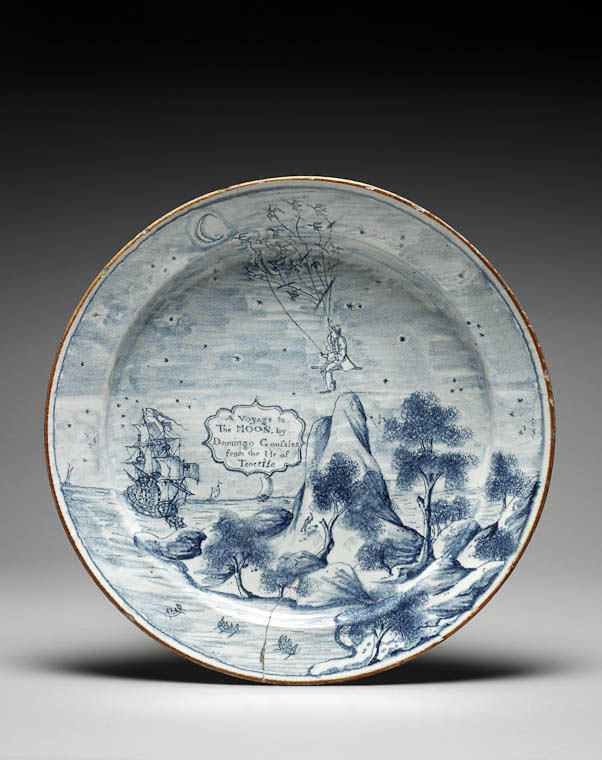
Dr Glaisher's father (also James) was a pioneering meteorologist and balloonist, who took his teenage son with him on two ascents,  and Dr Glaisher became a respected astronomer and was President of the Royal Astronomical Society for some years.  His collection contained several delftware plates commemorating early balloon flights, and this more unusual one from Bristol, dated 1740, (showing a holiday pastime in Teneriffe perhaps?).
It is based on a print illustrating "A Voyage to the Moone; or a Discours of a Voyage thither by Domingo Gonsales, the Speedy Messenger" of 1638.  The 'speedy messenger' was in fact Francis Godwin, Bishop of Hereford, and in his utopian story Gonsales describes how he harnesses wild swans to fly him to the Moon and back.


Bristol tin-glazed earthenware, 1740  
Purchased by Glaisher 1915 for £6.10s.  © Fitzwilliam Museum

As a mathematician and astronomer, and Fellow of Trinity, Cambridge,  this figure of Sir Isaac Newton from his collection would have appealed strongly to him.  He also helped Trinity to acquire a key manuscript letter from Newton to Hooke, discussing how to measure the rotation of the earth.


Sir Isaac Newton, showing the comet of 1680.
Ralph Wood, Staffs., overglaze enamels c. 1790 © Fitzwilliam Museum

Glaisher had an extensive library of books,  collecting manuscripts and Georgian chapbooks as well, which he donated in his will to his college and to Cambridge University Library.  He was a wealthy bachelor and his collections filled his rooms at Trinity.  "His collections never ceased to grow….outgrew available space, upstairs, downstairs, even in his remote bedroom.  He was granted an additional set of rooms at the top of his staircase and next to the upper floor of his own set; they, too, soon were filled.  He then hired a sort of warehouse, that also became filled in due course.  …the Fitzwilliam Museum … granted him a room (also soon filled) in the new wing…" wrote J. J. Forsyth.

He travelled widely, from Egypt to the United States,  and added to his collections (which included early samplers and Valentines) wherever he went. 


Haida totem pole from Queen Charlotte Island, British Columbia
©  Museum of Archaeology and Anthropology, Cambridge 

 In Cambridge, Glaisher would not have seemed eccentric, riding everywhere on his penny-farthing bicycle,  chairing a stormy public campaign meeting for Emily Pankhurst in 1910, and buying this Haida totem pole from the anthropologist C. F. Newcombe, for Cambridge University's Museum of Archaeology and Anthropology, where it is the centrepiece of the display.

His carefully recorded collections of nearly 6000 pieces of European pottery and porcelain now grace the Fitzwilliam Museum for our enjoyment and study today.

(with thanks to Dr. Julia Poole for her articles)

*  catch  Blue and White: British Printed Ceramics, at the V&A (ends January)  
Robert Dawson Blue Plate © V&A Museum