Translate

Showing posts with label British Museum. Show all posts

Sunday, 22 April 2018

Celestial bodies: "…things of Beauty Growing... " Michael Cardew


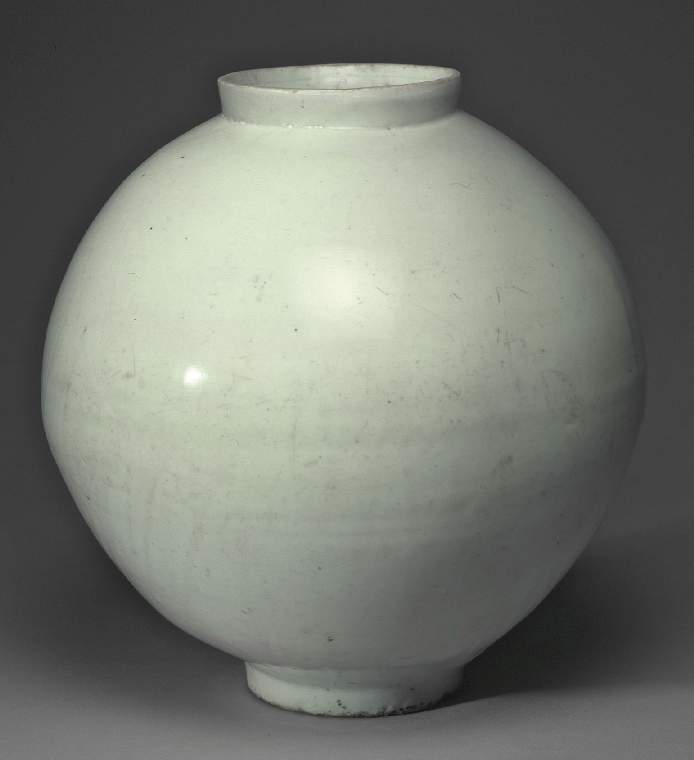
Korean porcelain vase,  Choson dynasty c. 1650-1700 
© Fitzwilliam Museum

This large 'moon jar' is one of my favourite pieces in the Fitzwilliam ceramics galleries. Unlike this photo,  it shines milky white and the lighting in its display case throws curving highlights on its sides. You can see the rivulets where the viscous white glaze has run down the sides and almost see the ridge where the two thrown hemispherical halves were joined together by the potter with wet clay when leather hard.  This matching would take very great skill, but any faults resulting in the firing were accepted in Korean philosophy as nature at work.   It represents the Confucian ideals of purity and simplicity which were admired by Choson scholars and courtiers - works of art which were in fact storage jars for rice or wine.  

This one below belonged to Bernard Leach and was a gift to Lucie Rie who kept it in her studio. It shows the firing faults of unevenness around the join, the grit particles in the glaze and specks of ash from the kiln, all features admired by the Koreans for the natural freedom of the firing process.  Few of this large size survived the firing stresses intact.


18th C. Choson glazed white porcelain moon jar  (ht. 47.5 cms)  acquired by Leach in Korea, 1935
© British Museum


These rare surviving Moon jars have inspired contemporary potters from Bernard Leach to Park Young-sook today, for their serenity and their technical challenge,  and there are several interpretations in the current Fitzwilliam ceramics exhibition, Things of Beauty Growing: British studio pottery .  


  Intertidal Jar, stoneware with Waun Llodi clay,  ht. 36 cm.    © Adam Buick  2011

Adam Buick now concentrates on the challenge of creating Moon jars ('hang-ari)  from small to large, using Pembrokeshire clays from near his studio, in close relation with the landscape.   He uses local earth and stone inclusions in both bodies and glazes,  often stones and seaweed collected from the beach, which fire with very unpredictable results. 

Moon jar,  ht. 27.5 cms.   Adam Buick, 2012
© British Museum 

The inclusion stripes in this modern pot are formed by rolling brown clay into the porcelain clay before throwing, so the stripes appear randomly as the moon jar is turning on the wheel.  Compare it with this medieval Chinese vase:

Chinese Song dynasty stoneware vase, c. 960-1279 
© Fitzwilliam Museum

The unusual striped decoration shows the ancient potter's varying control of the brush-strokes, reacting  to the momentum as the vase turns on the wheel.  It is displayed next a twentieth century piece -  William Staite Murray's tall striped vase, The Bather. 

The spacious exhibition explores modern studio pottery through the basic shapes of  vase, bowl, charger, and set, and also as monument,  as well as the different techniques and materials used.  

Halima Cassell is represented by The Virtue of Unity, a current work of 36 bowls,  using clays from around the globe, which she carves when just firmer than leather hard.  Each one is different, with an origami-like complexity of folds, and interchanging positive and negative spaces, as in printmaker M.C. Escher's optical illusions. These include apertures, some of which are only seen by the shadows the lighting casts around them.


Halima Cassell at work 


The Virtue of Unity    Halima Cassell  2009- 2017
(photo from studiopottery.co.uk)

The title of this major exhibition is taken from a the words of an interview with Michael Cardew (1901-1983). 

"…if you trust your material and you trust your instincts, you will see things of beauty growing up in front of you…"  Michael Cardew

[quoted from Simon Olding's review: see researchuca.ac.uk]


Friday, 9 February 2018

An emperor's collection: "rare as the stars of morning"


On the top floor of the British Museum is an amazing collection of the finest Chinese ceramics, many of them from the Imperial courts or the personal collections of Emperors themselves.  Some of the rarer pieces are Ru ware, from Northern kilns, which were only made for about forty years in the twelfth century AD, and were highly prized by connoisseurs, courtiers and scholars, as well as Emperors.  This piece is a cup stand from the Song dynasty, part of the collection of Sir Harry Garner and his wife; he was a government scientist whose hobby was the study of Chinese art and design.


Ru stoneware cup stand, N. Song dynasty 1090-1127.  © V&A Museum
This may have been to hold  a tea bowl; the emperor Huizong was a great tea connoisseur.

The Ru kilns were in Henan province, near the Northern Song capital of Kaifeng, and it is thought many of the master potters followed the court south to Hangzhou when Kaifeng fell to the mongolian Jin dynasty in 1127.

From the beginning, these Ru ware pots were rare and desirable, made specifically for the court of the Emperor Huizong, (AD 1100-1125) and even today there are less than 100 complete pieces in known collections, even after the discovery and excavation of the kiln sites near Baofengxian in 1987. They were admired for their finely potted hard bodies, often with the rim protected in smooth copper, and particularly their resemblance to magical jade.  The distinctive blue-green celadon colour was the result of ferrous oxide in the glaze, fired in a reducing atmosphere: the air holes to the kiln are blocked producing a smoky atmosphere and the fire draws its oxygen from the iron in the glaze, changing the colour in the process to cool grey-blues and greens. (Note that photographs of the same object vary in accuracy of tone.)  


Ru stoneware brush-washing dish, Northern Song (960-1127) © Rohsska Museum, Gothenburg

Most of the surviving pieces of Ru and other ancient wares reached the West through the efforts of Percival David, who persuaded the Chinese officials to let him curate and exhibit the Imperial ceramics in the neglected Forbidden City in the late1920s.  He returned in 1930 with a programme of exhibitions and catalogues and purchased any pieces he could which reached the antiquities market. In 1950 he gave his extensive ceramic collection to University College London for public education and research, and it is now on longterm loan to the British Museum.

This to me, is one of the stars in Percival David's collection, simply for itself, and then for its later connection with Hongli, the Qianlong Emperor from 1735-96.


Ru stoneware with celadon glaze and copper rim, from Qingliangsi, Northern Song c. AD 1086-1125
© Percival David Loan Collection,  Joseph Hotung Gallery, British Museum

These test samples for colour and kiln temperature show some of the difficulties of achieving perfect pieces in the temperamental medieval wood-fired kilns, with variable quality clays and glaze materials, relying on the expertise of the kiln master to control the temperatures and the reduction of oxygen over several days of firing.  Even stormy weather could ruin a whole kiln batch, as Bernard Leach discovered working with traditional methods in Japan.

Ru ware firing samples, designed to be strung together. c.1086-1125 
© Percival David Loan Collection, British Museum

The Emperor Hongli liked to add his thoughts and poems as inscriptions, making his mark on particular pieces in the Imperial collection (much of which was inherited from his father).  He promoted his image as a Confucian scholar and sage, a connoisseur collector of antiquities, as well as a wise, strong ruler.


The Qianglong Emperor in his study.   This portrait was painted for him by Guiseppe Castiglione, a Jesuit lay brother at the court.

Here is a translation of his inscription added to the Ru bowl above, in his collection:

"Many dishes have survived but bowls are difficult to find. In the palace alone are stored well nigh a hundred dishes. Yet bowls are as rare as stars in the morning.  What is there, forsooth, for which a cause cannot be found?  Large bowls are difficult to preserve, small dishes easy.  In this I find a moral and a warning.  The greater the object, the heavier the task for its care.  Composed by the Qianlong Emperor in the cyclical year bingwu ."  [AD1786].


Later inscription added in 1786 by Qianlong Emperor to Ru stoneware bowl shown above 
© Percival David Collection, B.M.

The other attraction of Ru and similar wares was the crackle in the glaze, described as "cracked ice" or "crab claw veins."  This crazing is technically a fault, caused by the glaze and body of the pot expanding and contracting at different rates in the kiln, but the Chinese potters were skilful enough to exploit it as a decorative technique, using several layers of glaze to help achieve it; other wares filled the cracks with dark stain for emphasis.  The other secret of the finest wares was the long grinding by hand of the glaze materials, even for two or three days.  It is this unpredictability of the materials and production methods which gives each piece its individuality, and explains why such a small number of perfect pieces were produced.  

Some coveted Ru wares and other celadons were exported to Korea, and then copied there.   A contemporary Korean scholar and official Yi Kyu-bo (1168-1241) describes the ceramic works near the capital Kaesong:

"The felling of trees left Mount Namsan bare and the smoke from the fires obscured the sun.
The wares produced were celadon bowls: out of every ten, one was selected - for it had the bluish green lustre of jade.
It was clear and bright as crystal, it was hard as rock.
With what skill did the potters work - it seemed as if they borrowed the secret from Heaven!"


 Ru ware from the Percival David Collection.  The central wine bottle is 20 cms. high  
© British Museum


Qianglong Emperor's inscription translation by R.L. Hobson, © Percival David Foundation.
Yi-Kyu-bo translation from Beth McKillop's "Korean Art & Design" © V&A Museum.

Monday, 4 September 2017

September: a visit to Constable country


Willy Lott's Cottage, Dedham Vale;  watercolour, grey ink   John Constable 1832  © British Museum 

Friday, 1st September
"A crisp, chilly morning, with that whiff of melancholy in the air.  Autumn is well on the way.  I would not mind if only I felt well, clear-headed and un-drugged.  Sisson* took me to Flatford Mill which the N.T. has acquired.  I love Constable, but I do not love this place.  It has been made a travesty of the totally unpretentious, rural, domestic scene of one of England's greatest painters.  Today the manor house is too picture postcardy for words.  Willy Lott's Cottage is abominably whimsy inside.  Sisson favours whitewashing or white painting all interior beams, I am glad to say. I concur with nearly all his ideas.  The Mill itself is still relatively unspoilt, and the island garden, with fat box hedges and old apple trees is full of charm.

We drove to Thorington Hall.  It has a rather neglected look, and the furniture inside -- well!  The house has had evacuees, and not been inhabited as a private house since the war, which explains much.

Thorington Hall's landmark octagonal, star-topped chimneys at Stoke-by-Nayland


Paycocke's House  elaborate carved frontage 

I left the Sissons after luncheon, and drove to Paycocke's, that hideously over-restored house in Coggeshall.  The tenants' bogus French furniture most inappropriate.  Sisson and I would like to whitewash all the harsh new brick nogging on the street elevation."

Prophesying Peace  James Lees-Milne 1944

Dedham Vale and Dedham Church  John Constable 1828 
© National Gallery of Scotland

Flatford Mill, Thorington Hall, and Paycocke's House in Coggeshall, near Colchester  were all acquired by the National Trust.  They represent the prosperity of the Stour and other  East Anglian river valleys where, like the medieval monks before them, Tudor butchers progressed from keeping  flocks of sheep to becoming wealthy cloth merchants, with river transport to major ports like Ipswich (where Cardinal Wolsey's father was a butcher-cum-grazier and merchant). By the eighteenth century cloth manufacture moved north and the cloth-fulling mills were converted to grain mills, like Flatford, where the Constable family farmed, and shipped their flour down to Pin Mill near Ipswich.


Dedham Lock and Mill   John Constable 1820  ©V&A Museum


*Marshall Sisson was an architect who lived in Shermans House in Dedham; in August the next year Lees-Milne stayed with the Sissons for the weekend:  "Sisson and I walked to Flatford Mill, where we watched the milling crowds bathing, running, jumping and enjoying themselves".  Prophesying Peace  1945  James Lees-Milne

Maybe they walked along Fen Lane, which was Constable's boyhood path from East Bergholt to school in Dedham?

Fen Lane, East Bergholt  John Constable 1817  © Tate Britain

Saturday, 12 November 2016

"She's a dish" ?

Shakespeare's Measure for Measure is a play full of moral ambiguity and vice, in which two virtuous women are threatened by hypocrisy and male power.  Isabella, a novice nun, must trade her virginity to save her brother's life,  while Mariana has been jilted for lack of her dowry, both at the mercy of Angelo, the outwardly upright Ducal deputy.
Elsewhere, Pompey the bawd, trying to make Mistress Overdone's brothel appear respectable to the officers,  describes how

 "..she came in…longing for stewed prunes.  Sir we had but two in the house, which at that very distant time stood, as it were, in a fruit-dish, a dish of some threepence; your honours have seen such dishes; they are not China dishes, but very good dishes."  Measure for Measure Act 2, sc, 1.


Small 'Kraak' porcelain dish,  imitated in blue and white Dutch delft   
© V&A Museum

The first recorded performance of  Measure for Measure was for the Christmas Revels of 1604.  Ever up to date, Shakespeare's "China dishes" would surely be recognised by his elite audience as a reference to the spectacular sale of Chinese porcelain in Holland from captured Portuguese carracks in 1602 and 1603. One cargo alone contained 50 tons or 100,000 pieces of Chinese export porcelain. Before this, Chinese porcelains were exotic rarities, owned only by royalty and the very wealthiest of courtiers and Levant merchants.

Pompey's "very good (threepenny) dishes" might have been pewter, but more likely Dutch 'delft' - imitations of the imported 'Kraak' i.e. carrack porcelains, made of tin-glazed earthenware - liquid resistant, shiny and colourful but prone to chip and crack.  Some immigrant Dutch potters were making basic tin-glazed earthenwares in London from 1570s (especially smooth tiles and jars for apothecaries). The Museum of London has a large collection, many found in pieces in old cesspits.  


                     3 rare survivals:  Tin-glazed drug pots, English or Dutch, c.1600-1650.  
                                                 © British Museum, London 

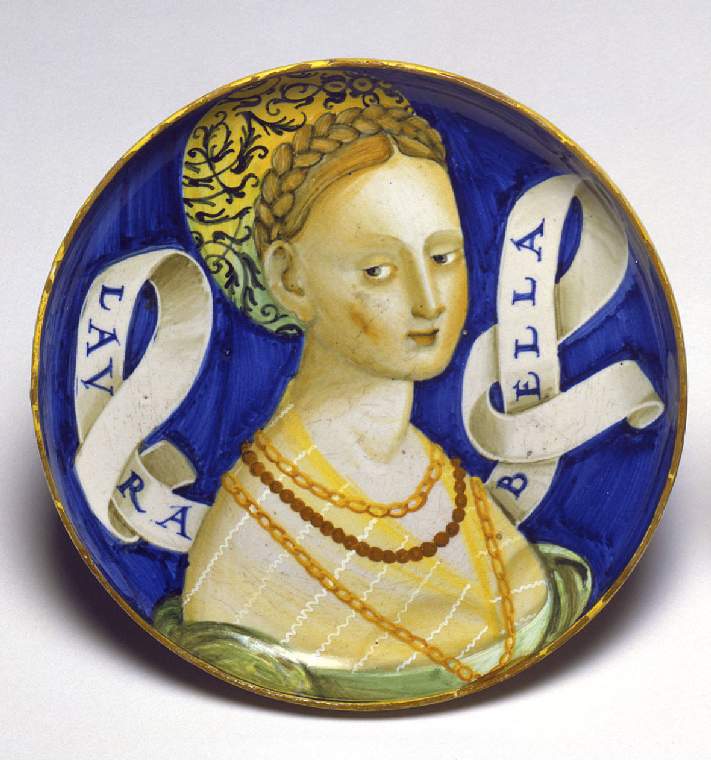
It was Italian potters who introduced the technique into Holland, for tin-glazing in Italy had reached a high art form in the early 1500s, with master potters decorating wares with scenes from history and classical myth in vivid colours (known as 'maiolica').  Popular display pieces were the coppe amatorie, stock  images of idealised beautiful women, inscribed with a name and flattering titles such as bella, diva, gracioza, galante.  

'Laura bella', shallow maiolica bowl on foot, Urbino or Casteldurante, Italy, c. 1525-35
© Fitzwilliam Museum


'Silvia diva mia bella' , Urbino or Casteldurante, Italy, c. 1540
© V&A Museum

A modern feminist take on these idealised  "fair women" has been created by the Boston-born book artist, Angela Lorenz in 1993,  in her set of 6 collagraphed paper plates, framed and stored in a slatted crate.  She now lives and works mainly in Bologna, and this piece was inspired by these 'Belle Donne' images.


She's a Dish: paper plates  © Angela Lorenz, National Art Library, V&A

The six paper plates are variously labelled:  
 "She is round. She is idealised. She hangs on the wall.
  She is not to be used. She is not disposable. She's a dish."

Angela Lorenz, from artist's book, 1993 


Angela Lorenz, from artist's book, 1993

Each 'She' is in fact a dish of collaged spaghetti, sealed with glue and inked in typical maiolica colours, making a relief print in the style of those Renaissance fair women, now captured in their 16th century ceramics in museums across the globe.

See Angela Lorenz's website: angelalorenzartistsbooks.com

Sunday, 14 August 2016

Poetry, Pots, and a Parson

North Devon is known for its large honey-coloured Harvest Jugs, particularly the boldly decorated, signed and dated ones from the eighteenth and nineteenth centuries.  The patterns and the inscriptions were widely copied and imitated, and inspire potters today.


Lead glazed slipware harvest jug, decorated with sgraffito, 1703 
© Fitzwilliam Museum

"now i am com for to Supply your workmen
when in harvist dry they do labor hard and sweat
good drink is better far than meat; in wintertime when it is coold
i Likewise then good drink can hold: booth seasons doe the same require,
and most men doe good drink desire"

These West Country harvest jugs are often decorated with tulips and other flowers, birds, unicorns, and, reflecting their coastal origins, ships, compasses, suns and mermaids.  There were thriving potteries in Barnstaple and Bideford, where the Burton Museum & Gallery has a magnificent collection of plain and fancy pots,  bequeathed by R.J.Lloyd.

Here are some more examples:

John Phillips, Bideford, 1780  © Trustees of the British Museum

"When I was in my native Place I was a lump of Clay
and Diged was out of the Earth and Brought from thence a Way,
but now I am a Jugg became by Potter's Art and Skiel
and now your Servant am Become and carry alle I will."

This one is much cruder, although the handle join is scrolled,  and its verse is more like a motto:

Slipware jug,  © Burton Museum, Bideford

"As A ring is round & hath no End
So is my Love Unto my Friend"

Others celebrate Ceres, Goddess of the harvest*, or the Barley Mow:


"harvest is come, all busy now
in making of the Barley mow
if you the Barley now neglect
you cannot then Good Ale Expect"
(signed T. Jones 1792)


Twentieth century and contemporary potters still create Harvest jugs in the traditional  North Devon style, often choosing inscriptions referring to their craft;  this verse was Michael Cardew's choice, in 1925:

"Despise me not because I'm made of clay -
But make me welcome when I come this way-
My belly fill with good strong punch (or beer) -
& I will make you merry all the year."


The inscriptions frequently are placed underneath the handle, which enlivens the simple flower pattern in this one below:


Devon Harvest Jug from Buckland Abbey, signed Abel Symons 1813
© National Trust/Lynda Aiano

Its inscription is the most interesting part of this grand jug, as it commemorates an old West Country ritual, "Crying the Neck".

"The Potter fashioned me complete, as plainly doth appear
for to supply the harvest men with good strong English beer.
Drink round my jolly reapers and when the corn is cut
we'll have the other jug - and cry A Neck A Neck."

As the last sheaf is cut (by hand) the reaper holds it aloft and cries " I 'ave un, I 'ave un". His fellows shout "What 'ave ee? What 'ave ee?" to which he replies "a Neck, a Neck" and  "Hurrah for the Neck! Hurrah!"  This age-old pagan custom was revived by the Old Cornwall Society (and see strawcraftsmen.co.uk),  but the churches' Harvest Festival tradition was begun in 1843, by the eccentric Parson Robert Hawker of Morwenstow, North Cornwall.

A poet, antiquarian (and opium smoker?), he built himself a tiny bothy (National Trust's smallest property), reached by a track along the cliff edge, where he could write and watch for ships in danger from the precipitous rocks at Hartland Point.

Hawker's driftwood hut © H. Bolton

 He rescued many seamen, and others are buried in the graveyard of his church of St John & St. Morwenna beside the vicarage at Morwenstow. It is worth exploring for its evocative headstones for the drowned sailors.  The Museum of Wrecks at Hartland Quay records the dangers of this coast, including an ill-fated aeroplane.


Hartland coastline  © H. Spurway

Parson Robert Hawker is best known for the Trelawney anthem,  --
"And shall Trelawney live? Or shall Trelawney die?  
Here's twenty thousand Cornishmen shall know the reason why!" --
which he published anonymously in 1825 as The Song of the Western Men, basing it on old Cornish ballads for a new literary audience. 

This is why the harvest jugs with inscriptions have so much more appeal for me, with their makers' initials and dates;  the earlier ones in particular are recording West Country oral history for us with all their craftsmen's skill.  This fine North Devon jug below is boldly decorated and glazed, but lacks the extra pleasure of these country rhymes saved by the potters.

 Harvest Jug, Barnstaple or Bideford, 1764 © V&A Museum

* see wikimedia for copyrights.

Friday, 6 May 2016

May: "The merry cuckoo, messenger of spring"

"The merry cuckoo, messenger of spring,
His trumpet shrill hath thrice already sounded."  Edmund Spenser

"What strikes me as strange, as I walk, cycle, or drive along the village lanes, and hear reed warblers singing from virtually every corner, is that I am not hearing another summer visitor; one intimately connected with this species.  In the time I have lived here, I have never once heard a cuckoo: a sound so closely associated with the coming of spring it is marked by annual letters to The Times newspaper.

"Sumer is icumen in, Lhude sing cuccu!"


Anon, Reading Abbey, early 13th C.  Harley Ms,  British Museum


Just after May Day, when the cuckoo's call should have been echoing across every village green in England, I  bump into a neighbour of ours, Mick.   He has spent his whole life in the parish, and his keen interest in birds makes him an oracle on changes in our local birdlife.  I ask him if there used to be cuckoos here. 'Cuckoos?' he replies incredulously. 'Cuckoos! They used to drive us mad with their calling!'

Yet Mick hasn't heard one in the village for a decade or more…..

The fate of the cuckoo in Somerset has been mirrored across much of lowland England, although the species does appear to be holding its own in Scotland, where cuckoos lay their eggs in the nests of meadow pipits, rather than reed warblers.  Why cuckoos have declined, and so precipitously, we are not entirely sure…..

What is certain though, is that if this decline continues, the cuckoo will eventually lose its place as the quintessential sign of the coming of spring.  I doubt very much if the children at our village school have ever seen or heard a cuckoo.  If they are aware of it at all, they probably place it in the same category as the dragon, the phoenix, and other mythical creatures.  In another decade or so, when cuckoos may well have disappeared from the whole of southern Britain, what will they mean to us then, beyond a set of old rural stories and sayings, growing less and less relevant as each year passes?"

Wild Hares and Humming Birds  Simon Moss

Sunday, 6 December 2015

A Cabinet of Collectors 1. Willam Courten, called Charleton


William Courten (1642-1702) in youth, c. 1655
© Trustees of British Museum

In March 1690, John Evelyn recorded that:

"I went againe to see Mr. Charleton's Curiosities both of Art & nature: as also his full & rare collection of Medails:  which taken alltogether in all kinds, is doubtless one of the most perfect assembly of rarities that can be anywhere seene:  I much admired the contortions of the Thea [tea] roote, which was so perplext, large & intricate, (& with all hard as box) that it was wonderful to consider:"


 Tea plant, from A Natural History of the Tea Tree  John C. Lettsom 1772

John Evelyn visited William Courten (known as Charleton) several times, to admire his collections of rare medals, paintings, books, shells, minerals and precious stones, plants and natural history specimens from across the globe, which he displayed for visitors in ten rooms in the Middle Temple. 


© Natural History Museum London

William may have changed his name to Charleton to distance himself from a long, contentious family lawsuit.  He became a wealthy merchant and travelled widely, as well as seeking rarities via his network of friends, including John Locke, whom he met in France in 1675.  In 1679 Locke replies from Paris to his friend Charleton in Montpellier:

   "However, I have got into my custody [for forwarding to London] that which I suppose you value most. i.e. six boxes of seds plants ett and one turned one wherein is a green Lizard,  and doubt not on twesday next to have the books at least all those that are not Contrabanded."

Locke gave him a recipe for preserving plants, and in 1685 Charleton is writing from London to Locke in Utrecht about his collection:

"I most heartily thank you for the acquisition you have made for me of 2 such great rarities as the clove, and cinnamon tree branches, and wish I had anything to make a return to the gentleman that gave them you;….'of doubles I have preserved in spirit of wine which I had at Montpellier (and as well conditioned as when first put into the glasses) a black, and grey scorpion*, a strange sort of locust, a large peice of chrystall with mosse in it, and a small parcel of rich silver ore'…


He also asks him to buy some desirable items:  " I heare there is lately a great Collection to be sold by auction at Amsterdam…amongst which are 2 Remoras if to be had at reasonable rates [20 shillings] I would willingly have them both, and what fine coloured Indian birds there may be…, the Insects that are Exotick of all kinds will be verry acceptable, espicially the great Phalangium [a venomous spider], the teeth of which are usually set in gold to make tooth picks of, the Tarantula of the spider* sort found in the Kingdome of Naples, for the other is a kind of Lizart and common all over Italy, the Stella arborescens [basket-fish] if to be meet with I should desire you to procure for me, amongst the seamen things may be had at easier rates than when they come into the possession of curious and knowing men…" 
*  Evelyn mentions 'the spider and bird, scorpion, other serpent &c.' after visiting in 1691.

Charleton sent some seeds also via a Dr Hans Sloane, which is probably how Locke too became friends with Sloane.   On his death in 1702, Charleton left all his collections to Sir Hans Sloane, and so they ended up now dispersed among the British Museum, the Natural History Museum, the British Library and elsewhere.

[see Biographia Britannica by Andrew Kippis 1725-1795, and Sachiko Kusukawa on www.cam.ac.uk/research.]
]

Thursday, 5 November 2015

A master potter's hand

When I saw the photo of this beautiful pot I immediately wanted to share it, and to handle it.  I love the glossy black slip, and the way it segues into that wonderful striped band, echoing the flow from the spout when in use.  It would not look out of place at the Contemporary Ceramics Centre or a West End gallery,  but it was excavated from the ancient city site of Kerma, in the Sudan, and was made some time between 2500 BC and 1450 BC.   


Spouted ceramic beaker from Kerma, Kingdom of Kush, 2500-1450 BC.
© Trustees of British Museum


[And see the British Museum blog by curator Anna Garnett: Linking Cultures, September 1st] 

Saturday, 13 September 2014

Saving Wedgwood 4: the enlightened Scotsman

"We walked hence to see the Palazzo Barberini, design'd by the now Pop<e>s Architect Cavaliere Bernini, & which I take to be as superb, and princely an object, as any modern building in Europ for the quantity:
…to this is annexed a Gallery completely furnish'd <with> whatsoever Art can call rare and singular, & a Library full of worthy Collections, Medails, Marbles, and Manuscripts;"

Diary entry, Rome,  November 1644, John Evelyn, (ed. E.S. de Beer)

Among the Collections, was a Roman blue glass cameo vase,  decorated with scenes in white relief,  dating from the reign of Augustus, which (already famous for its beauty and mystery) was acquired by the Barberini family in 1627.  Over a century and a half  later in 1780 it was sold to meet gambling debts and in turn was sold on by James Byres to Sir William Hamilton in 1783.

James Byres, the dealer and intermediary, was an architect, antiquarian and scholar from Aberdeen, whose family fled to France after the Jacobite rising, then living in Rome and leading English visitors around the sights.
 "My guide was Mr. Byres, a Scottish antiquary of experience and taste.  But in the
daily labour of 18 weeks the powers of attention were sometimes fatigued."   Memoirs  Edward Gibbon


Temple of the Sybil in Tivoli,  etching, G.& F. Piranesi, c. 1756


Byres made a serious study of Etruscan painted tombs, on which the Adam brothers drew for their fashionable neoclassical interiors. His scholarly and philosophical interests also stretched to fossils and volcanoes, interests he shared with Sir William Hamilton, and it was the influence of Byres's pioneering work that led Wedgwood to name his new factory "Etruria".

see:  The Portland Vase  Susan Walker © Trustees of the British Museum
and www.savewedgwood.org

Thursday, 11 October 2012

A new pen, 1947

"Do you notice any improvement in the writing done with the 'Biro' pen?   Jim tells me that he will never want to use any other kind.  It was invented during the war for the use of the RAF pilots whose pens failed to work sometimes at the high altitudes."

Herbert Brush,  Monday 2nd June 1947.

"I went to the British Museum and bought a 'Biro' pen on the way, after going into three shops where the pen was sold out as soon as they obtained a supply.  I have heard so many good accounts of it that I made up my mind to buy one and use it in my diary.  The pen runs well and seems to suit my style of writing, and goes very smoothly, no matter how hard I press."

Herbert Brush, Tuesday 15th July 1947.

Our Hidden Lives   The Remarkable Diaries of Post-War Britain  ed. Simon Garfield