Translate

Showing posts with label Bologna. Show all posts

Wednesday, 4 October 2017

October: John Evelyn - home thoughts from abroad

Friday 1st October 1943

"A taxi motored me to Wotton House where I lunched and spent the afternoon.  Today it belongs to John Evelyn, just as it belonged to the diarist John Evelyn in the seventeenth century.

  Pen drawing of Wotton House, by Evelyn 1640.  © British Library, Evelyn Archive

It is a long rambling, untidy house.  The nucleus of it is Jacobean, and a few rich doorways of that period survive upstairs.  But the present Evelyn's grandfather spoilt the house in every conceivable way in the 1870s. In the hideous Ruskin-style library are many rare books, including some 200 of Evelyn's own; also royal seals, miniatures and nineteenth-century busts.  There are innumerable family portraits , including three of John Evelyn, of which the Kneller is the most remarkable.


John Evelyn, c.1687  by Sir Godfrey Kneller  © The Royal Society 

There is a table carved by Grinling Gibbons, whom Evelyn discovered, and an Italian ebony cabinet* in which Evelyn's manuscript diaries were found.  The army have occupied most of the house during the war.  They allowed a fire to blacken the original door cases, walls and ceiling of the dining-room.  Could Evelyn have called in Wren to design this room?.  The garden, now a wilderness, has a mound cut into terraces by Evelyn, and below it a temple on Doric columns, which he built.  All the trees are magnificent, and the beeches are said to have been planted by him."

Ancestral Voices   James Lees-Milne 

John Evelyn travelled extensively in France and Italy as a young man during the Civil War.  In his Diary he records (exhaustively) all the palaces, gardens, churches and art treasures he saw in France and the great cities of Italy:  visiting Genoa, Pisa, Lucca, Florence, Leghorn, Rome and Naples. Full of interesting insights, describing the people and customs,  he only occasionally mentions the food and weather, unless it affected his progress. He travelled by coach, on horse-back, and felucca (subject to storms) and by horse-drawn barge and boat from Bologna and Ferrara along the Po marshes to embark for Venice.  From Venice he journeyed home via Switzerland (he was ill with smallpox in Geneva) and France, where he married the English ambassador's young daughter, Mary Browne, in June 1647.  He left Paris for Calais at the end of September 1647, where he had first arrived four years before, and reached London late on 2nd October.


John Evelyn in 1648  by Robert Walker  © National Portrait Gallery


Having only just returned myself from Bologna airport, after several long days of amazing sightseeing in the Emilia-Romagna, I was struck by this poem Evelyn wrote in Naples in February 1645, well before his travels were ended.  Was he remembering the tranquil family home and its gardens at Wotton? 

"I left this Ode, …as the Non ultra of my Travells; sufficiently sated with rolling up and downe, and resolving with my selfe to be no longer an Individuum vagum, if ever I got home againe;...

Happy the man who lives content
With his own Home, & Contintent:
Those chiding streames his banks do curb
Esteemes the Ocean to his Orb;
Round which when he a Walke dos take,
Thinks t'have perform'd as much as Drake:
For other tongues he takes no thought
Then what his Nurse or Mother taught:
He's not disturb'd with the Rude Cries
Of the Procaccio's Up & Rise;
But being of his Faire possess'd
From Travelling sets up his rest:
In her soft armes no sooner hurl'd
But he enjoys another World,
Scornes Us who Travell Lands & Seas,
Thinkes there's no countries like to his:
If then at Home, such Joyes be had,
Oh, how un-wise are We, how Mad!"

Diary of  John Evelyn  edited E.S. De Beer

*I wrote about Evelyn's Italian ebony cabinet in an earlier blog (Jan 2016): see  "A Collector's Cabinet"

Saturday, 12 November 2016

"She's a dish" ?

Shakespeare's Measure for Measure is a play full of moral ambiguity and vice, in which two virtuous women are threatened by hypocrisy and male power.  Isabella, a novice nun, must trade her virginity to save her brother's life,  while Mariana has been jilted for lack of her dowry, both at the mercy of Angelo, the outwardly upright Ducal deputy.
Elsewhere, Pompey the bawd, trying to make Mistress Overdone's brothel appear respectable to the officers,  describes how

 "..she came in…longing for stewed prunes.  Sir we had but two in the house, which at that very distant time stood, as it were, in a fruit-dish, a dish of some threepence; your honours have seen such dishes; they are not China dishes, but very good dishes."  Measure for Measure Act 2, sc, 1.


Small 'Kraak' porcelain dish,  imitated in blue and white Dutch delft   
© V&A Museum

The first recorded performance of  Measure for Measure was for the Christmas Revels of 1604.  Ever up to date, Shakespeare's "China dishes" would surely be recognised by his elite audience as a reference to the spectacular sale of Chinese porcelain in Holland from captured Portuguese carracks in 1602 and 1603. One cargo alone contained 50 tons or 100,000 pieces of Chinese export porcelain. Before this, Chinese porcelains were exotic rarities, owned only by royalty and the very wealthiest of courtiers and Levant merchants.

Pompey's "very good (threepenny) dishes" might have been pewter, but more likely Dutch 'delft' - imitations of the imported 'Kraak' i.e. carrack porcelains, made of tin-glazed earthenware - liquid resistant, shiny and colourful but prone to chip and crack.  Some immigrant Dutch potters were making basic tin-glazed earthenwares in London from 1570s (especially smooth tiles and jars for apothecaries). The Museum of London has a large collection, many found in pieces in old cesspits.  


                     3 rare survivals:  Tin-glazed drug pots, English or Dutch, c.1600-1650.  
                                                 © British Museum, London 

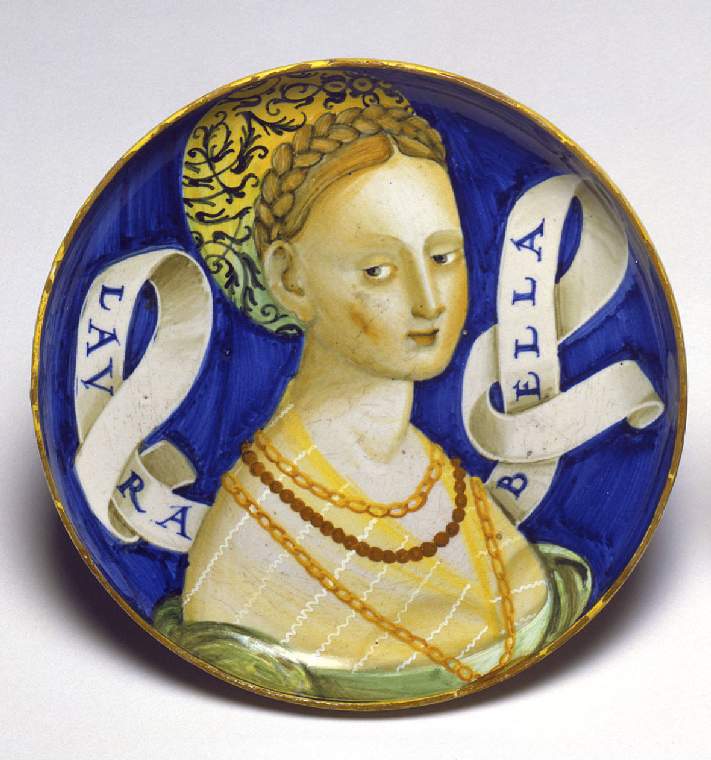
It was Italian potters who introduced the technique into Holland, for tin-glazing in Italy had reached a high art form in the early 1500s, with master potters decorating wares with scenes from history and classical myth in vivid colours (known as 'maiolica').  Popular display pieces were the coppe amatorie, stock  images of idealised beautiful women, inscribed with a name and flattering titles such as bella, diva, gracioza, galante.  

'Laura bella', shallow maiolica bowl on foot, Urbino or Casteldurante, Italy, c. 1525-35
© Fitzwilliam Museum


'Silvia diva mia bella' , Urbino or Casteldurante, Italy, c. 1540
© V&A Museum

A modern feminist take on these idealised  "fair women" has been created by the Boston-born book artist, Angela Lorenz in 1993,  in her set of 6 collagraphed paper plates, framed and stored in a slatted crate.  She now lives and works mainly in Bologna, and this piece was inspired by these 'Belle Donne' images.


She's a Dish: paper plates  © Angela Lorenz, National Art Library, V&A

The six paper plates are variously labelled:  
 "She is round. She is idealised. She hangs on the wall.
  She is not to be used. She is not disposable. She's a dish."

Angela Lorenz, from artist's book, 1993 


Angela Lorenz, from artist's book, 1993

Each 'She' is in fact a dish of collaged spaghetti, sealed with glue and inked in typical maiolica colours, making a relief print in the style of those Renaissance fair women, now captured in their 16th century ceramics in museums across the globe.

See Angela Lorenz's website: angelalorenzartistsbooks.com