Translate

Showing posts with label Simon Moss. Show all posts

Friday, 6 May 2016

May: "The merry cuckoo, messenger of spring"

"The merry cuckoo, messenger of spring,
His trumpet shrill hath thrice already sounded."  Edmund Spenser

"What strikes me as strange, as I walk, cycle, or drive along the village lanes, and hear reed warblers singing from virtually every corner, is that I am not hearing another summer visitor; one intimately connected with this species.  In the time I have lived here, I have never once heard a cuckoo: a sound so closely associated with the coming of spring it is marked by annual letters to The Times newspaper.

"Sumer is icumen in, Lhude sing cuccu!"


Anon, Reading Abbey, early 13th C.  Harley Ms,  British Museum


Just after May Day, when the cuckoo's call should have been echoing across every village green in England, I  bump into a neighbour of ours, Mick.   He has spent his whole life in the parish, and his keen interest in birds makes him an oracle on changes in our local birdlife.  I ask him if there used to be cuckoos here. 'Cuckoos?' he replies incredulously. 'Cuckoos! They used to drive us mad with their calling!'

Yet Mick hasn't heard one in the village for a decade or more…..

The fate of the cuckoo in Somerset has been mirrored across much of lowland England, although the species does appear to be holding its own in Scotland, where cuckoos lay their eggs in the nests of meadow pipits, rather than reed warblers.  Why cuckoos have declined, and so precipitously, we are not entirely sure…..

What is certain though, is that if this decline continues, the cuckoo will eventually lose its place as the quintessential sign of the coming of spring.  I doubt very much if the children at our village school have ever seen or heard a cuckoo.  If they are aware of it at all, they probably place it in the same category as the dragon, the phoenix, and other mythical creatures.  In another decade or so, when cuckoos may well have disappeared from the whole of southern Britain, what will they mean to us then, beyond a set of old rural stories and sayings, growing less and less relevant as each year passes?"

Wild Hares and Humming Birds  Simon Moss

Sunday, 3 April 2016

April swallows*

"As we head back home, the children trailing their bikes behind them, the sunlight catches a small bird as it flies over the grassy field by Perry Road. It is a shape at once familiar, yet strangely unfamiliar, for I haven't seen it for almost half a year.  It is a returning swallow: my first of the spring…..

Years ago I stood on the volcanic island of Surtsey, off the south coast of Iceland, an island so new that it didn't even exist when I was born.  As I tried to come to terms with this disconcerting notion, I saw a swallow hawking for insects under sunny blue skies.  It was a true pioneer -- swallows do not even nest in Iceland -- pushing the boundaries of its range to seek out new places to live and breed.


Surtsey Island

Over the years I have watched swallows crossing the Sahara Desert in Morocco, and the Negev Desert in Israel; alongside big game in the Masai Mara and Okavango Delta; at Cape May in New Jersey, and Punta Tombo in Patagonia.  In all these far-flung places I have experienced the same sense of wonder.  How can this tiny bird, weighing barely half an ounce, cross the world's continents with such ease?

 That same wonder grips me today, long after the swallow has flown out of sight; and I await with delicious anticipation the return of 'our' swallows, currently somewhere to the south.  One day, during the next week or two, I shall hear that familiar twitter, as they swoop down to land on the telegraph wires beside our home.

Later that day, as I collect the Sunday papers from the village stores, I mention my swallow; and am told that Mrs Puddy has beaten me to it, having seen her first swallow here on the first day of the month."

Wild Hares and Hummingbirds   Simon Moss

[*Browning's lines run: "And after April, when May follows, and the whitethroat builds, and all the swallows!"]

Monday, 1 February 2016

February in Somerset: Woeful and Joyful


"This is still, essentially, a landscape dominated by water in all its forms, eloquently described by local poet William Diaper, writing soon after the Great Storm of 1703:

'Eternal mists their dropping curse distill
And drizzly vapours all the ditches fill:
The swamp land's a bog, the fields are seas
And too much moisture is the grand disease.'

……..

Further along the rhyne I notice two smaller birds, diving down into the murky water, then bobbing up again like animated corks.  Even tinier than a moorhen or teal, these are our smallest waterbird, the little grebe or dabchick.

Dabchicks, as their name suggests, look rather like the offspring of a duck or moorhen; so tiny you cannot believe they are indeed full-grown. At this time of year they are greyish-brown with a fluffy white rear-end. But in a month or so they will moult into their handsome breeding garb: richer and darker, with a deep chestnut-brown neck, and the tiniest lime-green spot behind their bill, as if someone has daubed on a dash of luminous paint.  This is a colour rarely seen in nature, and all the more striking for that. 
……..

Being in one place is also the best way to understand the passing of the seasons: not the great shifts between winter and spring, summer and autumn, which we all notice; but the tiny, subtle changes that occur almost imperceptibly, from week to week, and day to day, throughout the year."

Wild Hares and Hummingbirds   Stephen Moss

Friday, 25 December 2015

Christmas Greetings


Best wishes for Christmas and the New Year


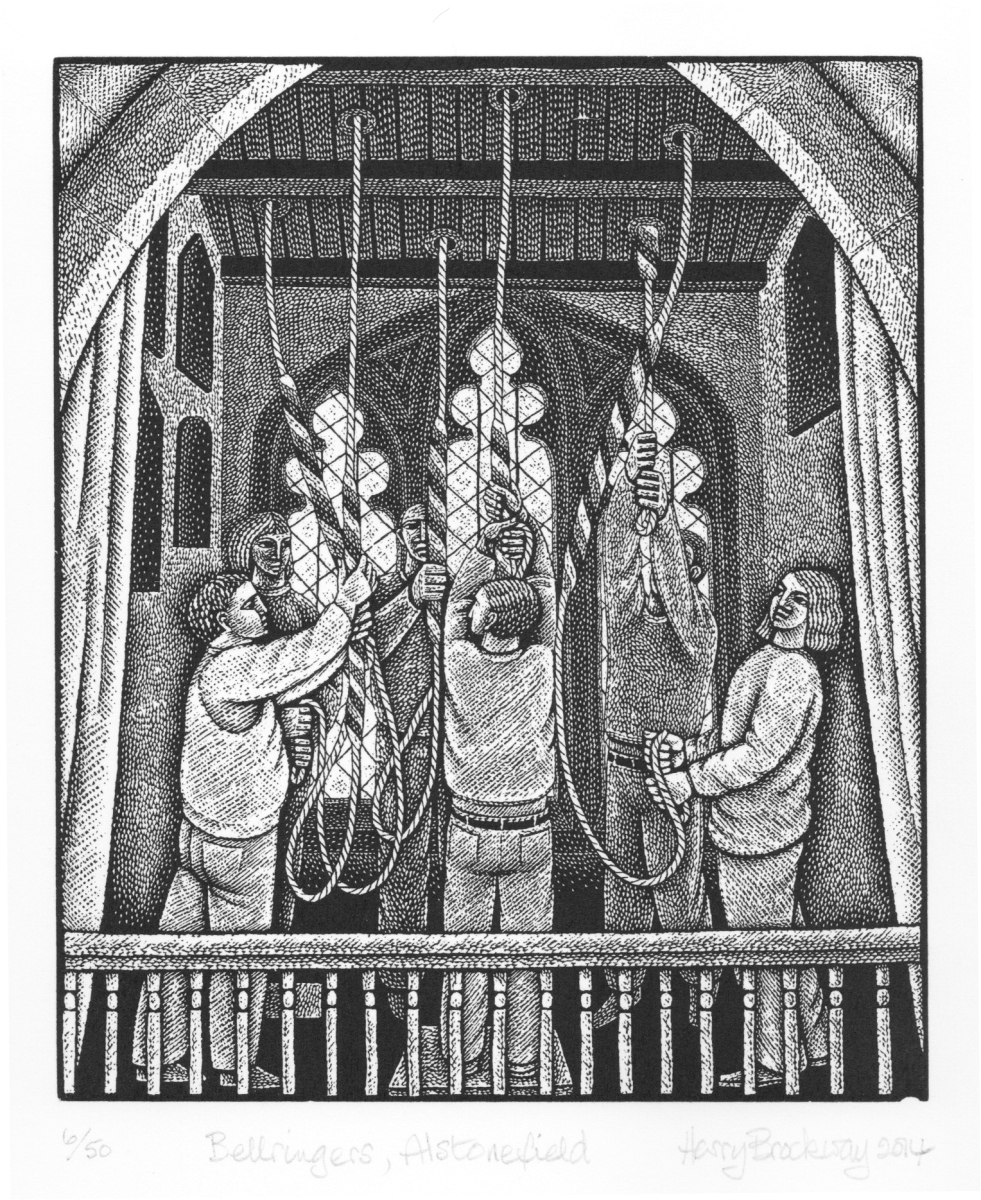
Harry Brockway's striking wood engravings head each monthly chapter of Wild Hares and Hummingbirds, by Simon Moss.  
This engraving of "Bellringers at Alstonefield" brings you all my seasonal greetings, and thanks for all your fascinating and entertaining blogs.

Tuesday, 1 December 2015

December - "a chord of starlings"

The coming of winter. From Wild Hares and Hummingbirds,  Simon Moss.

"The next morning Jack Frost has returned with a vengeance, and now the scenery really has turned whiter-than-white; white trees, white hedgerows, white grass, white roofs and white sky. This is landscape in crystal form, only punctuated by the staccato notes of black birds as they dash across the sky or gather in the fields: chords of starlings, followed by the occasional crow, jackdaw or rook.  And one brief splash of colour: a flock of goldfinches, whose crimsons and golds illuminate the landscape like a coloured frame added to an old black-and-white film.


Gwyngyed Mountain, Winter   Ogwyn Davies
©  University of Aberystwyth

Later, as the sun sets over Brent Knoll, a low ridge of colour hangs over the Mendips, while a darker, more menacing wave arrives from the west.  A strong, full moon begins to rise, gradually illuminating the flat, white landscape.  A lone buzzard perches on top of a hawthorn hedge, surveying his misty kingdom.  Apart from a distant dog barking, and the hum of the milking parlour at Perry Farm, all is quiet; when it is as cold as this, no bird will waste energy in song.  In the rhyne by the farm a lone heron stands rigid on the ice, as if fixed permanently to the spot.  On catching sight of me he has just enough energy to flap those huge rounded wings and fly away.  I hope he finds some water, somewhere in this frozen land.

Soft, ghostlike, the mist surges westwards from the darkness, creating a blanket of vapour over the layer of snow beneath, like a counterpane laid carefully over a duvet.  As it finally covers the land, the tops of trees and hedgerows poke out as if grasping towards the last few minutes of daylight, before they too are swathed in the mist."


Winter series  Wilhelmina Barns-Graham
© the Barns-Graham Charitable Trust

Tuesday, 3 November 2015

November in Somerset - Alfred's cakes and shamanic mushrooms

As I dipped into my monthly chapter of Stephen Moss's natural  history of a Somerset village,  I chanced upon his evocative description of woodland mushrooming and English fungi lore.  It also happily links my last two blogs.

"We are going on a fungal foray: to learn how to forage for free food, ideally without wending up in the local casualty department.
…We are walking through a dense woodland: little stands of oak and beech surrounded by great swathes of Norwegian spruce: the fast-growing, economically profitable 'Christmas tree' we know so well. Wildlife is thin on on the ground and hard to see among the dense, inky foliage. The only evidence that anything is here at all is the occasional snatch of sound: the trill of a wren, the peeping of gold crests and coal tits, or the harsh screech of a distant jay.  Closed, claustrophobic, this is not a place in which I feel at ease.

…We spread out through the woods like a police forensic team, carefuly scanning every inch of the ground in front of us.


Landscape of the Brown Fungus  Paul Nash, 1943
National Galleries of Scotland

Walking through the wood at such a slow, deliberate pace, changes the way you appreciate the landscape.  I begin to notice the patterns of the fallen beech leaves arranged in a random collage, ranging from chocolate-brown, through chestnuts, to buffs, yellows and the occasional tinge of lime-green, the summer shade retained even at this late stage of the year. The veins of the leaves overlap each other to make abstract patterns, intermingling with the greens of the surrounding brambles, ferns and moss.

Many fungi are picked, but few are chosen; and as Adrian [Boots] inspects our baskets he discards most of what we have found.  The temptingly named honey fungus is, he tells us, often sold in markets as an edible variety.  If you do eat it, you may get a nasty stomach upset, though it won't actually kill you.  Coral fungus does indeed resemble bright orange corals -- you wouldn't want to eat it, even if you could.

The edible varieties bear out Adrian's warning that appearance cannot be used as a guide to safe eating, as they could hardly be more different from one another. … We find wood blewits and a beautiful orangey-yellow chanterelle, which when gently squeezed emits a delicate scent of ripe apricots.

….Another fungus rich in folklore, though not edible, is King Alfred's cakes -- so called because when you cut open these hard little lumps they look as if they are burnt inside, a feature which would have reminded our ancestors of the famous royal cake-burning incident that took place a few miles south of here.

Daldinia Concentrica, Alfred's cakes, or coal fungus - cross section
© see Woodlands.co.uk
Just before lunchtime, we come across what looks like a cluster of bright red apples strewn across the forest floor,  these are fly agaric, whose name comes from its traditional use as an insecticide.  However, its main claim to fame is that indigenous people across Siberia have historically used it for its hallucinogenic properties, as part of their shamanic traditions.

We decide against trying to recreate this ancient practice.  Instead, Adrian heats up his Primus stove, chops up the few edible fungi we have managed to gather together, and sautes them in a mixture of butter and oil….

As we eat,  Adrian tells us about the complex relationship between trees and fungi.  Tree roots are not very good at obtaining nutrition, so they use the networks of underground fungi to do it for them.  What we see on the surface -- the fruiting bodies we call mushrooms and toadstools --are but a tiny fraction of what lies out of sight, beneath the soil.  The time and effort it has taken us to collect this meagre offering is a salutary reminder of just how tough life was for our hunter-gatherer ancestors; and how good they must have been at knowing where to look and what to pick...

By late afternoon the light has turned soft and even as it percolates through the trees, and the smell of woodland begins to intensify: a not unpleasant blend of dampness and decay.  As we return to the warmth of the Swan Inn [at Rowberrow] for a welcome pint, a solitary raven croaks unseen overhead; reminding us of the wilderness we have shared with nature for the past few hours."


November Moon   Paul Nash, 1942
Fitzwilliam Museum © Estate of Paul Nash