Translate

Showing posts with label Michael Cardew. Show all posts

Sunday, 22 April 2018

Celestial bodies: "…things of Beauty Growing... " Michael Cardew


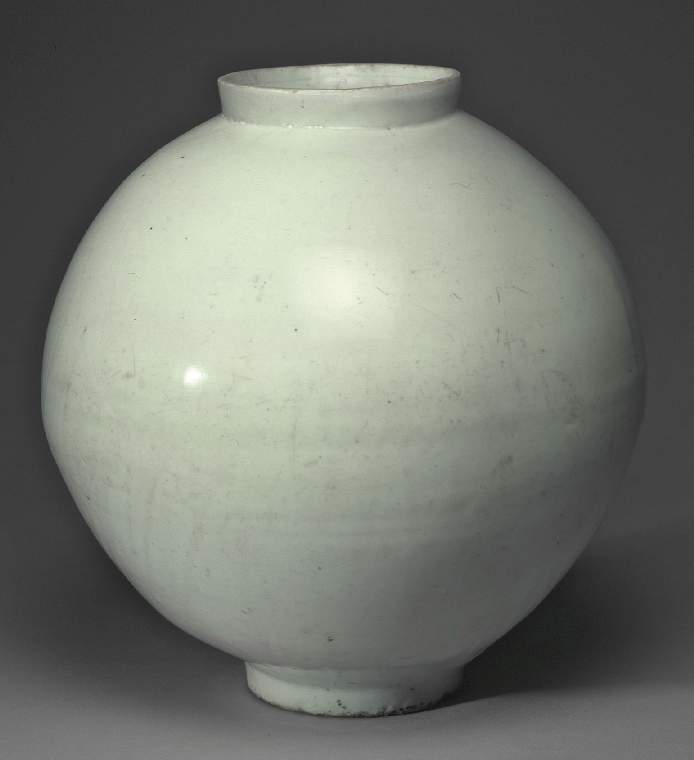
Korean porcelain vase,  Choson dynasty c. 1650-1700 
© Fitzwilliam Museum

This large 'moon jar' is one of my favourite pieces in the Fitzwilliam ceramics galleries. Unlike this photo,  it shines milky white and the lighting in its display case throws curving highlights on its sides. You can see the rivulets where the viscous white glaze has run down the sides and almost see the ridge where the two thrown hemispherical halves were joined together by the potter with wet clay when leather hard.  This matching would take very great skill, but any faults resulting in the firing were accepted in Korean philosophy as nature at work.   It represents the Confucian ideals of purity and simplicity which were admired by Choson scholars and courtiers - works of art which were in fact storage jars for rice or wine.  

This one below belonged to Bernard Leach and was a gift to Lucie Rie who kept it in her studio. It shows the firing faults of unevenness around the join, the grit particles in the glaze and specks of ash from the kiln, all features admired by the Koreans for the natural freedom of the firing process.  Few of this large size survived the firing stresses intact.


18th C. Choson glazed white porcelain moon jar  (ht. 47.5 cms)  acquired by Leach in Korea, 1935
© British Museum


These rare surviving Moon jars have inspired contemporary potters from Bernard Leach to Park Young-sook today, for their serenity and their technical challenge,  and there are several interpretations in the current Fitzwilliam ceramics exhibition, Things of Beauty Growing: British studio pottery .  


  Intertidal Jar, stoneware with Waun Llodi clay,  ht. 36 cm.    © Adam Buick  2011

Adam Buick now concentrates on the challenge of creating Moon jars ('hang-ari)  from small to large, using Pembrokeshire clays from near his studio, in close relation with the landscape.   He uses local earth and stone inclusions in both bodies and glazes,  often stones and seaweed collected from the beach, which fire with very unpredictable results. 

Moon jar,  ht. 27.5 cms.   Adam Buick, 2012
© British Museum 

The inclusion stripes in this modern pot are formed by rolling brown clay into the porcelain clay before throwing, so the stripes appear randomly as the moon jar is turning on the wheel.  Compare it with this medieval Chinese vase:

Chinese Song dynasty stoneware vase, c. 960-1279 
© Fitzwilliam Museum

The unusual striped decoration shows the ancient potter's varying control of the brush-strokes, reacting  to the momentum as the vase turns on the wheel.  It is displayed next a twentieth century piece -  William Staite Murray's tall striped vase, The Bather. 

The spacious exhibition explores modern studio pottery through the basic shapes of  vase, bowl, charger, and set, and also as monument,  as well as the different techniques and materials used.  

Halima Cassell is represented by The Virtue of Unity, a current work of 36 bowls,  using clays from around the globe, which she carves when just firmer than leather hard.  Each one is different, with an origami-like complexity of folds, and interchanging positive and negative spaces, as in printmaker M.C. Escher's optical illusions. These include apertures, some of which are only seen by the shadows the lighting casts around them.


Halima Cassell at work 


The Virtue of Unity    Halima Cassell  2009- 2017
(photo from studiopottery.co.uk)

The title of this major exhibition is taken from a the words of an interview with Michael Cardew (1901-1983). 

"…if you trust your material and you trust your instincts, you will see things of beauty growing up in front of you…"  Michael Cardew

[quoted from Simon Olding's review: see researchuca.ac.uk]


Sunday, 14 August 2016

Poetry, Pots, and a Parson

North Devon is known for its large honey-coloured Harvest Jugs, particularly the boldly decorated, signed and dated ones from the eighteenth and nineteenth centuries.  The patterns and the inscriptions were widely copied and imitated, and inspire potters today.


Lead glazed slipware harvest jug, decorated with sgraffito, 1703 
© Fitzwilliam Museum

"now i am com for to Supply your workmen
when in harvist dry they do labor hard and sweat
good drink is better far than meat; in wintertime when it is coold
i Likewise then good drink can hold: booth seasons doe the same require,
and most men doe good drink desire"

These West Country harvest jugs are often decorated with tulips and other flowers, birds, unicorns, and, reflecting their coastal origins, ships, compasses, suns and mermaids.  There were thriving potteries in Barnstaple and Bideford, where the Burton Museum & Gallery has a magnificent collection of plain and fancy pots,  bequeathed by R.J.Lloyd.

Here are some more examples:

John Phillips, Bideford, 1780  © Trustees of the British Museum

"When I was in my native Place I was a lump of Clay
and Diged was out of the Earth and Brought from thence a Way,
but now I am a Jugg became by Potter's Art and Skiel
and now your Servant am Become and carry alle I will."

This one is much cruder, although the handle join is scrolled,  and its verse is more like a motto:

Slipware jug,  © Burton Museum, Bideford

"As A ring is round & hath no End
So is my Love Unto my Friend"

Others celebrate Ceres, Goddess of the harvest*, or the Barley Mow:


"harvest is come, all busy now
in making of the Barley mow
if you the Barley now neglect
you cannot then Good Ale Expect"
(signed T. Jones 1792)


Twentieth century and contemporary potters still create Harvest jugs in the traditional  North Devon style, often choosing inscriptions referring to their craft;  this verse was Michael Cardew's choice, in 1925:

"Despise me not because I'm made of clay -
But make me welcome when I come this way-
My belly fill with good strong punch (or beer) -
& I will make you merry all the year."


The inscriptions frequently are placed underneath the handle, which enlivens the simple flower pattern in this one below:


Devon Harvest Jug from Buckland Abbey, signed Abel Symons 1813
© National Trust/Lynda Aiano

Its inscription is the most interesting part of this grand jug, as it commemorates an old West Country ritual, "Crying the Neck".

"The Potter fashioned me complete, as plainly doth appear
for to supply the harvest men with good strong English beer.
Drink round my jolly reapers and when the corn is cut
we'll have the other jug - and cry A Neck A Neck."

As the last sheaf is cut (by hand) the reaper holds it aloft and cries " I 'ave un, I 'ave un". His fellows shout "What 'ave ee? What 'ave ee?" to which he replies "a Neck, a Neck" and  "Hurrah for the Neck! Hurrah!"  This age-old pagan custom was revived by the Old Cornwall Society (and see strawcraftsmen.co.uk),  but the churches' Harvest Festival tradition was begun in 1843, by the eccentric Parson Robert Hawker of Morwenstow, North Cornwall.

A poet, antiquarian (and opium smoker?), he built himself a tiny bothy (National Trust's smallest property), reached by a track along the cliff edge, where he could write and watch for ships in danger from the precipitous rocks at Hartland Point.

Hawker's driftwood hut © H. Bolton

 He rescued many seamen, and others are buried in the graveyard of his church of St John & St. Morwenna beside the vicarage at Morwenstow. It is worth exploring for its evocative headstones for the drowned sailors.  The Museum of Wrecks at Hartland Quay records the dangers of this coast, including an ill-fated aeroplane.


Hartland coastline  © H. Spurway

Parson Robert Hawker is best known for the Trelawney anthem,  --
"And shall Trelawney live? Or shall Trelawney die?  
Here's twenty thousand Cornishmen shall know the reason why!" --
which he published anonymously in 1825 as The Song of the Western Men, basing it on old Cornish ballads for a new literary audience. 

This is why the harvest jugs with inscriptions have so much more appeal for me, with their makers' initials and dates;  the earlier ones in particular are recording West Country oral history for us with all their craftsmen's skill.  This fine North Devon jug below is boldly decorated and glazed, but lacks the extra pleasure of these country rhymes saved by the potters.

 Harvest Jug, Barnstaple or Bideford, 1764 © V&A Museum

* see wikimedia for copyrights.