Translate

Showing posts with label Holbein. Show all posts

Thursday, 28 February 2019

Masters of manipulation -- seeing backwards


  The Ambassadors   Hans Holbein the Younger 1533  © National Gallery London

I hate being manipulated which is why I tend to avoid internet social media, but fine artists do this all the time, manoeuvring light, colour and perspective, often in a way of which we are not aware, and at other times obviously, creating an unreal optical illusion.  Holbein's painting of The Ambassadors* is one well-known example, with its foreground tilted skull, which changes as the viewer moves position before it.

Rene Magritte's paintings do this, unsettling the boundaries between logical reality and illusion with a visual paradox.  This is a very clear example:

  The Blank Signature   Rene Magritte 1965  © National Gallery of Art, USA

This is an example of a blivet or Schuster's Fork, an optical puzzle written about in engineering and science fiction magazines of the mid-1960s, and named after D. H. Schuster from his article in The American Journal of Psychology in 1964:
How a blivet works

I have always been puzzled by this painting of Walter Sickert's with the bars of the iron bedstead.

La Hollandaise (the Dutch Girl)  W. R. Sickert 1906  © Tate Gallery London

Sickert uses flashes of light contrasting with the dark to manipulate the perspective, as in the right foot, and are they bars or shadows across the womans' head?

This reminds me of some of Lucian Freud's paintings and drawings.  I am sure one of his earlier works shows a clearly drawn birdcage, in which some of the bird's body is outside the bars while the rest is inside the cage.  Frustratingly I cannot find this image, but he also manipulates the viewer's expectations in his choice of  subject:.


Chicken in a bucket  Lucian Freud  1944  (Wikimedia)

 and this beautifully observed back half of a horse:


Horse,  Lucian Freud  (Wikimedia)

Freud shared a love of horses with the subject of this portrait, Brigadier Parker-Bowles, but look how he has angled the obscured front leg of the chair on the line of contrast between dark and light, suggesting an unsettling tilt, and a sense of energy in the sitter:
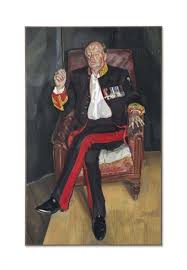
The Brigadier  Lucian Freud 2003-4  (wikimedia)

And this famous French impressionist painting is not at all as straightforward as it immediately seems:


A bar at the Folies-Bergere, Edouard Manet 1882  © Courtauld Gallery London

We look straight ahead at the barmaid in front of us, as if she and the viewer are standing in front of a large mirror, but is this so?  Her reflection is at such a sharp angle,  as are the bottles of champagne on the marble top,  and where is that gentleman customer? Are these actually reflected, or are we looking at a whole other scene behind her?    
"Yet one of the reasons the picture appeals as much as it does is that the spectator wobbles delightfully between looking forwards and seeing backwards."  Jonathan Miller, On Reflection,  National Gallery 1998

*see the detailed comments at artsy.net

Wednesday, 1 March 2017

March: Art treasures in Warwickshire


Upton House, near Banbury
Friday, 1st March 1946:

"I reached Upton [House, Warwickshire] at 6.30 to stay the night with the Bearsteds.  He and Lady B. both charming, with unassuming manners of the well-bred.  Hubert Smith arrived just in time for dinner, his car having broken down.

At midnight Lord B. took me round the house. Inside there is nothing of consequence architecturally save a  few early eighteenth-century chimneypieces and a beautiful Coleshill-style staircase, rearranged by Lord B. and extended.  Morley Horder, architect, built on to the house in the 1920s.  But heavens, the contents!  There is a lot of good Chippendale-style furniture and some marvellous Chelsea china of the very best quality.  It was badly packed away during the war when the house was occupied by a bank, and some on unpacking found to be damaged.  The picture collection superb, as fine as any private collection in England.  Many of the pictures are not yet back from the Welsh caves where they were stored with the National Gallery pictures.

It is only the garden he is offering with the house, but he wishes to include all the works of art.  So does his son who is to inherit."
Caves of Ice     James Lees-Milne, 1946


Upton House from the south  Anthony Devis c. 1784  © National Trust


View of the gardens and park

Lord Bearsted and his sister Mrs Nellie Ionides* were both great art collectors, as was their father Marcus Samuel the 1st Viscount, co-founder of the Shell Oil company.    Walter Samuel Bearsted, 2nd Viscount, acquired Upton House in 1927 and began remodelling it.  The wonderful art on display  includes original paintings for Shell Oil posters by well known British artists.   Here are just two:

 Farmers Use Shell    John Armstrong  1939 
© artist's estate  (Shell Art Collection loan) 


Charwomen Use Shell    Edward Ardizonne  1938
© artist's estate (Shell Art Collection loan)


Walter Samuel Bearsted was a  trustee of the National Gallery and the Tate Gallery, and Chairman of the Whitechapel Gallery;  both he and his son Richard wanted to bequeath the family collection to the National Trust.

The range and quality of the collection, which includes works by Stubbs, Hogarth, Brueghel, Canaletto, Tiepolo, Van der Goes - the list goes on, and many more can be seen at artuk.org.  Here are just three of nearly 200 paintings, selected almost at random.  


Crossing the Ford     Thomas Gainsborough c. 1750     © National 'Trust


Young man with a Pink     Hans Holbein the Younger 1533    © National Trust


Love among the Ruins   Edward Burne-Jones* 1894  © National Trust
*Burne-Jones was a friend of Nellie Ionides' father in law, Luke Ionides, and painted his sister, her husband Basil's Aunt Aglaia.

Friday, 4 March 2016

A Cabinet of Collectors 8: Olga Hirsch

A Wrapped-up Story

Card games were a very popular pastime at the Tudor courts.  Anne of Cleves reportedly entertained Henry VIII on their unconsummated wedding night by playing cards with him.


 Anne of Cleves, portrait miniature by Hans Holbein c. 1539
© Victoria & Albert Museum

Worn and dog-eared cards could be recycled.  Holbein's lovely portrait of Anne, like so many miniatures of the period, is painted on vellum and backed with a piece cut from a playing card.

The printing centres of Germany and then France led the market in early woodblock printed and hand painted playing cards, for which several layers of paper were glued together (i.e. pasteboard).

The Queen of Hearts, from Jehan Personne, 1493
(see The World of Playing Cards)

The last sheet might be folded over the front edges for strength, and some were backed with block-printed decorated papers.  To make full use of their printing blocks,  factories in Germany, Holland and Austria would use the same woodblocks to print fabric, paper, and even to stamp the baker's bread, which would then be wrapped in those decorated printed papers.

But the main uses of printed decorated papers, besides wrapping goods, was by publishers and booksellers.  Books were frequently sold just with protective paper covers, for owners to have bound to their own choice, and marbled papers, introduced into England by John Evelyn, are still the classic choice as endpapers.  Decorated printed papers were also ideal for books of non-standard sizes, such as music scores, and this is how the British Library's remarkable collection of decorative printed papers began.

Olga Hirsch began accumulating antique printed papers for repairing her husband Paul Hirsch's collection of rare music scores and literature*, and then started to collect them for their own sake.  She sought out examples of different techniques -- block printing, metallic, embossed, stencilled and pasted papers - from different countries and periods from the 16th to the 20th century.  Her collection of 3500 decorated papers, as well as many book examples and reference material, was bequeathed to the British Library in1968, outstripping most other international collections.
* Her husband's unique music library bought by the British Museum in 1946.


 Scrotted marbled paper, early 19th century
National Library of the Netherlands

French block printed paper, Olga Hirsch collection

Mid-19th century rococo style, with gold and colour blocking
Olga Hirsch collection


Japanese 19th century katagami (stencil cut) paper
© British Library, Olga Hirsch collection

The Hirsches, like Anne of Cleves and Holbein the Younger, were also foreign migrants from Germany, settling in Britain, and remembered in our national collections.  And it is by the circuitous  influence  of old recycled paper, that an American migrant artist, James Whistler, created one of our iconic views of the Thames, now in the Tate Gallery.

Nocturne: Blue and Gold, Old Battersea Bridge
James McNeill Whistler  © Tate Britain


Whistler and his contemporaries were inspired by the work of Hokusai, master of woodblock prints, discovered in Paris by Felix Braquemond in 1856.  Copies from Hokusai's sketchbook were being used as wrapping paper, protecting shipments of Japanese export porcelain.


 Mishima Pass,  Mount Fuji,   Katsushiga Hokusai  c. 1830-32
© Metropolitan Museum of Art