Translate

Showing posts with label Horace Walpole. Show all posts

Sunday, 30 April 2017

May in Norfolk: dangerous ladies


Blickling Hall, Norfolk  © National Trust

Thursday, 1st May, 1947

"It is May Day and pouring and blowing icily.  Stopped at Cawston church to gaze my fill at the fourteenth-century roof and painted panels of saints on the screen.   At Blickling made my peace with the caretakers and Miss O'Sullivan who is always nice to me. Alec* came over and had some useful suggestions for arranging furniture.  The rooms now filled do not look any more beautiful because the furniture is on the whole poor. The house was today open for the first time, and only twenty people came. So we need not have fussed ourselves."  (*Alexander Penrose)

Caves of Ice  James Lees-Milne, 1947

Blickling Hall (built 1616) was one of Lees-Milne's favourite houses, although when he visited in May 1942 the RAF were occupying the house, not without causing some damage,  and a sea of Nissen huts was in the grounds.  In 1984 he met the teenage actors who were performing a play to celebrate the National Trust's acquisition of Blickling from Philip Kerr, 11th Marquess of Lothian,  in 1941.  "I am apparently the only person left who remembers Lord Lothian, [Donald] Matheson and the place in pre-war days." 

Although few people would have recognised it, Blickling Hall was seen in cinemas across England in 1945 and 46 when its exterior was used to represent "Maryiot Cells", the Buckinghamshire home of scandalous "Lady Skelton".  This was Margaret Lockwood's iconic film with James Mason, The Wicked Lady, in which the heroine sheds corsets and morals and turns highwayman herself.  Audiences both sides of the Atlantic were shocked and enthralled by their favourite stars in this period drama.

Gainsborough Film Studio poster c. 1945


Publicity film still for  "The Wicked Lady" (*from a story by Magdalen King-Hall)
 with Margaret Lockwood and James Mason

A more famous and charismatic lady associated with Blickling Hall is Anne Boleyn, as it was the home of her father Sir Thomas Boleyn, and Anne is thought to have been born there (around 1504)  although at that period Blickling Hall was still a moated late-medieval manor house.

Drawing of Queen Anne by Hans Holbein, © Royal Collection

Most of the contemporary portraits of Anne were destroyed after her death, and the accuracy of later paintings is open to doubt.  This miniature portrait was in the collection of Horace Walpole, at Strawberry Hill, when it was thought to represent Queen Katharine of Aragon.


Possibly Anne Boleyn, c. 1532-3  Lucas Hornbout
© 9th Duke of Buccleuch Trust


Returning to her childhood home, Anne is believed to haunt Blickling on May 19th, the date of her execution in 1536, carrying her bloody head with her.  She is driven, it is said, in a coach with flaming headless horses and driver; meanwhile, her over-ambitious father, Thomas Boleyn, later himself executed for his political scheming,  is condemned on the same night to cross a dozen bridges before cockcrow, driving from Blickling to Wroxham, every year for a thousand years.


View of the South Front  Entrance   © National Trust

Blickling is also famous for its Library, the collection of Sir Richard Ellys, which was brought to the House in 1740.  Among its 12,500 volumes are sure to be histories of the House and Estate, its famous occupants, and its ghosts.
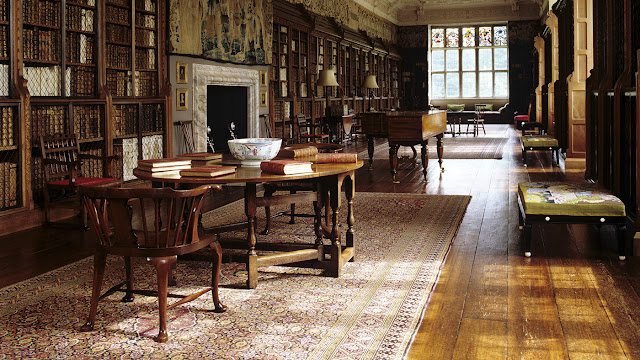

The Library in the Long Gallery at Blickling
© National Trust

Today the gardens at Blickling are as beautiful as the house:  

"The first sight of the entrance front from the public road is so famous and breathtaking that every passing motorist halts instinctively to take a longer look.  But the secret of the place is only discovered late in the day among the trees and flowering shrubs that stretch upwards from the east side of the house.  Never has there been a garden quite like it, not at least since the eighteenth century,…Great arches of beech and oak form choirs and aisles, and under them grow azaleas, rhododendron, magnolias and wild bluebell."  Nigel Nicolson, 1978


Thursday, 12 November 2015

New Spring Gardens, Vauxhall

As the dark evenings draw in, I thought it would be pleasant to remember the charms of summer with this view of the famous Vauxhall Gardens, especially for anyone queueing for buses or fighting onto trains at Vauxhall in the rush hour today. 


Grand Walk at Vauxhall Gardens   Antonio Canaletto 1751
© see Public Catalogue Foundation

Visitors in the eighteenth century also complained about the traffic congestion, whether they came across the Thames by horse-ferry or drove all the way to London Bridge or darkest Putney --and still, after Westminster Bridge was built in 1750, "the tide and torrent of coaches was so prodigious" complained  Horace Walpole in 1769.  He and his friend, after much delay, ...."then alighted; and after scrambling under bellies of horses, through wheels, and over posts and rails, we reached the gardens where there were already many thousand persons".  They were "rejoiced to come away, though with the same difficulties as at our entrance; for we found three strings of coaches all along the road, who did not move half a foot in half-an-hour."


The gardens brought the arts and culture as well as entertainment to the general public, as in this engraving showing the iconic statue of Handel ( of 1738) which graced the entrance.  Horace Walpole's older brother was in part responsible, for when a young immigrant artist found Sir Edward Walpole's wallet on leaving the Gardens and returned it to him, Sir Edward found him a post working for the leading sculptor of the day, Henry Cheere.  The young immigrant, Louis Francois Roubiliac, who created this inventive portrait of the great composer,  soon became known for his celebrity portrait busts and monuments, which now grace Westminster Abbey, churches, universities  and many museums and institutions.

Tom,  Jerry and Logic enjoying Vauxhall,
from Pierce Egan's "London Life" 1823,   © British Library

Vauxhall Gardens went in and out of fashion, with a range of entertainments, attracting the great, including royalty, and the less great, as George Cruikshank's comic illustration shows.  Perhaps James Boswell's  comment sums up the Gardens' long lasting appeal:

"Vauxhall Gardens is peculiarly adapted to the taste of the English nation: -- there being a mixture of curious show, -- gay exhibition, musick, vocal and instrumental, not too refined for the general ear;- for all which only a shilling is paid.  And, though last, but not least, good eating and drinking for those who wish to purchase that regale."    

Thursday, 4 December 2014

Mr Chevenix's library

'It is a little plaything-house that I got out of Mrs. Chevenix's shop, and it is the prettiest bauble you ever saw.
…..the Chevenix's have tricked it out for themselves; up two pair of stairs is what they call Mr. Chevenix's library, furnished with three maps, one shelf, a bust of Sir Isaac Newton, and a lame telescope without any glasses. ...

….For the rest of the house, I could send it to you in this letter as easily as the drawing, only that I should have nowhere to live till the return of the post."

Letters  Horace Walpole to Horace Mann,  June1747

Thursday, 5 June 2014

Ghosts at Ham

"I went yesterday to see my niece in her new principality of Ham.  It delighted me and made me peevish.  Close to the Thames in the centre of all rich and verdant beauty, it is so blocked up, barricaded with walls, vast trees, and gates, that you think yourself a hundred miles off and a hundred years back.  The old furniture is so magnificently ancient, dreary, and decayed, that at every step one's spirits sink, and all my passion for antiquity could not keep them up.  Every minute I expected to see ghosts sweeping by -- ghosts that I would not give sixpence to see, Lauderdales, Tollemaches, and Maitlands.  There is one old brown gallery full of Vandycks and Lelys, charming miniatures , delightful Wouvermans and Poelemburghs, china, japan, bronzes, ivory cabinets, and silver dogs, pokers, bellows, &c., without end.  One pair of bellows is of filagree.  In this state of pomp and tatters my nephew intends it shall remain, and is so religious an observer of the venerable rites of his house, that because they were never opened by his father but once, for the late Lord Granville, you are locked out and locked in, and after journeying all around the house, as you do round an old French fortified town, you are at last admitted through the stable-yard, to creep along a dark passage by the housekeeper's room, and so by a back door into the great hall. "

Correspondence of Horace Walpole
Letter to Lord Montagu, June 11, 1770