Translate

Sunday, 30 April 2017

May in Norfolk: dangerous ladies


Blickling Hall, Norfolk  © National Trust

Thursday, 1st May, 1947

"It is May Day and pouring and blowing icily.  Stopped at Cawston church to gaze my fill at the fourteenth-century roof and painted panels of saints on the screen.   At Blickling made my peace with the caretakers and Miss O'Sullivan who is always nice to me. Alec* came over and had some useful suggestions for arranging furniture.  The rooms now filled do not look any more beautiful because the furniture is on the whole poor. The house was today open for the first time, and only twenty people came. So we need not have fussed ourselves."  (*Alexander Penrose)

Caves of Ice  James Lees-Milne, 1947

Blickling Hall (built 1616) was one of Lees-Milne's favourite houses, although when he visited in May 1942 the RAF were occupying the house, not without causing some damage,  and a sea of Nissen huts was in the grounds.  In 1984 he met the teenage actors who were performing a play to celebrate the National Trust's acquisition of Blickling from Philip Kerr, 11th Marquess of Lothian,  in 1941.  "I am apparently the only person left who remembers Lord Lothian, [Donald] Matheson and the place in pre-war days." 

Although few people would have recognised it, Blickling Hall was seen in cinemas across England in 1945 and 46 when its exterior was used to represent "Maryiot Cells", the Buckinghamshire home of scandalous "Lady Skelton".  This was Margaret Lockwood's iconic film with James Mason, The Wicked Lady, in which the heroine sheds corsets and morals and turns highwayman herself.  Audiences both sides of the Atlantic were shocked and enthralled by their favourite stars in this period drama.

Gainsborough Film Studio poster c. 1945


Publicity film still for  "The Wicked Lady" (*from a story by Magdalen King-Hall)
 with Margaret Lockwood and James Mason

A more famous and charismatic lady associated with Blickling Hall is Anne Boleyn, as it was the home of her father Sir Thomas Boleyn, and Anne is thought to have been born there (around 1504)  although at that period Blickling Hall was still a moated late-medieval manor house.

Drawing of Queen Anne by Hans Holbein, © Royal Collection

Most of the contemporary portraits of Anne were destroyed after her death, and the accuracy of later paintings is open to doubt.  This miniature portrait was in the collection of Horace Walpole, at Strawberry Hill, when it was thought to represent Queen Katharine of Aragon.


Possibly Anne Boleyn, c. 1532-3  Lucas Hornbout
© 9th Duke of Buccleuch Trust


Returning to her childhood home, Anne is believed to haunt Blickling on May 19th, the date of her execution in 1536, carrying her bloody head with her.  She is driven, it is said, in a coach with flaming headless horses and driver; meanwhile, her over-ambitious father, Thomas Boleyn, later himself executed for his political scheming,  is condemned on the same night to cross a dozen bridges before cockcrow, driving from Blickling to Wroxham, every year for a thousand years.


View of the South Front  Entrance   © National Trust

Blickling is also famous for its Library, the collection of Sir Richard Ellys, which was brought to the House in 1740.  Among its 12,500 volumes are sure to be histories of the House and Estate, its famous occupants, and its ghosts.
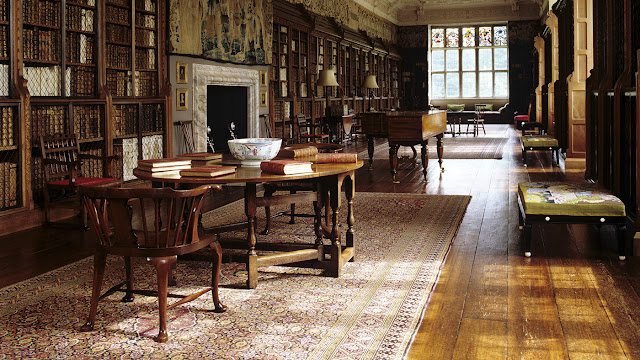

The Library in the Long Gallery at Blickling
© National Trust

Today the gardens at Blickling are as beautiful as the house:  

"The first sight of the entrance front from the public road is so famous and breathtaking that every passing motorist halts instinctively to take a longer look.  But the secret of the place is only discovered late in the day among the trees and flowering shrubs that stretch upwards from the east side of the house.  Never has there been a garden quite like it, not at least since the eighteenth century,…Great arches of beech and oak form choirs and aisles, and under them grow azaleas, rhododendron, magnolias and wild bluebell."  Nigel Nicolson, 1978


Sunday, 16 April 2017

Resurrection , imperfect


John Donne Arriving in Heaven   Stanley Spencer, 1911   Fitzwilliam Museum, Cambridge

Stanley Spencer was inspired to paint this by reading Donne's Sermons, a book given him by his friends and fellow students at the Slade, Jacques and Gwen (Darwin) Raverat.  "One had been brought up with the notion that heaven was, if not all enveloping, at least straight ahead.  In this picture [Stan] told me, he had the idea that heaven was to one side: walking along the road he turned his head and looked into Heaven,"  Gilbert Spencer.

Resurrection, imperfect

"Sleep sleep, old Sun, thou canst not have repast
As yet, the wound thou took'st on friday last;
Sleepe then, and rest; the world may beare thy stay,
A better Sun rose before thee to day,
Who, not content to'enlighten all that dwell
On the earths face, as thou, enlightned hell,
And made the darke fires languish in that vale,
As, at thy presence here, our fires grow pale.
Whose body having walk'd on earth, and now
Hasting to Heaven, would, that he might allow
Himselfe unto all stations, and fill all,
For these three daies become a minerall;
Hee was all gold when he lay downe, but rose
All tincture, and doth not alone dispose
Leaden and iron wills to good, but is
Of power to make even sinfull flesh like his.
Had one of those, whose credulous pietie
Thought, that a Soule one might discerne and see
Goe from a body, 'at this sepulchre been,
And, issuing from the sheet, this body seen,
He would have justly thought this body a soule,
If not of any man, yet of the whole."

Poems  John Donne, 1573-1631

Thursday, 13 April 2017

Pierre Puvis de Chavannes: 'Stay' away, 'stay' away Death...

Tucked away downstairs in London's National Gallery is a mysterious little painting, entitled  Death and the Maidens. It is an oil sketch for a large painting, now in the Clark Institute collection, and was inspired by a Schubert song* from 1817, later part of his famous string quartet No 14.

The young maiden begs fierce Death to pass her by,
"Go Fierce Death, I am still young, Please go, and do not touch me";
but Death replies that he is gentle:
"Give me your hand, Be of good cheer, I am not cruel, You will sleep softly in my arms".

Death and the Maidens, oil sketch  c. 1872   Pierre Puvis de Chavannes 
© National Gallery, London

The very fact that this is a sketch, while the artist is thinking his theme onto the canvas, gives it this sense of mystery, with the black-robed figure of Death loosely indicated in the foreground and a shadowy maiden stooped in the background.
As seen in the finished painting below, the theme is here clearly portrayed in Puvis de Chavannes' typical classicised Arcadian style, the sunlit maidens are enjoying the bloom of youth, gathering flowers, while Death lies apart, resting from his reaping; yet despite the clarity in its painting, that sense of enigma remains.


Death and the Maidens    Pierre-Cecile Puvis de Chavannes 1872
© Clark Institute,  Williamstown, Massachusetts

Puvis de Chavannes could also create drama and strong movement on the canvas, as in this painting of St John's beheading, with the same style of strong flat colour and clear outlines.


Death of St. John the Baptist   Pierre Puvis de Chavannes  1869
© Barber Institute, Birmingham, UK

In his lifetime, he was famous as a painter of monumental murals, in the style of Italian frescoes, such as Summer, painted for the entrance of the Musee d'Orsay, Paris 1873, or the Muses of Inspiration murals, installed in Boston Public Library in 1895,  and he was admired by the symbolists for his allegorical  classical scenes.    


Detail from "Summer "  1873     © Musee d'Orsay., Paris 


The painting below is based on his mural commissioned for his home town of Lyons, for their Musee 
des Beaux-Arts.  It was his practice while the actual murals were on exhibition prior to installation to create a smaller easel version. 


The Sacred Grove, beloved by the Arts and the Muses   Puvis de Chavannes   1884-89 


With his close friend Rodin, together with sculptors Jules Dalou and Eugene Carriere, they founded the new Societe Nationale des Beaux-Arts in 1890;  Puvis de Chavannes was its first president.  After his death in 1898, his style went out of fashion and over time his widespread influence was gradually forgotten.


Memorial to Puvis de Chavannes,   Auguste Rodin,  plaster, c. 1899  © Musee Rodin, Paris

Rodin designed this classically inspired and symbolic monument as memorial to his friend, although it was never cast. His portrait bust of Pierre-Cecile stands on antique architectural fragments, with the Spirit of Eternal Repose (a figure from Rodin's "Gates of Hell" inspired by Dante's Inferno and the classical statues in the Louvre) leaning against an apple tree, in Greek myth those apples of Hesperides which gave immortality.

Rodin's attributed last words were: "And it is said that Puvis de Chavannes is not beautiful".

*from Death and the Maiden poem by Matthias Claudius.

Saturday, 1 April 2017

April: the stones of Avebury, "a more delightful indagation"


Thursday, 2nd April, 1946

"…I drove with Eardley straight to Avebury.  He took me round the Circle.  He is madly keen on Avebury and rather peevish about my lack of enthusiasm and disrespect for the ugly stones which Keiller* has dragged from the ground into the light of day.  I cannot approve of the proposal to destroy the old village inside the Circle.  I admit that the empty sections of the Circle are impressive where the terraces have been cleaned of scrub and are neatly cropped by sheep; but to remove medieval cottages and clear away all traces of habitation subsequent to the Iron Age seems to me pedantic and a distortion of historical perspective.  We walked round the Manor garden.  Eardley was bored by the house because it is not classical and is romantic. Today's fashionable distaste for the romantic in English country houses is as overemphasised as was the Edwardians' for the classical and regular.""

Ancestral Voices  James Lees-Milne, 1946

Avebury Manor  © National Trust


It was John Aubrey, writer and antiquarian, whose careful study of the Avebury henge brought it to the attention of scholars.  Later travellers like Celia Fiennes and John Evelyn would record their visits to Stonehenge, but Avebury's apparently random stones were not widely noticed or remarked upon before 1649 when Aubrey chanced upon them during a hunt;  he stopped to look more closely and caught up with the hunt later.

"The morrow after Twelfth Day Mr Charles Seymour and Sir William Button met with their pack of hounds at the Grey Wethers….
'Twas here that our game began and the chase led us at length through the village of Avebury, into the closes there: where I was wonderfully surprised at the sight of those vast stones of which I had never heard before; as also at the mighty bank and graffe [ditch] about it .  I observed in the enclosures some segments of rude circles, made with those stones, whence I concluded they had been in the old time complete.  I left my company a while, entertaining myself with a more delightful indagation [investigation]: and then (steered by the cry of hounds) overtook the company, and went with them to Kennet, where was a good hunting dinner provided."  7th January 1649 (from his Monumenta Britannica ms.)


John Aubrey, engraving by C.F. Wagstaff after a drawing by William Faithorne, c. 1666 in the Ashmolean Museum

Aubrey gave Charles II a personal tour of the Avebury stones during the King's progress to Bath in the summer of 1663, just as James I  on seeing Stonehenge in 1620 had asked his Royal architect, Inigo Jones, to research the origins of that monument.

"I brought with me a draught of it donne by memorie only; but well enough resembling it, with which his Majesty was pleased: gave me his hand to kiss, and commanded me to waite upon him at Marlborough when he went to Bath with the Queen (which was about a fortnight later) which I did: and the next day when the Court were on their journie, his Majesty left the Queen and diverted to Avebury where I showed him that stupendous antiquity with the view thereof.   He and His Royal Highness the Duke of York were well pleased."  John Aubrey


 West Kennet Avenue, Avebury

In the seventeenth century, both Stonehenge and even more so Avebury's circles were in poor condition, with their sarsen stones buried, broken and removed; at Avebury they had been incorporated into village houses and the surrounding ditches filled in.  Nevertheless, the Royal visit put these  mysterious ancient monuments on the map for wealthy educated travellers.

Salisbury Plain was "eminent for many barrow or butts that are thick all over the plaine, and this of Stoneage, that is reckoned one of the wonders of England how such prodigeous stones should be brought there; ...  the story is that none can count them twice alike, they stand confused;"  Celia Fiennes, c. 1680s

Celia Fiennes counted only 91 but John Evelyn with difficulty counted 95 in July 1654, and thought  these sarsens were brought from Avebury.  In his Diary he describes the rural landscape, "for evenness, extent, Verdure, innumerable flocks, to be one of the most delightful prospects in nature and put me in mind of the pleasant lives of the Shepherds we reade of in Romances and truer stories:"  He also  mentions the barrows and mounds in the vicinity, as "antient intrenchments, or places of burial after bloudy fights:"

Indefatigable Samuel Pepys visited both Stonehenge and Avebury in June 1668. Like his friend Evelyn  he comments on the countryside: riding "over the downes, where the life of the shepherds is, in fair weather only, pretty",  and believes the profusion of stones around easily supplied both Stonehenge and Avebury.  He is told the legend of Silbury Hill, so called from one King Seale buried there, and sees from his coach, "one place with great high stones pitched round, which, I believe, was once some particular building, in some measure like that of Stonage".  


West Kennet Long Barrow  © National Trust

Even older than Avebury and Stonehenge is the West Kennet Long Barrow, a neolithic burial chamber c. 3650 BC.  Excavations in 1955-56 found it to have been used for burials for around a thousand years, at which period the entrance had been blocked off.   I went inside with a history group on a field trip once and it was a very eerie experience which I would not really wish to repeat.

* The revival of the Avebury complex is the result of Alexander Keiller's efforts to rescue and restore the stone circles and avenues in the 1930s,  and the history of the stones and his years of work is on view in the Manor House museum.  Objects he found while excavating the stones run from very early pottery shards through Roman coins and later carvings, to a piece of a Keiller's marmalade pot from 1900, found while digging up stone 14.  However, in his process of recreating the ancient site, the buildings and history of many later centuries were swept away.  James Lees-Milne's comments on the method Keiller chose are still a matter of controversy today.


Monday, 20 March 2017

Adventures in Troyes

" Chretien de Troyes has had the peculiar fortune of becoming the best known of the old French poets to students of medieval literature, and of remaining practically unknown to anyone else."  W.W. Comfort.


The first kiss,  Lancelot and Guinevere    French ms. c.1400  Bibliotheque National Paris


A trouvere at the court of Marie, Countess of Champagne, in late12th century Troyes, Chretien de Troyes is credited with writing some of the earliest Arthurian romances of courtly love, particularly introducing the story of Lancelot (The Knight of the Cart) and his fin amor for Queen Guinevere.  The characters and tales in his poems are well known to us even today, without having read a single word he wrote, made popular by countless later writers and artists.

Lancelot and Queen Guinevere     Herbert James Draper c. 1900 

"Such extravagant claims for Chretien's art have been made in some quarters that one feels disinclined to give them even an echo here. The modern reader may form his own estimate of the poet's art, and that estimate will probably not be high.  Monotony, lack of proportion, vain repetitions, insufficient motivation, wearisome subtleties, and threatened, if not actual, indelicacy, are among the most salient defects which will arrest, and mayhap confound, the reader unfamiliar with medieval literary craft."

This beautifully expressed condemnation comes from the introduction to Chretien's Four Romances, translated by William Wistan Comfort in 1914, who continues: "No greater service can be performed by an editor in such a case than to prepare the reader to overlook these common faults, and to set before him the significance of this twelfth-century poet."  An expert in French medieval literature,  whose doctoral thesis was on French chansons de geste, Comfort concludes:

"So we leave Chretien to speak across the ages for himself and his generation.  He is to be read as a storyteller rather than as a poet, as a casuist rather than a philosopher.  But when all deductions are made, his significance as a literary artist and as the founder of a precious literary tradition distinguishes him from all other poets of the Latin races between the close of the Empire and the arrival of Dante.


The first kiss, Paolo and Francesca, illustrating Dante's "Divine Comedy"   
Dante Gabriel Rossetti * c. 1867  © Tate Gallery London

 " Noi leggevam quel giorno per diletto
Di Lancelotto, come l' amor lo strinse."

"We read that day for delight, about Lancelot, how love bound him."
from Dante's Inferno, Canto 5;   Clive James, in the introduction to his translation.


If you are still not won over to to read Chretien's poems, you may well prefer the delights of Troyes, his old stamping ground, which has retained its medieval centre, shaped like a champagne cork, (although little has survived from Chretien's time outside of museums).

Street in old Troyes


Typical timber framed houses, rebuilt in traditional local style after a fire in 1524. 

 Fifteen or so years ago, Troyes hardly catered for tourists - no postcards, fridge magnets or t-shirts on sale - and you could safely walk down its main roads of an evening and barely see a car.  Then you could visit the unrestored church of St. Jean-au-Marche, (where Henry V married his French princess, Catherine de Valois in June 1420) - and admire its world-class collection of cobwebs,  or be dazzled by the stained glass there and in Troyes' other churches, and be moved by the delicacy of the carved Madonnas and saints in each church and museum.


Tree of Jesse window, partly 13th  century,  in Troyes Cathedral


Madonna and Child  

We wined and dined in Troyes' narrow streets and watched the cats cavort on the roof tiles, admired the efficient French pompiers dealing with a fire nearby as morning worshippers left the Cathdral, (the previous Cathedral had been burnt down in 1188 and was rebuilt over several centuries) and strolled in its parks and markets.


Summer in the Jardin du Belfroi


We found the skills of the medieval glass craftsmen brought up to date in the Museum of Modern Art. Maurice Marinot gave up a painting in 1913 to create his masterly blown and enamelled bowls and sculptural glass vessels, some taking a year to complete. His legacy is here along with paintings by French artists from Vuillard to Picasso, and a large collection of Andre Derain's paintings.

Maurice Marinot flask

 The Museum building was the former Bishops' Palace,  where our  tentative request for a corner in which to eat our picnic baguettes was met with smiling directions into the Palace's tranquil garden.


Musee d'Art Moderne, Troyes

Maybe because English visitors were fewer then, we were met with smiles and help on our visits by local bus and train to surrounding villages like Nogent-sur Seine, Chaource, and Bar-sur-Aube (home of one Champagne's  great medieval international markets).  You could understand how the treasures of this region might inspire Chretien de Troyes to write his courtly tales of romance and beauty.


*Dante Gabriel Rossetti was one of the Pre Raphaelite artists and writers to be inspired by Arthurian and other tragic lovers.  He also translated  Dante's poetry.

Sunday, 12 March 2017

Giovanni di Paolo; "through the looking-glass"


St. John the Baptist goes into the wilderness,    Giovanni di Paolo, tempera on panel 1454 
 © National Gallery, London

This is one of my favourite paintings at the National Gallery.  I saw it on my first-ever visit, when I was taking a French pen-friend sightseeing; and I was beguiled by the diminutive figure of St. John the Baptist setting off into the desert and appearing undiminished, reading his book among those jagged threatening mountains.  There is a cinematic quality to its narrative, as St John leaves a towering fortified gateway enclosing a domestic style chimney and later we see far below the miniature fields and out-of-scale buildings of the world he has left behind.  And are those bordering roses pointing towards the new ethereal world awaiting on the horizon?

Although this small painting is well-known, I have hugged it to myself as a secret personal pleasure for decades, and only recently found out more about the artist.

Giovanni di Paolo (c.1403-1482) was a leading Sienese artist, working in the tradition of the masters of the previous century, particularly Duccio,  both as a manuscript illuminator and painter.  Records show an early commission for a Book of Hours for the wife of a wealthy Milanese family in Siena.     For the majority of citizens the equivalent of these luxury devotional books were the golden painted altarpieces in their churches, the central panel of Christ or  Madonna and Child surrounded by panels showing the Saints and their lives. Predella panels formed the base support.

This is another panel from his St John the Baptist series; they are thought originally to have been part of a Madonna & Child altarpiece now in the Metropolitan Museum, New York.


Birth of St John the Baptist   Giovanni di Paolo, predella panel 1454 
© National Gallery, London

Siena in the 14th and 15th centuries was a cosmopolitan trading city with influences from east and west for its artists, and particularly the Papal court in Avignon, as well as the new Florentine artists and sculptors.   Giovanni was a leading painter of the Sienese International Gothic school, which followed the Byzantine influences of the 1300s, to distinguish Siena from its rivals in Florence, but incorporated the new sense of Renaissance perspective and modelling of  human figures.  Here Di Paolo has manipulated the perspective of the bed to lead the eye back to the figures of the newborn saint and his father Zacharias writing his name, John.

He was also influenced by Gentile da Fabriano and Fra Angelico, and his paintings with their handling of colour and line create a dramatic sense of other worlds.


Saint Clare saves the sailors  c. 1455    © Gemaldergalerie, Berlin

 Composite altarpieces with many panels like these formed a visual focus of devotion during the ritual of prayers at Mass, when the priest had his back to the congregation.  When after the 1560s the priest stood behind the altar table, facing the congregation with the Eucharist in plain view, these powerful altarpieces were no longer as important and were gradually moved, broken up and destroyed or sold.   Now they are in collections across the world, on public view again but in parts and dispersed their original setting.

Fortunately Giovanni di Paolo's manuscript paintings for Dante's Paradiso are together and intact in book form just as they were conceived.  Here are a few of them:


Dante's "Paradiso",  Christ in his chariot,  Giovanni di Paolo  c. 1444-50   © British Library


   Beatrice guides Dante to meet Peter Damian in the sphere of Saturn, Canto 21.   © British Library


Nebuchadnezzar recounts his dream to Daniel,  Canto 4.  © British Library


Dante with Apollo before Parnassus,  Canto 1.    © British Library


"Minerva breathes, Apollo steers" - Beatrice leads Dante up towards the moon, Canto 2. 


Looking at Di Paolo's images of the Paradiso, it is no surprise that John Pope-Hennessy says of Di Paolo's work that, "he plunges, like Alice, through the looking-glass.."


Wednesday, 1 March 2017

March: Art treasures in Warwickshire


Upton House, near Banbury
Friday, 1st March 1946:

"I reached Upton [House, Warwickshire] at 6.30 to stay the night with the Bearsteds.  He and Lady B. both charming, with unassuming manners of the well-bred.  Hubert Smith arrived just in time for dinner, his car having broken down.

At midnight Lord B. took me round the house. Inside there is nothing of consequence architecturally save a  few early eighteenth-century chimneypieces and a beautiful Coleshill-style staircase, rearranged by Lord B. and extended.  Morley Horder, architect, built on to the house in the 1920s.  But heavens, the contents!  There is a lot of good Chippendale-style furniture and some marvellous Chelsea china of the very best quality.  It was badly packed away during the war when the house was occupied by a bank, and some on unpacking found to be damaged.  The picture collection superb, as fine as any private collection in England.  Many of the pictures are not yet back from the Welsh caves where they were stored with the National Gallery pictures.

It is only the garden he is offering with the house, but he wishes to include all the works of art.  So does his son who is to inherit."
Caves of Ice     James Lees-Milne, 1946


Upton House from the south  Anthony Devis c. 1784  © National Trust


View of the gardens and park

Lord Bearsted and his sister Mrs Nellie Ionides* were both great art collectors, as was their father Marcus Samuel the 1st Viscount, co-founder of the Shell Oil company.    Walter Samuel Bearsted, 2nd Viscount, acquired Upton House in 1927 and began remodelling it.  The wonderful art on display  includes original paintings for Shell Oil posters by well known British artists.   Here are just two:

 Farmers Use Shell    John Armstrong  1939 
© artist's estate  (Shell Art Collection loan) 


Charwomen Use Shell    Edward Ardizonne  1938
© artist's estate (Shell Art Collection loan)


Walter Samuel Bearsted was a  trustee of the National Gallery and the Tate Gallery, and Chairman of the Whitechapel Gallery;  both he and his son Richard wanted to bequeath the family collection to the National Trust.

The range and quality of the collection, which includes works by Stubbs, Hogarth, Brueghel, Canaletto, Tiepolo, Van der Goes - the list goes on, and many more can be seen at artuk.org.  Here are just three of nearly 200 paintings, selected almost at random.  


Crossing the Ford     Thomas Gainsborough c. 1750     © National 'Trust


Young man with a Pink     Hans Holbein the Younger 1533    © National Trust


Love among the Ruins   Edward Burne-Jones* 1894  © National Trust
*Burne-Jones was a friend of Nellie Ionides' father in law, Luke Ionides, and painted his sister, her husband Basil's Aunt Aglaia.

Sunday, 19 February 2017

Pisces: piscatorial tales: "Come now, it's time to leave"

Pisces is the final sign of the zodiac in my blogs (and here it seems I have two ideas weaving about).

Pisces - the two fish - is the largest of the constellations and features in ancient mythology, the earliest known example of its symbol found on an Egyptian coffin lid  c. 2300 BC.   Many thousand years later, the fishes appear on the coinage of the Mogul Emperor, Jahangir:  he believed in divination to guide his actions so astrological symbols were an essential part of his environment.


Mogul gold coin from c. 1569 - 1627

In classical Greek myth, the two fish represent Aphrodite and Eros, escaping into the river Euphrates (like Pan or Capricorn) from the giant Typhon, and are usually shown joined with ribbons.  I rather liked this cheerful image from a 14th century manuscript:


Breviari d'amor, French early 1300s, M. Ermengau
© British Library

The Pisces myth seems to be closely linked with two great rivers of the ancient world, the Nile and the Euphrates, along with many ancient stories of magic fish.  In the biblical Apocrypha the Euphrates was where Tobias, guided by his angel, caught his giant fish; and the Euphrates runs through regions which were the source of many stories gathered together in the The Thousand and One Nights. Based on a lost book of Persian tales, the Hazar Asfanah,  Antoine Galland's French translation from a ninth century Arabic version was published early in the eighteenth century.

Edwardian children would have read these stories in Andrew Lang's famous fairy books,  particularly The Arabian Nights Entertainments published in 1898.  The books are also known for their dramatic and detailed illustrations by Henry Justice Ford.

Colour-plate illustration for "The Girl-Fish" by H.J. Ford, from The Orange Fairy Book 

Here is one of Ford's line drawings illustrating the tale of magic fish in "The Vizir who was Punished" from the Arabian tales.  "When the cook was about to turn them on the other side, the wall opened, the damsel appeared, addressed the same words to the fish ['Fish, fish, are you doing your duty?'], received the same answer, and then overturned the pan, and disappeared."

Even in this poorly scanned image you can sense the drama and see Ford's wonderful evocation of exotic eastern palaces, in the Princess's Egyptian-style dress and the Islamic tiled fireplace.


"The Girl Upsets the Frying Pan" in Lang's The Arabian Nights Entertainments, H. J. Ford  1898

Henry Justice Ford was born into a London solicitor's family on 5th February 1861 (not quite a Piscean) and after leaving Cambridge with a classics degree he studied art at the Slade and then at Hubert von Herkomer's Art School.  Between 1894 and 1916 his studio was in Edwardes Square, Kensington, a short walk from the Victoria and Albert Museum, where he could have seen this Turkish fireplace, acquired in 1891.

Tiled fireplace, possibly from the palace of Fuad Pasha, Istanbul, c. 1731
© Victoria and Albert Museum

The detail in Ford's drawing even indicates a frieze of arabic writing just above the chimney opening. 
In the V&A's fireplace, seven cartouche tiles list the names of the legendary seven Sleepers of Ephesus, another story from the Near East found in Christian and Islamic legend.   Similar stories of heroes sleeping under the earth to be awakened, cross many ages and cultures and, like tales of enchanted fish, inspire artists and writers.

"But come now, it's time to leave;
the Fish glitter on the horizon,
the Bear is right over Caurus
and over there we can climb down."

Dante, Inferno, Canto XI (trans. © Steve Ellis)

Tuesday, 14 February 2017

St Valentine's day: Love and death for the Merry Monarch, Charles II

Pierre Mignard painted this flattering portrait of Louise de Keroualle, Charles II's French Catholic mistress, in 1682 in Paris; some years later he became Louis XIV's first painter.
The distinctive blue sleeves may have been from a studio prop, and the negro child, the coral, nautilus shell, and the pearls all contrast with Louise's pearly skin, and also hint at the "vanitas" of earthly love.


Louise de Keroualle, Duchess of Portsmouth,   Perre Mignard, 1682
© National Portrait Gallery, London

Charles II had many mistresses - or "Valentines",  over the years, most famously English-born Nell Gwyn, and it was her rival Louise de Keroualle she was referring to, in her famous quip "I am the Protestant whore!" during a period of anti-Catholic demonstrations.

There were constant rumours that the King himself was a closet Catholic, and almost certainly died as such on 6th February 1685.   It was to avoid such anti-Catholic disturbances that Charles II was quietly buried between eight and nine at night on St Valentine's Day, 14th February 1685, as John Evelyn recounts:

"the King was [this night] very obscurely buried in a vault under Hen: 7th Chapell in Westminster, without any manner of pomp, and soone forgotten after all this vainity, & the face of the whole Court exceedingly changed into a more solemn and moral behaviour: The new King affecting neither Prophanesse, nor bouffonry:  All the Greate Officers broke their white-Staves on the Grave &c: according to form:"  Diary of John Evelyn, ed. E.S. De Beer


Henry VII's Chapel, © Westminster Abbey

Evelyn's friend, Samuel Pepys, whose Diary tells us so much about Charles II and his Court in the 1660s,  also records Valentine's Day merrymaking, a mixture or romance, sex, and 'bouffonry'.  It was the custom for groups of friends to draw lots for their Valentines for the forthcoming year, and give their ladies gifts. John Locke writes to his Oxford valentine in 1659: "I have an overflow of happiness and honour in being yours though a Lottery made me soe, and you have given no small proofs of an excellent and obliging nature in accepting such a trifle from the hand of fortune. "

You were also expected to take as your Valentine the first person of the opposite sex whom you saw that morning:
"14. St.  Valentine. 
This morning comes betimes Dicke Pen[n] to be my wife's valentine, and came to our bedside.  By the same token I had him brought to my side, thinking to have made him kiss me, but he perceived me and would not. So went to his Valentine -- a notable, stout, witty boy.  I up, about business; and opening the door, there was Bagwell's wife, with whom I talked afterwards and she had the confidence to say she came with a hope to be time enough to be my Valentine, and so endeed she did -- but my oath preserved me from losing any time with her."  Samuel Pepys, Diary 1665

In May 1660, Pepys sailed with Edward Lord Montague to the Hague, part of the  convoy to bring King Charles and his brother James back to England, where Pepys was presented to the King, his brother James, Duke of York and their sister Mary, the Princess Royal.  Before this, Charles and his attendants in exile had been living in penury, " in a sad, poor condition for clothes and money…their clothes not being worth 40s., the best of them".

Here is Charles as Prince of Wales with his siblings in happier times, with on the left in the painting Princess Mary, whose son would reign as William III, and Charles' brother James, still in long skirts, who would succeed Charles as King James II, in February 1685.

The five eldest children of Charles I,  copy after Anthony Van Dyck 1637
© National Portrait Gallery

Wednesday, 1 February 2017

February at Norton Conyers. "We are guardians of the past to benefit the future"*


Norton Conyers house, near Ripon, N. Yorks 
© Norton Conyers

Friday 1st February 1946:

"Left Womersley for Ripon. … At 2.30 reached Norton Conyers, a sunny, pleasant house facing due south across a wide expanse of open park towards Ripon and framed in a broad background of expanding trees.  The south front has several curved Jacobean gables and is roughcast, which gives it a somewhat naked appearance.  The last Graham baronet stripped off the roughcast to reveal red brick, but soon replaced it when he experienced the damp.  Lady Graham, mother of the present baronet, received me.  A capable, outspoken and blunt woman, which whom before I left I made friends, but to start with was hostile.  She manages the property of some 18,000 acres for her son….
Charlotte Bronte stayed here [1839] and made it the scene of Rochester's house in Jane Eyre.  A lunatic Lady Graham was once incarcerated in an attic room I was shown.  


The staircase to the attics, blocked up in the 1880s*
© The Telegraph newspaper

"The entrance hall is filled with portraits of Grahams.  There is a large Ferneley of a meet of the Quorn outside Quenby.  The portraits include a Zoffany group, a Battoni, a Hudson, a Romney. There is a wide Jacobean oak staircase.  On one tread near the top a large knot of wood is shown.  It resembles a horse's hoof, reputedly of the horse which planted it here before collapsing, having borne its master twenty miles home badly [mortally] wounded after the Battle of Marston Moor."


The Jacobean staircase and portraits.
© Norton Conyers

"On the stairs a small Zoffany of the housekeeper who was to murder one of the Grahams.  Upstairs an oak panelled room with double four-poster bed in which Charles I slept.  Lady Graham told me that both Charles I and James stayed in this room.  In the garden are some lead figures and urns of the eighteenth century.  Lady Graham had a long talk with me afterwards and said she wanted to endow the house with some private money of her own, but I was not to tell her son this."

Caves of Ice  James Lees-Milne, 1946

*Sir James Graham's words.  The blocked staircase to the attic room was uncovered in 2004, during the 30 hands-on years Sir James and Lady Graham spent restoring Norton Conyers.  Lady Graham said then that:
 "the house has a very strong presence.  It reveals it secrets grudgingly, so we have to work hard".  

Nearly 70 years after Lees-Milne's visit, the story of Norton Conyers' secrets was told by Stuart Penney in The Telegraph, May 2005.