Translate

Sunday, 31 March 2019

April beginnings: "so priketh hem Nature in hir coragis"*


"Sweet Thames run Softly",  Robert Gibbings wood engraving, 1940

"The Mole had been working very hard all the morning, spring cleaning his little home. First with brooms, then with dusters; then on ladders and steps and chairs, with a brush and a pail of whitewash; till he had dust in his throat and eyes, and splashes of whitewash all over his black fur, and an aching back and weary arms.  Spring was moving in the air above  and in the earth below and around him, penetrating even his dark and lowly little house with its spirit of divine discontent and longing.  It was small wonder, then, that he suddenly flung down his brush on the floor, said "Bother!" and "O Blow!" and also "Hang spring-cleaning!" and bolted out of the house without even waiting to put on his coat.  Something up above was calling him imperiously, and he made for the steep little tunnel which answered in his case to the gravelled carriage-drive owned by animals whose residences are nearer to the sun and air.  So he scraped and scratched and scrabbled and scrooged, and then he scrooged again  and scrabbled and scratched and scraped, working busily with his little paws and muttering to himself, "Up we go! Up we go!" till at last, pop! his snout came out into the sunlight and he found himself rolling in the warm grass of a great meadow."

The Wind in the Willows,  Kenneth Grahame 1908

"The Wind in the Willows"     Paul Bransom

The first illustrations, by Paul Bransom, were not until the eighth edition in 1913, and many notable illustrators have followed, like Arthur Rackham and E. H. Shepard, but I have always read Kenneth Grahame's story of Ratty, Mole, Badger and Mr Toad in a sibling's 1941 school edition with no pictures, just the excitement of Grahame's words.

As a child, when his mother died, Kenneth Grahame and his sister and brothers were sent to England  to live with their grandmother at The Mount, Cookham Dean, close to the Thames.  Here his uncle, the local curate, introduced him to boats and the river and later when Grahame lived further west at Blewbury with his family, the stories he wrote in The Wind in the Willows were those he had told to his young son Alastair.

  The gardens at The Mount,  Cookham Dean,  Stanley Spencer  1938 © artist's estate


Cookham Reach and Barley Hill,  Stanley Spencer c. 1920

Stanley Spencer grew up in Cookham itself and his paintings of the village and Cookham Lock have made the place famous.  Robert Gibbings was a friend from the Slade Art School, and in 1939 rowed along the Thames in his boat the "Willow" compiling his book Sweet Thames Run Softly.

*"Thanne longen folk to goon on pilgrimages."  The Canterbury Tales, Geoffrey Chaucer

Saturday, 16 March 2019

Islamic art in Qatar

My local market has a very good second-hand bookstall, where I came across the guidebook to the Museum of Islamic Art in Doha, Qatar.


The building was designed by I.M Pei (probably best known for the Louvre's Glass Pyramid) and its faceted geometric shape,  which changes with the sun, captures the essence of Islamic art.  His inspiration was the ninth century mosque of Ahmed Ibn Tulun in Cairo:
 "If one could find the heart of Islamic architecture, might it not lie in the desert, severe and simple in its design, where sunlight brings forms to life?"

The Doha Museum's interior is more obviously spectacular, with its play on circles, octagons, stars and squares, key motifs in Islamic art, decorating objects and interiors.


The atrium, with double stairway and decorated chandelier


Diamond patterns and facets reflect the interior light  


These changing and intersecting patterns in the architecture are seen more clearly in the interior design and decoration and are repeated in the objects in the Museum's collection.


Detail of inlaid cabinet, with stars and foliage, India, 16th-17th century

Slip decorated plate with Kufic calligraphy, Samarqand or Nishapur,  10th century.*
"Foolish is the person who misses his chance and afterwards reproaches fate."  attrib. Yahya ibn Ziyad

The interior designer, in collaboration with I.M. Pei, was Jean-Michel Wilmotte, who used dark grey porphyry and bronzed exotic wood - Brazilian louro faya,  creating display galleries where the Museum's treasures appear suspended in space and light. 


Treasures of the Museum include an inlaid brass candlestick from Shiraz, an enamelled glass mosque lamp, and the Rothschild silk carpet, probably made in Kashan in the reign of Shah Tahmasp (1524-76).

Many of these and other objects are inscribed with dedications to their owners or, as around the mosque lamps, with verses from the Qur'an;  sophisticated carpet designs are closely related to the designs of book covers, for the highest art after architecture in the Islamic canon is the art of the book or calligraphy, which conveys the word of God.


Book binding, Herat, Afghanistan, 15th century
Kufic Qur'an, Abbasid or Fatimid, N. Africa or Near East, 10th century


Mamluk Qur'an, Egypt or Syria 14th century

Light and shadows on the Museum of Islamic Art, Doha, Qatar
(This and other images from mia.org.qa/collections)


*These epigraphic plates from Samarqand and Nishapur are among my favourites, with their spare designs and stylised inscriptions, often blessings or proverbs, providing convivial grace-notes to a meal.
There are good collections of these and other beguiling Islamic arts found in museums such as the Metropolitan New York, the British Museum and the V&A, London, or the Louvre, Paris. 


Friday, 1 March 2019

March beginnings: "Midway on our path through life, I found myself in a dark wood, Where the way ahead was obscured"*


The Cathedral and Gundulf's Tower,  from "The Gentleman's Magazine"

"An ancient English Cathedral town?  How can the ancient English Cathedral town be here! The well-known massive grey square tower of its old Cathedral?  How can that be here!  There is no spike of rusty iron in the air, between the eye and it, from any point of the real prospect.  What is the spike that intervenes, and who has set it up?  Maybe it is set up by the Sultan's orders for the impaling of a horde of Turkish robbers, one by one.  It is so, for cymbals clash, and the Sultan goes by to his palace in long procession. Ten thousand scimitars flash in the sunlight, and thrice ten thousand dancing-girls strew flowers.  Then, follow white elephants caparisoned in countless gorgeous colours, and infinite in number and attendants.  Still, the Cathedral tower rises in the background, where it cannot be, and still no writhing figure is on the grim spike.  Stay! Is the spike so low a thing as the rusty spike on top of the post of an old bedstead that has tumbled all awry?  Some vague period of drowsy laughter must be devoted to the consideration of this possibility.
Shaking from head to foot, the man whose scattered consciousness has thus fantastically pieced itself together, at length rises, supports his trembling frame upon his arms, and looks around. "
Charles Dickens, 1870

Illustration by Charles Keeping, Folio Society edition 1982

 So begins The Mystery of Edwin Drood, with the Cathedral choir-master, John Jasper, awakening in a Limehouse opium den.  This was Dickens' last, unfinished novel, being written for publishing in monthly parts.  He died suddenly on June 9th, 1870, leaving the conclusion of this last work itself an unsolved mystery.


The May monthly part, with scenes from the novel, 1870.
A young Luke Fildes made his name when he was chosen to illustrate The Mystery of Edwin Drood.


*The opening lines of Dante's Inferno (various translations):
Nel mezzo del cammin di nostra vita, Mi ritrovai per una selva oscura, Che la diretta via era smarrita."    

Thursday, 28 February 2019

Masters of manipulation -- seeing backwards


  The Ambassadors   Hans Holbein the Younger 1533  © National Gallery London

I hate being manipulated which is why I tend to avoid internet social media, but fine artists do this all the time, manoeuvring light, colour and perspective, often in a way of which we are not aware, and at other times obviously, creating an unreal optical illusion.  Holbein's painting of The Ambassadors* is one well-known example, with its foreground tilted skull, which changes as the viewer moves position before it.

Rene Magritte's paintings do this, unsettling the boundaries between logical reality and illusion with a visual paradox.  This is a very clear example:

  The Blank Signature   Rene Magritte 1965  © National Gallery of Art, USA

This is an example of a blivet or Schuster's Fork, an optical puzzle written about in engineering and science fiction magazines of the mid-1960s, and named after D. H. Schuster from his article in The American Journal of Psychology in 1964:
How a blivet works

I have always been puzzled by this painting of Walter Sickert's with the bars of the iron bedstead.

La Hollandaise (the Dutch Girl)  W. R. Sickert 1906  © Tate Gallery London

Sickert uses flashes of light contrasting with the dark to manipulate the perspective, as in the right foot, and are they bars or shadows across the womans' head?

This reminds me of some of Lucian Freud's paintings and drawings.  I am sure one of his earlier works shows a clearly drawn birdcage, in which some of the bird's body is outside the bars while the rest is inside the cage.  Frustratingly I cannot find this image, but he also manipulates the viewer's expectations in his choice of  subject:.


Chicken in a bucket  Lucian Freud  1944  (Wikimedia)

 and this beautifully observed back half of a horse:


Horse,  Lucian Freud  (Wikimedia)

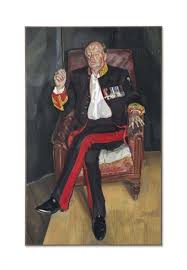
Freud shared a love of horses with the subject of this portrait, Brigadier Parker-Bowles, but look how he has angled the obscured front leg of the chair on the line of contrast between dark and light, suggesting an unsettling tilt, and a sense of energy in the sitter:
The Brigadier  Lucian Freud 2003-4  (wikimedia)

And this famous French impressionist painting is not at all as straightforward as it immediately seems:


A bar at the Folies-Bergere, Edouard Manet 1882  © Courtauld Gallery London

We look straight ahead at the barmaid in front of us, as if she and the viewer are standing in front of a large mirror, but is this so?  Her reflection is at such a sharp angle,  as are the bottles of champagne on the marble top,  and where is that gentleman customer? Are these actually reflected, or are we looking at a whole other scene behind her?    
"Yet one of the reasons the picture appeals as much as it does is that the spectator wobbles delightfully between looking forwards and seeing backwards."  Jonathan Miller, On Reflection,  National Gallery 1998

*see the detailed comments at artsy.net

Saturday, 16 February 2019

An "entente cordiale" ? The Headless Spook

Whenever I travel on the London Tube
I stare at people, though I know it's rude,
To guess their thoughts, their kind of lives,
So it took me somewhat by surprise
When opposite me sat a pin-striped suit
Apparently worn by a headless spook.
"How careless," I thought, "to lose one's head."
"Try Lost Property," I almost said.
But it's unnerving to address an empty space
With collar and tie, but no actual face.
Was he in banking, insurance or law?
Was this a first visit? Had he been before?

The Pilgrim   Rene Magritte 1966  (Wikimedia Commons)

"Can I offer you dinner?" said a voice on my right.
The seat was empty! -- I turned in fright
And there like Alice and the Cheshire Cat,
Was this handsome face with a bowler hat.
"That would be nice,"  I dubiously said,
"But how can you manage with only a head?
Don't you think it might be better
If you and your body could get together?"
My heart gave lurch as he gave me a smile,
"That's been a problem for quite a while!
The waiters, they really haven't a clue,
For dining alone, I need a table for two!!"

"How did it happen?" I ventured to ask.
"I lost my head while passing through France.
My looks belie my age, my dear,
And time is timeless in my special sphere.
For years I've longed to return to my home
But over water I'm unable to roam,
I'm the very first spirit," he said with pride
"To use the Tunnel from the other side!"
"Your name?" I asked, and turned to him,
"Sidney Carton,"  he said with a disarming grin.
A Tale of Two Cities! I began to drool,
" I fell for you whilst still at school."

The Poet Recompensed   Rene Magritte 1956  (Wikimedia Commons)

Suddenly his features began to fade.
"Don't go yet!" I cried, dismayed.
He murmured gently, "Till another time.
You'd better wake up, it's the end of the line!!"

© Marion Kemp 1996 : from "In Praise of Hugs and other Poems.

Friday, 1 February 2019

February beginnings: "You are my sunshine, when skies are grey"*


Cottesloe Beach, and Indiana Tea rooms, Perth,  Western Australia

"On this blazing February day a hot pungent wind brought aromatic scents to our nostrils after seven weeks at sea.  I struggled over the blistering sands, shod in highly unsuitable English boys' sandals, and felt a calamitous sense of loss.    Where were the white chalk cliffs?  Where were the coarse shingle, the diagonal concrete groynes with their threaded green slime and seaweed, the slippery chalk rocks over which one lurched with a shrimping net?  This had been the prospect from Rottingdean, framed by distant views of the Palace Pier three miles away in Brighton, and broken by an impressive row of cyclopean stone piles from the abandoned Maritime Railway.  This was the only 'seaside' I knew and it had always been backed, befriended, or overhung -- depending on the skittish changeability of damp grey English skies -- by towering chalk cliffs at least eight hundred feet high.
But Cottesloe Beach!
The sun melted the tar on the road and it stuck to the unsuitable sandals.  The sea was a series of deep translucent unbelievable blues.  It was Nile green and sapphire blue…"

The Road to Gundagai  Graham McInnes, 1965

Graham McInnes was eight when he and and his younger brother the novelist Colin MacInnes were uprooted to Australia,  after their mother had remarried, and as Mrs Angela Thirkell moved with her children and their stepfather to Malvern, Melbourne.  Perth was their first point of call  (I too crossed the Indian Ocean decades ago, and still remember how incredibly green and beautiful Perth seemed after weeks at sea) before sailing on to Melbourne. His memoir gives a vivid picture of growing up  there in the 1920s.


  Melbourne :  Flinders Street station and Swanston Road, 1927 

* "You are my sunshine, my only sunshine," Louisiana song lyrics, attributed to Jimmie Davies and Charles Mitchell, c. 1939

Friday, 25 January 2019

Hats off to Robert Burns! and to beavers

"Hey brave Johnie lad, cock up your beaver!" Robert Burns
As we move into another month of woolly hat weather (and political gloom and doom) here is a little frivolity.  Admittedly Robert Burns' cheerful song has a political context, as it is thought to have come from an English song ridiculing those Scots who came to London, following James VI when he became King James I of England, or perhaps from a later Scots ballad of Jacobite claims or cross-border rivalry.  Robert Burns' 1792 version of this old song refers to:
"W'e'll over the Border and give them a brush, There's somebody there we'll teach better behaviour, Hey, brave Johnie lad, cock up your beaver!"

In Shakespeare's Hamlet*, the dead king's ghost appeared with his 'beaver' up (Act I, sc.2) but this was the face-guard of his helmet, which could be raised and lowered, (? from the Old French beve).
However, from the sixteenth century onwards, anyone who was wealthy enough wore some sort of beaver fur hat  with brims wide or narrow, worn pinned up (i.e. cocked), or otherwise, according to the dictates of fashion.   Here are some posh Tudor versions, possibly of wool felt or silk, though I think Anthony 2nd Viscount  Montague (centre) and his brothers liked to be ultra fashionable in beaver fur :


The Three Brothers Browne,   miniature by Isaac Oliver 1598   © Burghley House Preservation Trust

This oil painting  shows the changes in headgear across five generations of Sir Thomas More's family.  He, the Lord Chancellor, and his father left, wear the earlier flat cap, while his grandson, Thomas More II, who commissioned this historic family "assemblage", on the right with wife and sons, is wearing the later steeple crowned hat.


The More Family,  Rowland Lockey after Holbein,  c. 1593  © National Portrait Gallery

The Tudor man in the street wore a knitted wool or felted flat cap, compulsory wear on Sundays and holy days from 1571-79, to protect the English wool trades.
Real beaver fur made the very best felt, as its hairs, especially the soft under-hairs, were barbed and bound together well in its manufacture.  It was lightweight, pliable and rainproof.  European nobility depleted the supply of beaver in the late medieval period and had to import pelts from Scandinavia and then Russia.  The very best skins for manufacture were old ones, worn and greasy, the linings from the robes of Russians and then American Indians, for by the 1600s large numbers were imported from Canada;  demand spread and brims grew wider too.

The broad brimmed style was everywhere in the seventeenth century.  Here are two familiar images from Holland.

The Laughing Cavalier   Frans Hals,   1624  © Wallace Collection London


Detail from The Night Watch  Rembrandt van Rijn 1642   © Rijksmuseum, Amsterdam

A few years later, the Quaker William Penn, on good terms with his monarch, Charles II, according to Quaker precepts, kept his hat on before the King. But then Charles removed his own hat, saying to his friend: "It is the custom in this place that only one man should remain covered at a time."


Contemporary chalk drawing of William Penn,  Francis Place c. 1698  (see Historical Society of Pennsylvania)


Part of the Quaker faith was that all men were equal, and so they would not remove their hats before officials and those of higher social standing, (i.e. hat-honour); they only removed their hats when praying, as before God.  A leading Quaker in Rotterdam, friend and supporter of men like Penn and John Locke, one Benjamin Furly, fell out with his brethren over the hat-wearing rule, and was
ostracised.   He argued strongly, having followed Quaker practice for 30 years, that there were occasions when it might seem right to an individual to doff his hat, and this must be a matter of personal conscience.  "I have to this day forborne to practice the utmost liberty I have in mind, as to the Capital in ceremonious Ceremony". (7 Nov. 1692 to John Locke)

In the early 20th century, the famous Quaker Oats advertising shows a hatted Quaker, supposed to be copied from William Penn's portrait, although it is probably a generic image.

18th century engraving of William Penn, with hat  © National Portrait Gallery London


By the eighteenth century, Englishmen's hats were influenced by French and military styles from the numerous wars on the Continent.  Brims varied in size and could be fastened up in a variety of ways, front, back, sideways or including the tricorne.  Women also wore large brimmed masculine styles whether for hunting ( as in Tudor times) or following fashion's changes.  Gainsborough's portraits  show a wonderful display.

  Peter Muilman, Chas. Crokatt & Wm. Kneale  c. 1750  Thomas Gainsborough © Tate Gallery

In fashionable London,  these young men would have looked for the beaver signboard for where to buy their hats.
Manufacturing with its fumes and pollution took place elsewhere in suburbs like Battersea and Wandsworth:  The beaver fur was stewed in a toxic mix of copper acetate and mercury-laced gum arabic, before it could be processed into felt and moulded into hats.  This is sometimes thought to be the basis of the phrase, "Mad as a Hatter" (think Alice in Wonderland) which came from the USA in the mid nineteenth century.

 Another  American phrase, "Talking through one's Hat" spread in the 1900s, and Lilly Dache, the famous New York milliner to the stars,  used it as the title for her autobiography in  1946.

Dorothy Lamour in a Lilly Dache hat

The cousin who took her in when she arrived from France was a Quaker, and Lilly's short, fringed Parisienne dress did not go down well with Quaker ladies, until Lilly settled in and learnt more about the Society of Friends.  
"Believe me, I have made many hats.  And with each hat is a story… I have seen a hat change the whole course of a life."  And so, from Europe to North America, have beavers.

*Hamlet. A play for our times: a small nation on the edge of Europe -- beset by backstabbing, treachery, conniving, ineptness, wars and madness.

Wednesday, 16 January 2019

Thought for today- the English

"A True-Born Englishman's a contradiction,
In speech an irony, in fact a fiction."

 Daniel Defoe, author and journalist   M. Vandergucht engraving, after Jeremiah Taverner 1703

"From this amphibious ill-born mob began
That vain ill-natured thing, an Englishman.
The customs, surnames, languages and manners,
Of all these nations are their own explainers:
Whose relics are so lasting and so strong,
They ha' left a shibboleth upon our tongue;
By which with easy search you may distinguish
Your Roman-Saxon-Danish-Norman English."

The True-Born Englishman: A Satyr  Daniel Defoe, 1700.

Defoe, a Non-conformist, was attacking the prejudice against the new king, William III and his Dutch friends.

Tuesday, 1 January 2019

January beginnings: "It was the best of times, it was the worst of times,…" (Charles Dickens)

January:  This  month is named after Janus, the two-headed  Roman god who looks both ways, to the past and to the future.  So too do novelists, and I will mark each new month of 2019 not with famous first lines, but with  opening paragraphs, chosen almost randomly, from a wide range of authors.
Wishing you all a Happy New Year.


Spring Woodland,  Ivon Hitchen  © the artist's estate    Manchester City Art Gallery

"About a mile to the north of the village of Rapstone there was an area of mixed woodland and uncultivated chalk downs.  The woods included some beech, birch, field maple and yew.  The grassland, owing to the centuries of peace it had enjoyed from the depredations of farmers and builders, was rich in plant and insect life.  The violet hellebore and the bird's-nest orchid did well there and gentians and wild thyme proliferated. The Duke of Burgundy's fritillary and the Chalkhill blue butterflies were to be seen, as were the trapdoor spider, fallow and muntjac deer, badgers, foxes, adders and slow-worms.  At the foot of the hill there was a stream said to be haunted by two kingfishers, although their nesting place had never been found.
One afternoon in April a Volvo stopped on the road by the stream." 

So begins the battle for Rapstone Woods, between the Society for  Countryside,  Rural and Arboreal  Protection (SCRAP) and  the department for Housing, Ecological Affairs and Planning (HEAP), and the Minister, Leslie Titmuss MP. is caught in the crossfire.

Quotation from John Mortimer's 1998 comic novel, Titmuss Regained, part of his Paradise trilogy.

Monday, 24 December 2018

A basket of oranges

Will you find a golden orange in the toe of your Christmas stocking on the 25th? This tradition really developed from the Victorian rituals of family Christmas  - and the story of St Nicholas leaving golden coins in poor children's' shoes.  It became a feature of twentieth century children's Christmases when oranges were more widely available but were still a seasonal treat.

   The Arnolfini Portrait  Jan van Eyck 1434  © National Gallery

If you are London, you can go to the National Gallery and marvel at Jan Van Eyck's portrait of the Arnolfinis, with those luxury status-symbol oranges casually glowing, right  at the edge of the painting.  In the fifteenth century, oranges were grown in Andalucia, introduced by the Moors, and exported to the elite of France and Flanders.  They could cost six times as much as apples, but were prized for sauces, and medicinal use.

In Elizabeth's I's reign, oranges and lemons were more widely available, along with imported spices and sugar, especially in the capital, and were popular candied sweetmeats, although the wealthy preferred their scented (and disease repellent) pomanders not as whole oranges but as a paste in a pierced silver globe.

Seville oranges were mentioned by Shakespeare: "civil as an orange" in Much Ado about Nothing, and   in  Coriolanus a competing "orange-wife and fossetseller ";  and the wealthy landowners began to incorporate special  orangeries  in their gardens. The first oranges grown in England were said to be from seeds brought back by Sir Walter Raleigh, where his relative Sir Francis Carew planted the Orangery at Beddington, Surrey, in the 1580s.

Oranges  F. Guarnieri   mid 20th century  (artuk.org)

The traditional verse "Oranges and Lemons,  Say the bells of St Clement's"  is claimed by St Clement Danes, but also by the smaller St Clement Eastcheap, for its proximity to the Thames wharves where the citrus fruits were unloaded. The origins of this musical game is obscure, but this rhyme is printed in a 1665 edition of The English Dancing Master by John Playford 


After the Restoration of Charles II,  Nell Gwyn was not the only famous orange-seller.  In November 1667 Pepys records at the Theatre Royal,  when the gentleman in front choked on his fruit,  Orange Mall (one Mary Maggs) saved him by putting her fingers down his throat.  The other great diarist, John Evelyn records many visits to orangeries at great estates, and he even grew his own, serving them when he entertained the artist Verrio in  late September 1679.  

Apples and Oranges  Paul Cezanne c. 1900  © Musee d'Orsay

The winter season oranges were then eagerly awaited by those who had to buy them.  Each December John Bonville, cousin of the philosopher John Locke, waited anxiously for the fresh imports, the best ones usually arriving early in January, to send to Locke living at Oates in Essex.  Half a hundredweight in a basket cost five shillings and threepence in Dec 1694, but in 1704 the best shipments did not arrive till 29th January, "after so many weeks which I have been waiting for oranges"  writes Bonville to his cousin.

Now we have oranges all the year round, and the old-fashioned tissue paper wrappers are collectors' items.  

Spanish orange tissue wrapper

Oranges and lemons has become a community children's party game, and is also played at different times of the year, but oranges are still associated with the Christmas season when they seem at their best.   A very happy holiday to all my readers!

 
Oranges and Lemons, 1928   Thos. Saunders Nash  © the artist's estate     Manchester Art Gallery