Translate

Tuesday, 22 December 2015

A Cabinet of Collectors 3: James Whitbread Lee Glaisher


It was Queen Mary II who introduced the passion for blue and white china into Britain, when she and her husband William III came over from Holland in 1689 to take the English throne.  The appeal of blue and white probably culminated in the mass production of the transfer printed Willow pattern in the nineteenth century, which continues to this day*.  The collector who owned this elaborate Delft posset pot describes "the real charm and beauty of the ware is to be seen in its highest perfection in some of the pieces decorated only in blue upon a white ground".  
This was Dr. James  W. L. Glashier, a mathematics  don at Trinity College, Cambridge,  lecturing to the Society of  Arts in 1897, and the posset pot features on his personal bookplate.   


Tin glazed earthenware (delft) posset pot, dated 1685,  Bristol/London c. 1504.  ©Fitzwilliam Museum
(Posset was a drink of warm milk with eggs, sugar and spices, curdled with wine or ale.)


James Whitbread Lee Glaisher (1848-1928)  © Trinity College, Cambridge

Dr Glaisher's father (also James) was a pioneering meteorologist and balloonist, who took his teenage son with him on two ascents,  and Dr Glaisher became a respected astronomer and was President of the Royal Astronomical Society for some years.  His collection contained several delftware plates commemorating early balloon flights, and this more unusual one from Bristol, dated 1740, (showing a holiday pastime in Teneriffe perhaps?).
It is based on a print illustrating "A Voyage to the Moone; or a Discours of a Voyage thither by Domingo Gonsales, the Speedy Messenger" of 1638.  The 'speedy messenger' was in fact Francis Godwin, Bishop of Hereford, and in his utopian story Gonsales describes how he harnesses wild swans to fly him to the Moon and back.
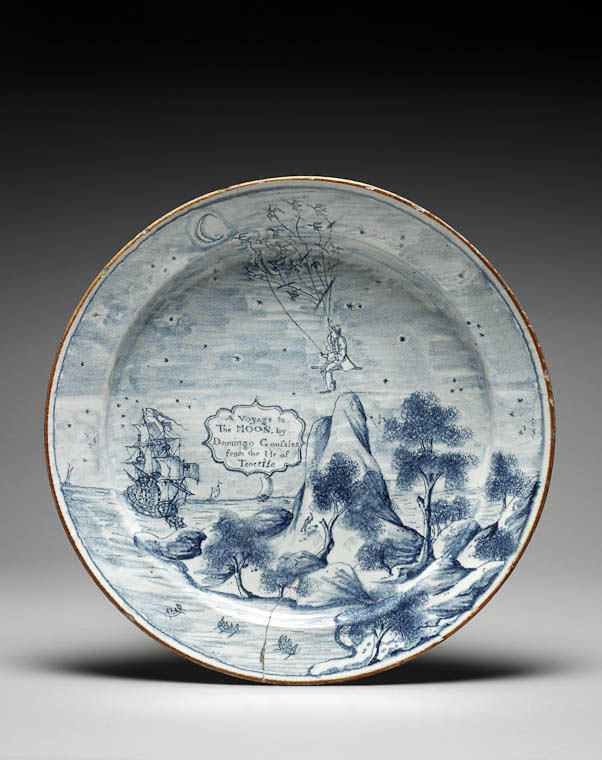


Bristol tin-glazed earthenware, 1740  
Purchased by Glaisher 1915 for £6.10s.  © Fitzwilliam Museum

As a mathematician and astronomer, and Fellow of Trinity, Cambridge,  this figure of Sir Isaac Newton from his collection would have appealed strongly to him.  He also helped Trinity to acquire a key manuscript letter from Newton to Hooke, discussing how to measure the rotation of the earth.


Sir Isaac Newton, showing the comet of 1680.
Ralph Wood, Staffs., overglaze enamels c. 1790 © Fitzwilliam Museum

Glaisher had an extensive library of books,  collecting manuscripts and Georgian chapbooks as well, which he donated in his will to his college and to Cambridge University Library.  He was a wealthy bachelor and his collections filled his rooms at Trinity.  "His collections never ceased to grow….outgrew available space, upstairs, downstairs, even in his remote bedroom.  He was granted an additional set of rooms at the top of his staircase and next to the upper floor of his own set; they, too, soon were filled.  He then hired a sort of warehouse, that also became filled in due course.  …the Fitzwilliam Museum … granted him a room (also soon filled) in the new wing…" wrote J. J. Forsyth.

He travelled widely, from Egypt to the United States,  and added to his collections (which included early samplers and Valentines) wherever he went. 


Haida totem pole from Queen Charlotte Island, British Columbia
©  Museum of Archaeology and Anthropology, Cambridge 

 In Cambridge, Glaisher would not have seemed eccentric, riding everywhere on his penny-farthing bicycle,  chairing a stormy public campaign meeting for Emily Pankhurst in 1910, and buying this Haida totem pole from the anthropologist C. F. Newcombe, for Cambridge University's Museum of Archaeology and Anthropology, where it is the centrepiece of the display.

His carefully recorded collections of nearly 6000 pieces of European pottery and porcelain now grace the Fitzwilliam Museum for our enjoyment and study today.

(with thanks to Dr. Julia Poole for her articles)

*  catch  Blue and White: British Printed Ceramics, at the V&A (ends January)  
Robert Dawson Blue Plate © V&A Museum  

Monday, 14 December 2015

A Cabinet of Collectors 2: C. Drury E. Fortnum


Charles Drury Edward Fortnum made his first fortune mining in Australia in the 1840s.  Back in England  he married twice, each time to a rich cousin, heiresses of the Fortnum family grocery wealth.
He travelled on the continent with his wives, collecting and studying Renaissance ceramics, especially maiolica, and bronzes, many of which he loaned to Henry Cole's South Kensington Museum (today the Victoria & Albert Museum) for a special  exhibition in 1862.   For several years, he was an Art Referee or consultant for the Museum, negotiating purchases,  for which he refused to be paid commission because he was 'a gentleman and not a dealer'.  A member of the Society of Antiquaries, he became a Trustee of the British Museum in 1889.

Venetian glass goblet, gilded and enamelled, 1475-1500  © V&A Museum
Purchased by Fortnum for the Museum in 1884

Victorian museums were very competitive institutions in their collecting, and subject to the interests and expertise of individual curators, who could be very cavalier in their decisions.    Offended particularly by one at the South Kensington Museum,  who refused to recognise and accept a terracotta relief by Antonio Rossellino which Fortnum had offered them,  Fortnum looked elsewhere for a home for his treasures. He felt strongly that "to entrust my loved children (my only family) to a baby-farm where they might die for want of proper nursing, clothing or care, would be the act of an extremely careless or unnatural parent".  Courted by curators from the Ashmolean Museum,  he eventually decided to transfer his collections to the Ashmolean, bequeathing them in his will, along importantly with funds to create a proper building to house them.

In 1889 Oxford University awarded him a Doctorate of Civil Law  (he had served as a local magistrate for many years)  in recognition of his gift.


C. Drury E. Fortnum, DCL,    Charles Alexander 1893
© Ashmolean Museum

He was a pioneer and his collection included  early 13th century pieces, as well as the luxury lustre wares, and istoriato narrative plates, showing scenes from history and classical myth.
He presented this istoriato plate to the Ashmolean in 1888, as well as other top quality and historically important pieces from his maiolica collection.


   Dish with Archelaus, King of Cappadocia, before the Emperor Tiberius
Urbino, c. 1530-35  ©  Ashmolean Museum


What the South Kensington Museum did have was Fortnum's masterly Catalogue of Renaissance Maiolica in the South Kensington Museum of 1873, which researchers still consult.  The woodcut illustrations show fine details in counterpoint to modern photographic images.

 His scholarly introductory essay describing the history, techniques and study of Renaissance maiolica was also published as a South Kensington Museum Art Handbook in 1875,  "enabling the public at a trifling cost to understand something of the history and character of the subjects treated of."

Sunday, 6 December 2015

A Cabinet of Collectors 1. Willam Courten, called Charleton


William Courten (1642-1702) in youth, c. 1655
© Trustees of British Museum

In March 1690, John Evelyn recorded that:

"I went againe to see Mr. Charleton's Curiosities both of Art & nature: as also his full & rare collection of Medails:  which taken alltogether in all kinds, is doubtless one of the most perfect assembly of rarities that can be anywhere seene:  I much admired the contortions of the Thea [tea] roote, which was so perplext, large & intricate, (& with all hard as box) that it was wonderful to consider:"


 Tea plant, from A Natural History of the Tea Tree  John C. Lettsom 1772

John Evelyn visited William Courten (known as Charleton) several times, to admire his collections of rare medals, paintings, books, shells, minerals and precious stones, plants and natural history specimens from across the globe, which he displayed for visitors in ten rooms in the Middle Temple. 


© Natural History Museum London

William may have changed his name to Charleton to distance himself from a long, contentious family lawsuit.  He became a wealthy merchant and travelled widely, as well as seeking rarities via his network of friends, including John Locke, whom he met in France in 1675.  In 1679 Locke replies from Paris to his friend Charleton in Montpellier:

   "However, I have got into my custody [for forwarding to London] that which I suppose you value most. i.e. six boxes of seds plants ett and one turned one wherein is a green Lizard,  and doubt not on twesday next to have the books at least all those that are not Contrabanded."

Locke gave him a recipe for preserving plants, and in 1685 Charleton is writing from London to Locke in Utrecht about his collection:

"I most heartily thank you for the acquisition you have made for me of 2 such great rarities as the clove, and cinnamon tree branches, and wish I had anything to make a return to the gentleman that gave them you;….'of doubles I have preserved in spirit of wine which I had at Montpellier (and as well conditioned as when first put into the glasses) a black, and grey scorpion*, a strange sort of locust, a large peice of chrystall with mosse in it, and a small parcel of rich silver ore'…


He also asks him to buy some desirable items:  " I heare there is lately a great Collection to be sold by auction at Amsterdam…amongst which are 2 Remoras if to be had at reasonable rates [20 shillings] I would willingly have them both, and what fine coloured Indian birds there may be…, the Insects that are Exotick of all kinds will be verry acceptable, espicially the great Phalangium [a venomous spider], the teeth of which are usually set in gold to make tooth picks of, the Tarantula of the spider* sort found in the Kingdome of Naples, for the other is a kind of Lizart and common all over Italy, the Stella arborescens [basket-fish] if to be meet with I should desire you to procure for me, amongst the seamen things may be had at easier rates than when they come into the possession of curious and knowing men…" 
*  Evelyn mentions 'the spider and bird, scorpion, other serpent &c.' after visiting in 1691.

Charleton sent some seeds also via a Dr Hans Sloane, which is probably how Locke too became friends with Sloane.   On his death in 1702, Charleton left all his collections to Sir Hans Sloane, and so they ended up now dispersed among the British Museum, the Natural History Museum, the British Library and elsewhere.

[see Biographia Britannica by Andrew Kippis 1725-1795, and Sachiko Kusukawa on www.cam.ac.uk/research.]
]

Tuesday, 1 December 2015

December - "a chord of starlings"

The coming of winter. From Wild Hares and Hummingbirds,  Simon Moss.

"The next morning Jack Frost has returned with a vengeance, and now the scenery really has turned whiter-than-white; white trees, white hedgerows, white grass, white roofs and white sky. This is landscape in crystal form, only punctuated by the staccato notes of black birds as they dash across the sky or gather in the fields: chords of starlings, followed by the occasional crow, jackdaw or rook.  And one brief splash of colour: a flock of goldfinches, whose crimsons and golds illuminate the landscape like a coloured frame added to an old black-and-white film.


Gwyngyed Mountain, Winter   Ogwyn Davies
©  University of Aberystwyth

Later, as the sun sets over Brent Knoll, a low ridge of colour hangs over the Mendips, while a darker, more menacing wave arrives from the west.  A strong, full moon begins to rise, gradually illuminating the flat, white landscape.  A lone buzzard perches on top of a hawthorn hedge, surveying his misty kingdom.  Apart from a distant dog barking, and the hum of the milking parlour at Perry Farm, all is quiet; when it is as cold as this, no bird will waste energy in song.  In the rhyne by the farm a lone heron stands rigid on the ice, as if fixed permanently to the spot.  On catching sight of me he has just enough energy to flap those huge rounded wings and fly away.  I hope he finds some water, somewhere in this frozen land.

Soft, ghostlike, the mist surges westwards from the darkness, creating a blanket of vapour over the layer of snow beneath, like a counterpane laid carefully over a duvet.  As it finally covers the land, the tops of trees and hedgerows poke out as if grasping towards the last few minutes of daylight, before they too are swathed in the mist."


Winter series  Wilhelmina Barns-Graham
© the Barns-Graham Charitable Trust

Sunday, 22 November 2015

Two Lotteries for London

The building of Westminster Bridge was partly funded by a lottery, for which the prize was a  truly giant silver wine cistern, or wine bottle cooler, made for Henry Jerningham.  Flanked by nymph and satyr, supported by crouching panthers and decorated with scenes of Bacchus, it was made by master silversmith Charles Kandler in 1735, with modelling by Michael Rysbrack, weighing some 8000 ounces.  The lottery tickets were five or six shillings each and were accompanied by a silver medal.  The winner (who may not have realised its enormous size and weight) sold the original to a niece of Peter the Great and it is now in the Hermitage collection.  

In 1884 Elkington's of Birmingham made electrotype copies of Russian silver treasures, including the Jerningham wine cistern, as part of an international art education project, and this copy is now in the Victoria and Albert Museum.


The Jerningham Wine Cooler,  electroplate copy 1884  
 ©V&A Museum


Another public lottery was run several decades earlier, for the building of Greenwich Hospital, which was begun following the wish of Queen Mary II to provide for old and wounded seamen after the naval battle of La Hogue.    It was carefully controlled, according to John Evelyn (treasurer and a Commissioner for the Hospital) in 1699 for: "All Lotterys 'til now cheating people, to be no longer permitted than to Christmas next, except that for the benefit of Grinwich Hospital:"

Even John Locke, who was aways very cautious with his money, bought himself a ticket in summer 1700, when asked by a fellow scholar to buy tickets for some friends in Paris.  There appear to have been monthly draws, with large and small lotteries at twenty shillings and five shillings a ticket.  Because of the vagaries of the post, often sending letters via acquaintances crossing the Channel, some draws were missed, but Locke and his French friend did have some winning tickets, as what they jokingly called the ''deus ex machina" looked favourably on them.

By August 1703 the sum of £89,364,  fourteen shillings and eightpence-farthing had been spent on the buildings since work began in 1696.  The first seamen were admitted in 1705 but building continued till 1752.   The Old Royal Naval College is a wonderful sight from the Thames to this day.

Greenwich Hospital,  Antonio Canaletto c. 1752 
© National Maritime Museum

Monday, 16 November 2015

Westminster Bridge - 'all bright and glittering in the smokeless air'.

Here are two views of the newly built Westminster Bridge, finally opened in 1750,  the only crossing between Putney Bridge and London Bridge, for a city which had grown extensively in the last hundred years.  Both show Westminster Abbey,  viewed from opposite directions.  The simple topographical scene has its charm, (the shimmering light, the reflected arches), but the one taken from Lambeth, on the south bank of the Thames, is a wonderful atmospheric landscape of the Thames traffic and eighteenth century London.  


Westminster Bridge  Antonio Joli (attrib.) c.1750
© Parliamentary Art Collection


Joli came to London in 1744, and was known for his theatre scenery and mural paintings, but he also learnt from his fellow countryman, Canaletto, as this other view of the Thames crossing shows.


Westminster from the River, London  Antonio Joli c. 1750
© Bank of England Museum

The bridge was replaced a century later when it become unstable, but it was from this first Westminster Bridge that the poet Wordsworth saw the city in 1802.


Thursday, 12 November 2015

New Spring Gardens, Vauxhall

As the dark evenings draw in, I thought it would be pleasant to remember the charms of summer with this view of the famous Vauxhall Gardens, especially for anyone queueing for buses or fighting onto trains at Vauxhall in the rush hour today. 


Grand Walk at Vauxhall Gardens   Antonio Canaletto 1751
© see Public Catalogue Foundation

Visitors in the eighteenth century also complained about the traffic congestion, whether they came across the Thames by horse-ferry or drove all the way to London Bridge or darkest Putney --and still, after Westminster Bridge was built in 1750, "the tide and torrent of coaches was so prodigious" complained  Horace Walpole in 1769.  He and his friend, after much delay, ...."then alighted; and after scrambling under bellies of horses, through wheels, and over posts and rails, we reached the gardens where there were already many thousand persons".  They were "rejoiced to come away, though with the same difficulties as at our entrance; for we found three strings of coaches all along the road, who did not move half a foot in half-an-hour."


The gardens brought the arts and culture as well as entertainment to the general public, as in this engraving showing the iconic statue of Handel ( of 1738) which graced the entrance.  Horace Walpole's older brother was in part responsible, for when a young immigrant artist found Sir Edward Walpole's wallet on leaving the Gardens and returned it to him, Sir Edward found him a post working for the leading sculptor of the day, Henry Cheere.  The young immigrant, Louis Francois Roubiliac, who created this inventive portrait of the great composer,  soon became known for his celebrity portrait busts and monuments, which now grace Westminster Abbey, churches, universities  and many museums and institutions.

Tom,  Jerry and Logic enjoying Vauxhall,
from Pierce Egan's "London Life" 1823,   © British Library

Vauxhall Gardens went in and out of fashion, with a range of entertainments, attracting the great, including royalty, and the less great, as George Cruikshank's comic illustration shows.  Perhaps James Boswell's  comment sums up the Gardens' long lasting appeal:

"Vauxhall Gardens is peculiarly adapted to the taste of the English nation: -- there being a mixture of curious show, -- gay exhibition, musick, vocal and instrumental, not too refined for the general ear;- for all which only a shilling is paid.  And, though last, but not least, good eating and drinking for those who wish to purchase that regale."    

Thursday, 5 November 2015

A master potter's hand

When I saw the photo of this beautiful pot I immediately wanted to share it, and to handle it.  I love the glossy black slip, and the way it segues into that wonderful striped band, echoing the flow from the spout when in use.  It would not look out of place at the Contemporary Ceramics Centre or a West End gallery,  but it was excavated from the ancient city site of Kerma, in the Sudan, and was made some time between 2500 BC and 1450 BC.   


Spouted ceramic beaker from Kerma, Kingdom of Kush, 2500-1450 BC.
© Trustees of British Museum


[And see the British Museum blog by curator Anna Garnett: Linking Cultures, September 1st] 

Tuesday, 3 November 2015

November in Somerset - Alfred's cakes and shamanic mushrooms

As I dipped into my monthly chapter of Stephen Moss's natural  history of a Somerset village,  I chanced upon his evocative description of woodland mushrooming and English fungi lore.  It also happily links my last two blogs.

"We are going on a fungal foray: to learn how to forage for free food, ideally without wending up in the local casualty department.
…We are walking through a dense woodland: little stands of oak and beech surrounded by great swathes of Norwegian spruce: the fast-growing, economically profitable 'Christmas tree' we know so well. Wildlife is thin on on the ground and hard to see among the dense, inky foliage. The only evidence that anything is here at all is the occasional snatch of sound: the trill of a wren, the peeping of gold crests and coal tits, or the harsh screech of a distant jay.  Closed, claustrophobic, this is not a place in which I feel at ease.

…We spread out through the woods like a police forensic team, carefuly scanning every inch of the ground in front of us.


Landscape of the Brown Fungus  Paul Nash, 1943
National Galleries of Scotland

Walking through the wood at such a slow, deliberate pace, changes the way you appreciate the landscape.  I begin to notice the patterns of the fallen beech leaves arranged in a random collage, ranging from chocolate-brown, through chestnuts, to buffs, yellows and the occasional tinge of lime-green, the summer shade retained even at this late stage of the year. The veins of the leaves overlap each other to make abstract patterns, intermingling with the greens of the surrounding brambles, ferns and moss.

Many fungi are picked, but few are chosen; and as Adrian [Boots] inspects our baskets he discards most of what we have found.  The temptingly named honey fungus is, he tells us, often sold in markets as an edible variety.  If you do eat it, you may get a nasty stomach upset, though it won't actually kill you.  Coral fungus does indeed resemble bright orange corals -- you wouldn't want to eat it, even if you could.

The edible varieties bear out Adrian's warning that appearance cannot be used as a guide to safe eating, as they could hardly be more different from one another. … We find wood blewits and a beautiful orangey-yellow chanterelle, which when gently squeezed emits a delicate scent of ripe apricots.

….Another fungus rich in folklore, though not edible, is King Alfred's cakes -- so called because when you cut open these hard little lumps they look as if they are burnt inside, a feature which would have reminded our ancestors of the famous royal cake-burning incident that took place a few miles south of here.

Daldinia Concentrica, Alfred's cakes, or coal fungus - cross section
© see Woodlands.co.uk
Just before lunchtime, we come across what looks like a cluster of bright red apples strewn across the forest floor,  these are fly agaric, whose name comes from its traditional use as an insecticide.  However, its main claim to fame is that indigenous people across Siberia have historically used it for its hallucinogenic properties, as part of their shamanic traditions.

We decide against trying to recreate this ancient practice.  Instead, Adrian heats up his Primus stove, chops up the few edible fungi we have managed to gather together, and sautes them in a mixture of butter and oil….

As we eat,  Adrian tells us about the complex relationship between trees and fungi.  Tree roots are not very good at obtaining nutrition, so they use the networks of underground fungi to do it for them.  What we see on the surface -- the fruiting bodies we call mushrooms and toadstools --are but a tiny fraction of what lies out of sight, beneath the soil.  The time and effort it has taken us to collect this meagre offering is a salutary reminder of just how tough life was for our hunter-gatherer ancestors; and how good they must have been at knowing where to look and what to pick...

By late afternoon the light has turned soft and even as it percolates through the trees, and the smell of woodland begins to intensify: a not unpleasant blend of dampness and decay.  As we return to the warmth of the Swan Inn [at Rowberrow] for a welcome pint, a solitary raven croaks unseen overhead; reminding us of the wilderness we have shared with nature for the past few hours."


November Moon   Paul Nash, 1942
Fitzwilliam Museum © Estate of Paul Nash


Saturday, 31 October 2015

"Witches' " boots from Lapland

Witches were long thought to be able to stir up storms and sink ships --as in Macbeth--

"Though you untie the winds and let them fight
Against the churches; though the yesty waves
Confound and swallow navigation up;"

and there was a special interest in the seventeenth century in the shamanism practised in Lapland, (possibly sparked by a series of witchcraft trials in Sweden).  The Sami culture, rituals and way of life were chronicled by Johannes Schefferus in 1673, aiming to prove that Swedish military success was not dependent on Sami magic.  But in the contemporary western European translations, chapters drawing on preconceived ideas of the Sami's  sorcery, drums, and pagan practices were inserted, without factual evidence, a case of publishers giving their readers the sensational accounts they wanted to hear, rather than a true picture.


© University Library of Tromso  (The Northern Lights Route)


 A young English diplomat in Stockholm, William Allestree, in 1673 sent home drawings of native Lapplanders to friends in England,  and later gifts of Lapp elkskin boots.  The ship carrying the boots, however,  was sunk,  which no doubt some superstitious readers of the adapted Lapponia translations would blame on the shamans' powers.  As Allestree  jests in his letter :

"Sir, yours of April the 14th, came to me on 17th Sept: by which you will judge, that either the Laps had no power to hasten it, or that they are no friends of mine, nor I at all in their book'es, who would deprive me so long of so great a kindness.  I could have wish'd, that as this, though late, came at length, the Laps-boots had had the same conveyance to you, and if they were lost in the sea, you may see, that though their makers are accounted witches because they cannot sinck, yet the boots who did so, were honest.   If the ship which carri'd them had not let in water, I am confident they would have held it out, and had the vessel bene in them*, it had been safer, then they were, being in it."
[*the elkskin boots, fur side out,  were waterproof]

Correspondence of John Locke, ed. E. S. De Beer,  Oxford University Press